
Thought for the Day
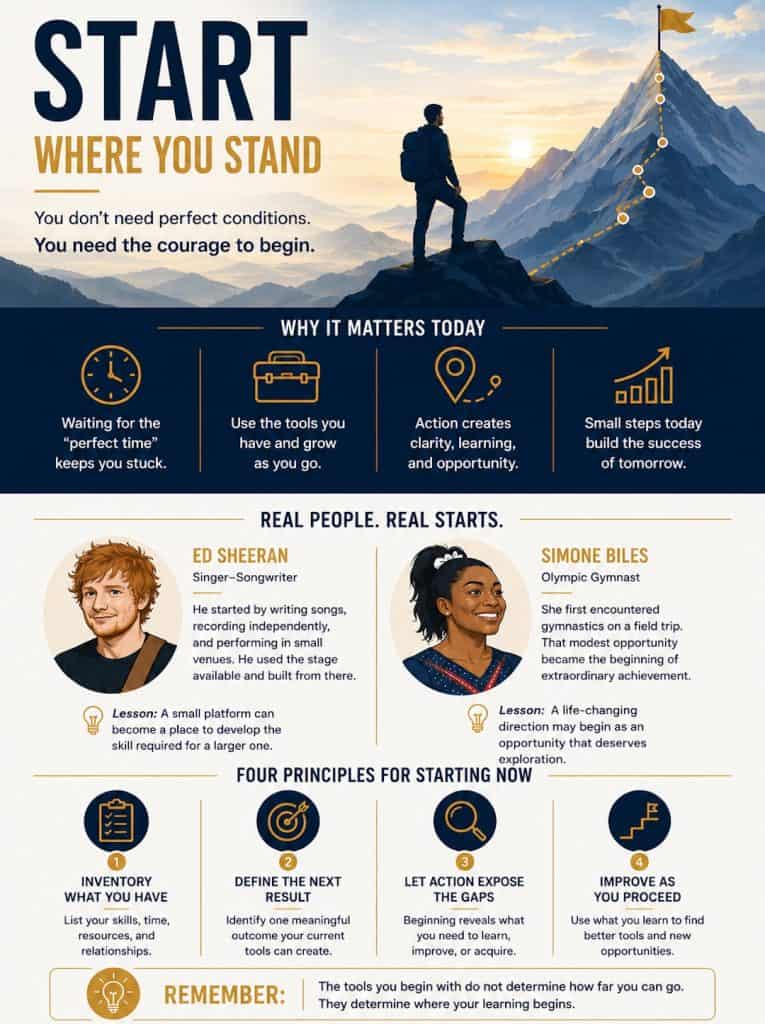
Start Where You Stand
“Do not wait: the time will never be ‘just right.’ Start where you stand, and work whatever tools you may have at your command and better tools will be found as you go along.”
Waiting can appear responsible. We tell ourselves that we will begin when we have more money, better equipment, additional training, greater confidence, more free time, or a clearer guarantee of success.
Preparation is valuable, but preparation can quietly become postponement. The search for ideal conditions can prevent us from using the opportunities, relationships, knowledge, and abilities already within reach.
Napoleon Hill’s message is not an argument for careless action. It is an argument against allowing imperfection to become an excuse for inaction.
The first step does more than create movement. It creates information.
Action reveals what works, what is missing, who may be willing to help, and which better tools should be acquired next.
The Modern Trap of Comparing Beginnings
Today, we frequently encounter other people’s finished products without seeing their earliest attempts. We see polished performances, successful businesses, advanced skills, professional studios, large audiences, and carefully produced results.
This can make our own starting point appear inadequate. A basic tool seems unworthy. A small audience feels insignificant. An imperfect first attempt appears embarrassing.
But every developed ability once existed in an undeveloped form. Every effective system began with less information than it possesses today. Progress becomes possible when we stop comparing our available tools with someone else’s accumulated resources.
Modern Examples of Beginning
Before Everything Is Ready
Achievement often develops through the tools, opportunities,
and lessons found after action begins.
Ed Sheeran: Use the Stage Available
Before major venues and global audiences, Ed Sheeran wrote songs, recorded independently, and performed in smaller settings. He did not begin with the platform he eventually developed. He used the guitar, songs, audiences, and opportunities available at the time.
The lesson: A small platform can become a place to develop the skill required for a larger one.
Simone Biles: Begin with
the Opportunity in Front of You
Simone Biles first encountered gymnastics as a child during a field trip. That ordinary introduction became the beginning of years of training, coaching, correction, and development. The complete path was not visible at the beginning.
The lesson: A life-changing direction may first appear as a modest opportunity that deserves exploration.
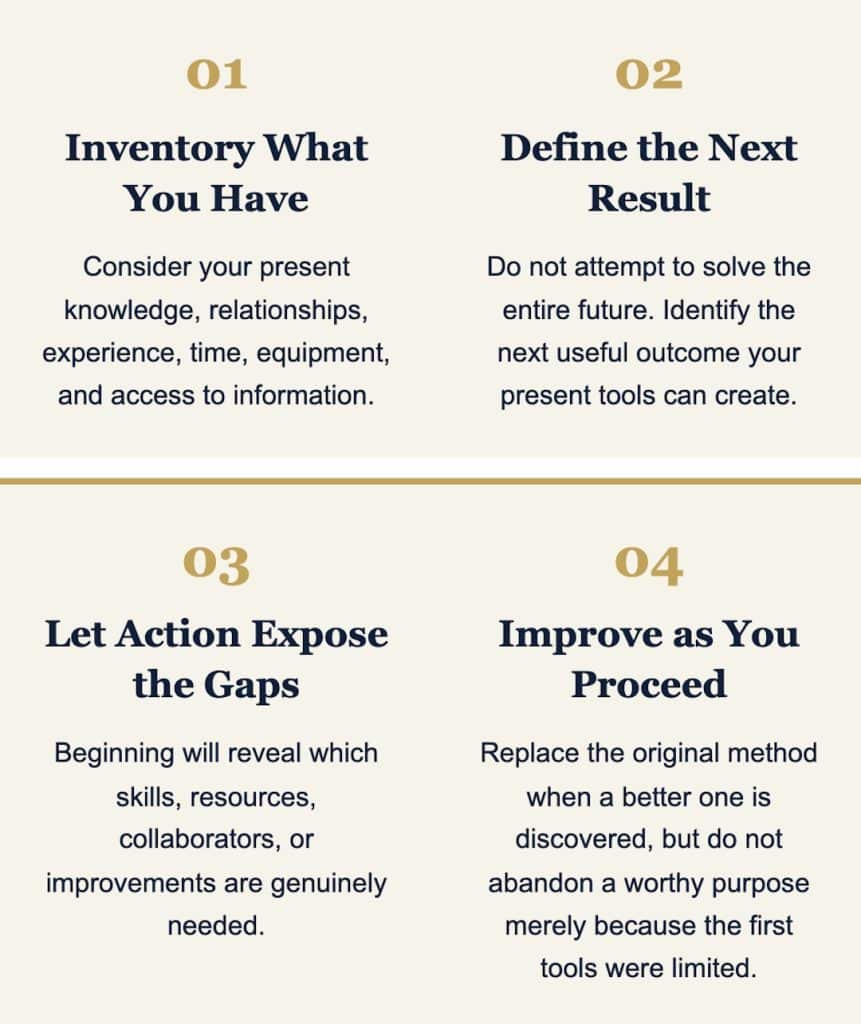
Four Principles for Starting Where You Stand
Better Tools Are Often Found Through Use
Hill’s principle should not be confused with ignoring preparation, safety, responsibility, or expert guidance. Some actions require training, permission, financial planning, or careful risk management.
But even when the final action must wait, preparation can begin. Research can begin. Saving can begin. Practice can begin. Relationships can be developed. A plan can be written and tested on a smaller scale.
There is nearly always some constructive action available at the present starting point.
The tools you begin with do not determine how far you can go. They determine where your learning begins.
Today, resist the temptation to postpone meaningful action until every condition is favorable. The ideal moment may never arrive because progress itself is what creates many of the conditions you are waiting for.
Begin with the knowledge you possess. Use the equipment available. Speak to the people within reach. Work at the scale your current resources allow.
Your first attempt does not need to display the full quality of your future achievement. It only needs to create enough movement for the next lesson, opportunity, and better tool to be discovered.
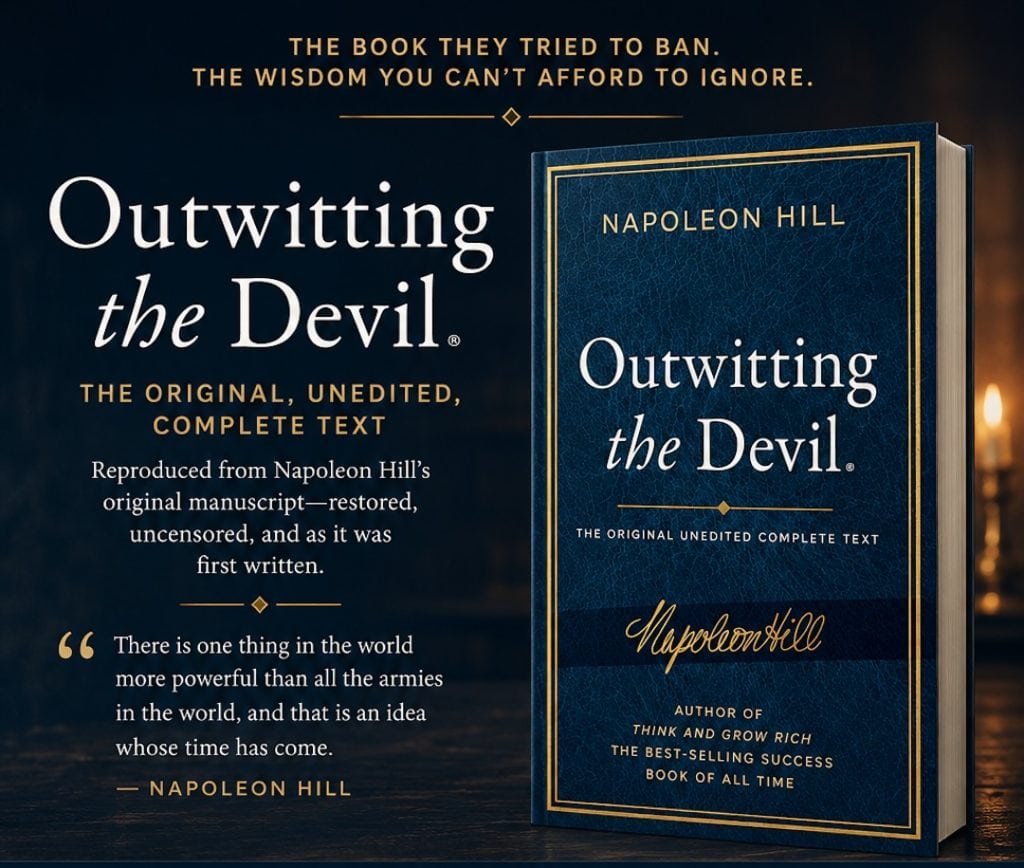
Outwitting the Devil: The Complete Text, Reproduced from Napoleon Hill’s Original Manuscript
Following the success of his 1937 landmark bestseller, Think and Grow Rich, Napoleon Hill wrote Outwitting the Devil, an exposé on the methods the Devil uses to ensnare and control the minds of human beings. Exploring the innermost depths of the psychology of motivation to understand why so many individuals, including himself, cannot find the initiative and courage they need to consistently implement the philosophy of individual achievement, Hill went so far as to interview the Devil himself. The resulting confession from the Devil made this book so controversial as to remain unpublished for over 70 years. Now it is your turn to break the Devil’s code and free yourself from the hidden methods of control that lead to ruin.
In this reproduction of the complete text of Hill’s original manuscript is laid out the exact nature of the power by which the Devil disarms human beings with fear, procrastination, anger, and jealousy so that they do not reach their full potential. This is the same power that paralyzed millions of individuals with fear and despondency during the Great Depression and continues to hold people back from their dreams. Complacency and mediocrity are not the root issue; they are symptoms of deeper ills that we are conditioned by society to accept. But you must open your mind to acquire knowledge and consider facts that might not harmonize with your personal beliefs in order to access a greater truth that will, as Hill said in his original preface, “bring harmony out of chaos in this age of frustration and fear.”
If you have been the victim of lost courage, weakened enthusiasm, and lack of self-discipline—if you are demoralized and plagued by fear, anxiety, overwhelm, or apathy—the seven principles to freedom detailed in this book herald your redemption. You will finally become independent of the causes of failure and misery, break the bonds of destructive habits, and unlock the secret of a natural law as significant as the law of gravity so that you can outwit the devil once and for all.
