
The Difference Between Confidence and Ego
Strong Leadership Knows the Difference
Confidence says, “I can contribute.” Ego says, “I must prove I am more important than everyone else.”

Confidence and ego can look surprisingly similar from a distance. Both may speak decisively. Both may take the lead. Both may possess ambition, certainty, and a willingness to act when others hesitate.
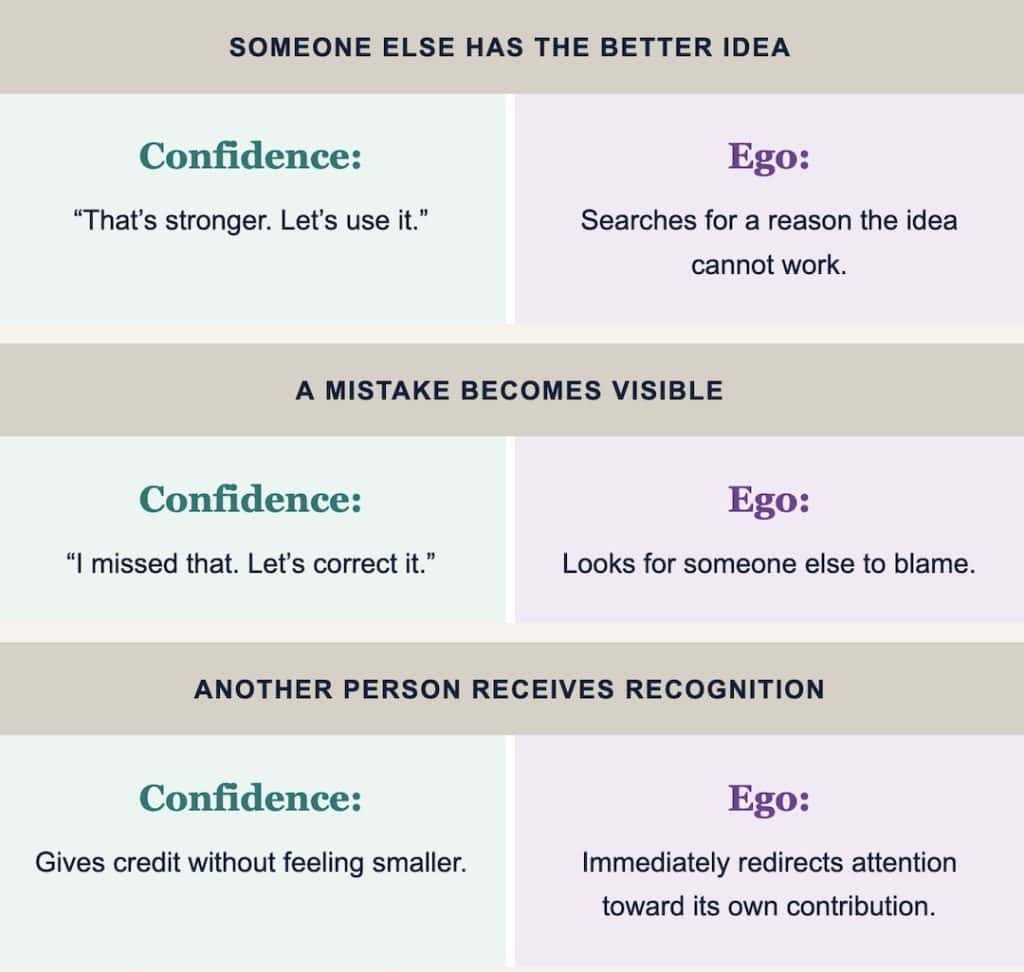
The difference becomes visible when something threatens the person’s sense of importance. What happens when someone else has the better idea? When criticism is justified? When another person receives the credit? When the leader does not know the answer? Those moments reveal whether strength is rooted in genuine self-belief—or in the constant need to defend an image.
The Leadership Test
Confidence does not need to be the most important thing in the room. It is secure enough to serve what matters most.
Confidence Through Napoleon Hill’s Principles
Napoleon Hill® connected genuine confidence with Positive Mental Attitude, sincerity of purpose, preparation, self-discipline, and the development of an attractive personality. That kind of confidence does not depend entirely on praise. It grows from knowing that you have prepared, developed your ability, clarified your purpose, and are willing to act.
Hill’s Master Mind and teamwork principles also remind us that achievement rarely requires one person to possess every answer. Great leadership can recognize another person’s strength without feeling diminished by it.
Same Situation. Different Response.
The distinction often appears in ordinary leadership moments.
What Is Your Confidence Trying to Accomplish?
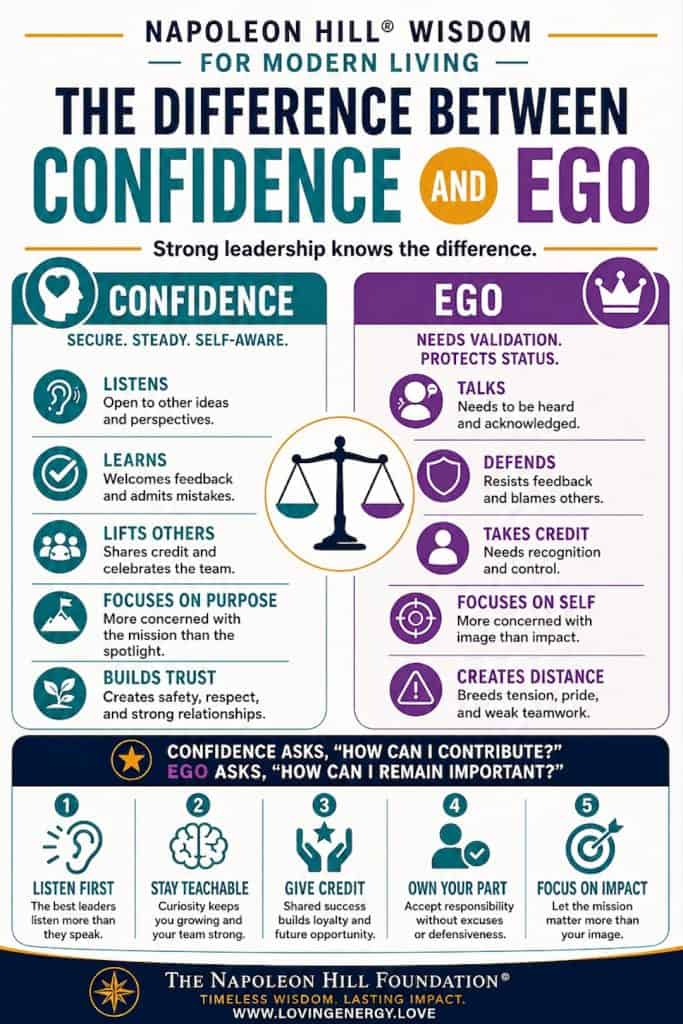
One of the clearest differences between confidence and ego is where the attention goes. Confidence focuses on the work: What does the goal require? What can I contribute? What do we need to learn? Who has the strongest ability for this part of the job? Ego keeps returning attention to the self: Do they respect me? Did I get enough credit? Do I look important? Am I still the smartest person here? Leadership becomes stronger when the purpose is allowed to become more important than the leader’s need to appear important.
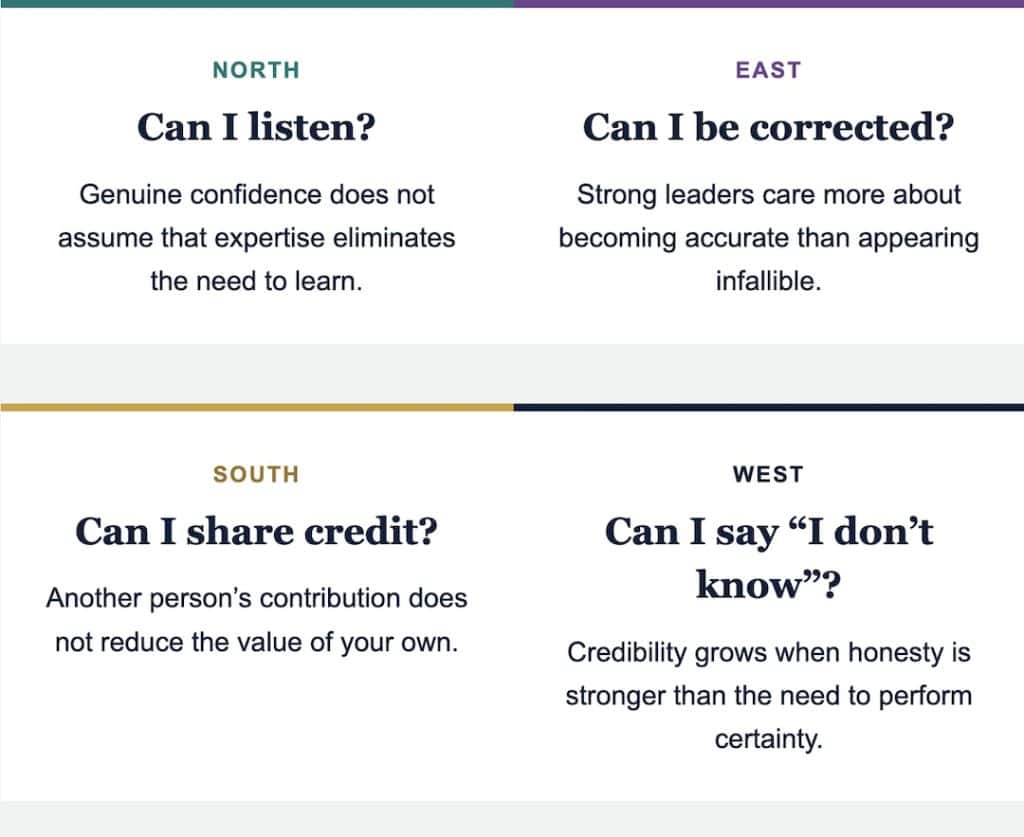
The Leadership Compass
Four questions can reveal which direction you are moving.
Ego Often Looks Strongest
When Confidence Is Weakest
Ego is not always loud arrogance. Sometimes it appears as defensiveness, perfectionism, credit-hoarding, inability to delegate, refusal to ask for help, or the need to control every decision. These behaviors can come from an underlying fear: If someone else performs well, perhaps I will matter less. Genuine confidence removes much of that competition. It allows a leader to surround themselves with capable people because excellence nearby no longer feels like a personal threat.
Confidence Makes Teams Stronger
Secure leaders create room for other people to become excellent. They can hire someone smarter in a particular area. They can invite disagreement. They can delegate meaningful responsibility. They can recognize talent publicly and correct mistakes privately. Ego may gather followers who protect the leader. Confidence develops people who strengthen the mission.
Confidence asks, “How can I contribute?” Ego asks, “How can I remain important?”
Humility Does Not Require Playing Small
Avoiding ego does not mean becoming timid. You can know your value. You can speak decisively. You can advocate for an idea, negotiate strongly, establish boundaries, and acknowledge that you possess real ability. The difference is that confidence does not require another person to become smaller so that you can feel larger.
Today’s Practice
Let Someone Else Be Excellent
Confidence and ego may both enter the room standing tall. Their difference becomes clear in what happens next. Confidence can listen without shrinking. It can admit error without collapsing. It can celebrate another person without feeling erased. Ego requires protection. Confidence has enough internal foundation to remain useful.
The strongest leader does not need to prove they are the greatest person in the room. They help the room produce its greatest result.
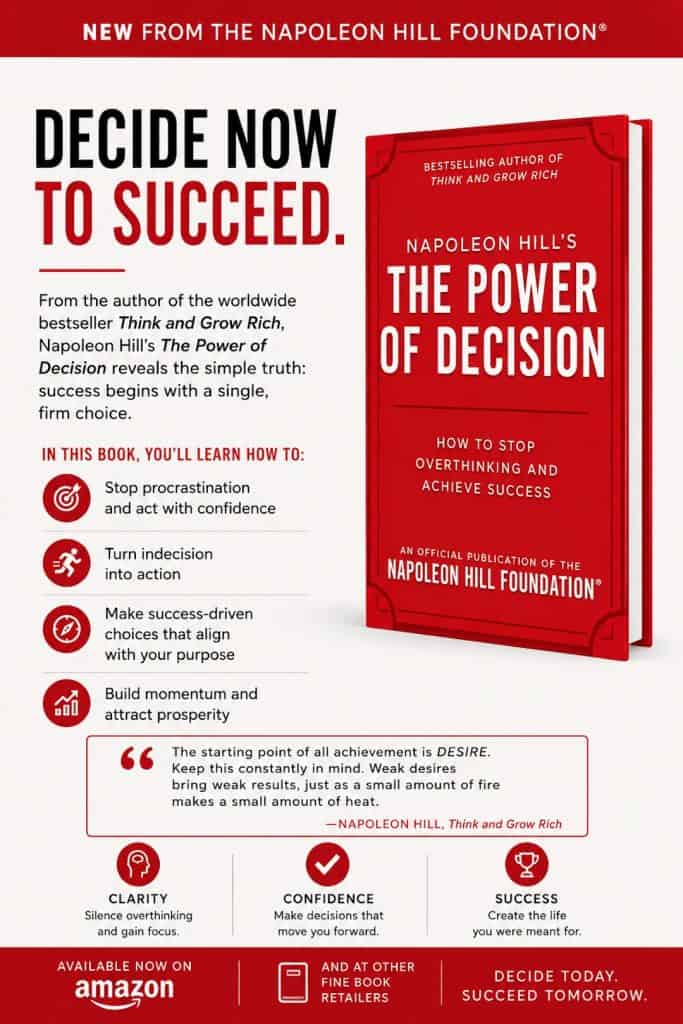
Napoleon Hill’s The Power of Decision: How to Stop Overthinking and Achieve Success
From the author of the worldwide bestseller Think and Grow Rich, Napoleon Hill’s Power of Decision reveals the simple truth: success begins with a single, firm choice. In this newly released compilation, The Napoleon Hill Foundation brings back Hill’s essential guide to overcoming doubt, banishing hesitation, and replacing overthinking with decisive action.
Packed with wisdom and practical steps, Hill shows you how to:
- Stop procrastination and act with confidence
- Turn indecision into action
- Make success-driven choices that align with your purpose
- Build momentum and attract prosperity
When you’re chasing personal goals, business success, or a more fulfilling life, The Power of Decision is your roadmap and motivation to clarity and achievement

6 responses to “The Difference Between Confidence and Ego”
Dziękuję bardzo Jojan 🙏
We trust the value of what we bring with humility
We contribute our gifts with confidence and purpose.
We celebrate ‘other’s’ brilliance with feeling empathy.
We are secure to listen, learn, and allow unknowingness
We embrace our uniqueness
Thank you, Benjamin, for taking the lead.
The point that confidence asks, “How can I contribute?” whereas ego asks, “How can I remain important?” really gives clarity and distinction.
Putting this into practice, I will pay extra attention to my internal responses when receiving feedback or when my ideas are rejected. I can also ask questions rather than become defensive. Finally, I will notice when I am seeking validation. Thank you for these cognitions of behaviours that make ineffective leaders so that I make become one that IS effective.
Finally, I truly appreciate the mix of text with infographics to present the content on your posts. I have one small suggestion—to move the paragraph about the book to above the image of it to put space between the two large images. This would be visually/energetically clearer, at least for me.
This article had me thinking whether I was coming into today’s meeting with confidence or ego or both. Apply the Leadership Test: confidence is secure enough to serve what matters most and doesn’t need to be the most important thing in the room. Perhaps what matters more is supporting understanding of team’s direction versus finishing the meeting within the allotted timeframe.
I enjoyed the concrete examples in “Same Situation, Different Response.” It shows how confidence and ego would respond differently to the same situation.
I like staying on the confidence side, and when the ego side’s thought patterns start creeping in, I am now able to transmute it! The vibe of the confidence side is much relaxed and grounded too. The most important part I like to focus is that is my contribution helping the purpose of the project / organization? I’m loving the infographics!