
.
Stop Negotiating With the Goal
How Small Exceptions Gradually Weaken Commitment
A commitment becomes fragile when every inconvenient
moment is allowed to reopen the decision.
.
Commitment Status
CLOSED TO DAILY RENEGOTIATION
Most goals are not abandoned in one dramatic moment. They are often weakened through a series of small exceptions. “I’ll skip today.” “I’ll start again Monday.” “This week is unusually busy.” “One delay won’t matter.” “I deserve a break from the plan.” Any one of those statements may be harmless. The danger appears when exceptions become the normal way the commitment is handled.
Every exception teaches your mind whether the goal is a commitment—or merely a preference.
Napoleon Hill and Self-Discipline
Napoleon Hill® treated self-discipline as the force that holds the other principles together. Definite purpose gives direction. Desire supplies energy. Personal initiative creates movement. But self-discipline keeps a person from repeatedly undoing yesterday’s decision because today feels inconvenient. Commitment becomes stronger when the decision is made once—and then honored repeatedly.
.
The Terms of Real Commitment
| TERM 01 | The goal has a clear standard. You know what following through actually looks like. |
| TERM 02 | The decision is not reopened every day. Mood does not get a fresh vote each morning. |
| TERM 03 | Exceptions are defined, not improvised. Real emergencies differ from ordinary inconvenience. |
| TERM 04 | A miss does not become a collapse. You resume quickly instead of turning one lapse into abandonment. |
The Negotiation Usually Sounds Reasonable
The mind rarely says, “Let’s destroy the goal.” It says, “Just this once.” That language matters because it makes the exception feel separate from the larger pattern. But repeated exceptions eventually become the pattern.
.
The Exception Loop

Repetition Teaches the Standard
Hill’s habit teachings emphasize repetition because repeated behavior gradually becomes easier and more automatic. That works in both directions. Repeated follow-through strengthens the identity of someone who keeps commitments. Repeated exceptions strengthen the expectation that commitments can be revised whenever pressure appears.
You strengthen commitment every time you honor the decision after the emotion that created it has faded.
Discipline Is Not Rigidity
A strong commitment still allows intelligent adjustment. New facts may require a new strategy. Health, family, finances, or other responsibilities may require a change in timing. A better method may appear. The distinction is simple: adjust because reality changed—not merely because discipline became uncomfortable.
.
Close the Loopholes
.
Write the Commitment Like a Contract
Vague goals invite negotiation. “I should exercise more” leaves enormous room for interpretation. “I will walk for thirty minutes on Monday, Wednesday, and Friday at 7:00 a.m.” creates a standard that can actually be honored. Clarity reduces the number of decisions that must be made later.
.
Today’s Practice
Identify One Open Loophole
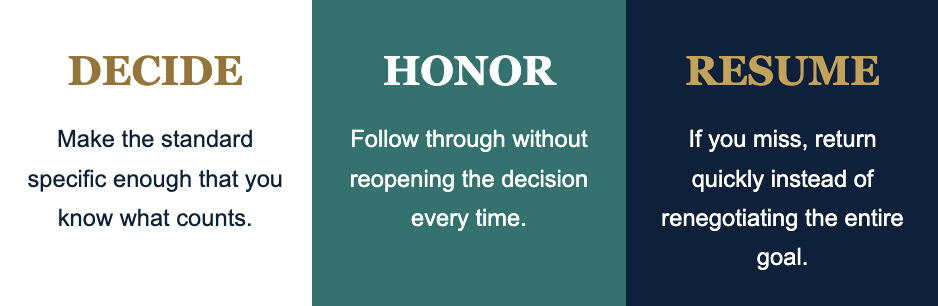
Choose one goal you keep renegotiating. Define the standard clearly, decide what qualifies as a legitimate exception, and commit to returning immediately after any unavoidable miss.
Commitment does not mean you will never miss. It means a difficult day does not get authority to rewrite the entire agreement. Decide carefully. Adjust intelligently when facts require it. But once the standard is clear, stop asking your temporary feelings for permission to honor it.
The goal becomes stronger when your word stops being negotiable every time the work becomes inconvenient.

.
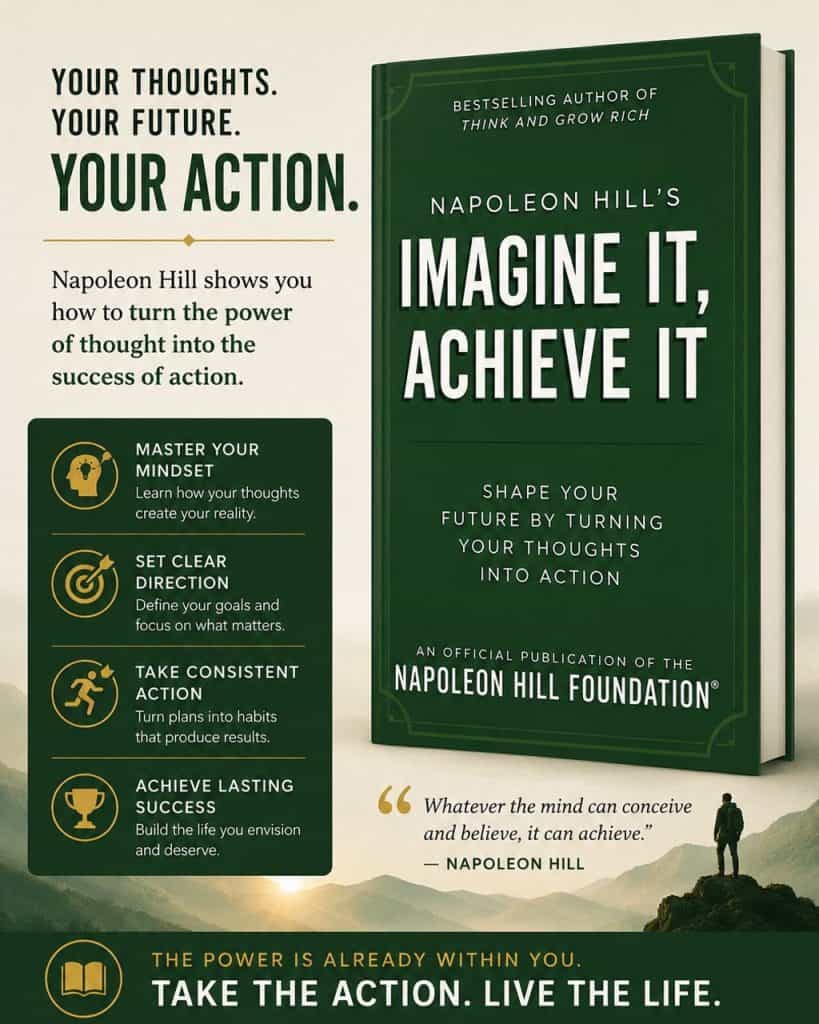
Napoleon Hill’s Imagine It, Achieve It: Shape Your Future by Turning Your Thoughts Into Action
Capitalize on the extraordinary power of imagination with Imagine It, Achieve It, a valuable guide inspired by Napoleon Hill’s principles of success. Learn how to harness both synthetic and creative imagination to turn your desires into tangible reality.
This book reveals how to:
- Transform your thoughts into actionable plans for achieving your goals.
- Tap into the power of creative imagination to access new ideas and opportunities.
- Develop visualization techniques to align your mind with success.
- Master the art of turning intangible desires into tangible results.
Whether you’re looking to excel in business, achieve personal milestones, or spark innovative ideas, Imagine It, Achieve It equips you with the mindset and tools to make it happen. Your imagination is the workshop of your mind—use it to create the life you envision!

3 responses to “Stop Negotiating With the Goal”
I’ve been making excuses to avoid doing tasks that lead to one of my dreams from fear of being seen: The act of that is finally named. Renegotiation. In my case, “other things are more important.” I won’t be doing that again. I will do at least one movement that lead to that dream no matter how small it may be. Thank you🙏
Repetition is a behavior. We can either gradually make it easier and automatic by following through on our commitments or repetitively make exceptions, gradually weakening our resolve.
Repetition is also how to get to unconscious competence.
“Most goals are not abandoned in one dramatic moment. They are often weakened through a series of small exceptions.”
Man, there is some powerful truth in that. I’d add, “I need energy to do it”, “I deserve it after the day I’ve had”, and “I’ve already tried” to the list of excuses. I have oftened let my mood make the decision for me…leading to immobility or giving up early.
I also tend to question the initial decision with phrases like, “Why did you commit to something you knew you wouldn’t follow through on?” or “Did you really want this or was the decision made on impulse or in response to what you think you want because of outside influence?”
My goal is my physical strength. There are low impact activities and sitting activities that can be done…and short workouts when two hours to go to the gym isn’t possible.