
The Discipline of Leaving Things Behind
Why Growth Sometimes Requires Releasing What No Longer Fits
Growth is not always about adding more. Sometimes progress begins with deciding what no longer deserves to come with you.
Not everything that helped build your past belongs in your future.
We often think of growth as accumulation. More knowledge. More goals. More responsibilities. More relationships. More strategies. More commitments. But eventually, growth can become impossible if nothing is ever released. Old methods continue consuming energy. Outdated goals keep occupying attention. Habits developed for a former season remain in place long after their usefulness has ended.
Maturity includes knowing the difference between persistence and carrying something simply because you have carried it for a long time.
Napoleon Hill and the Power of Habit
Napoleon Hill emphasized that repeated patterns eventually become established habits—and that those habits can either support or interfere with a definite purpose. That is why self-discipline is not only the ability to keep doing something difficult. It is also the ability to examine what has become automatic and decide whether it still deserves a place in your life.
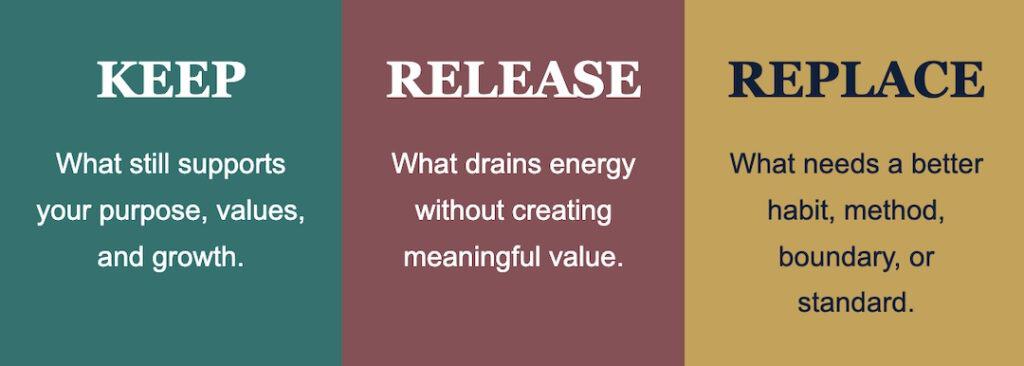
Keep — Release — Replace
.
Some Goals Expire
A goal can be meaningful when it is chosen and still become outdated later. Circumstances change. Values mature. Responsibilities shift. New information appears. Continuing toward a goal solely because you once announced it is not always persistence. Sometimes it is attachment to an earlier version of yourself.
.
Keep the Purpose.
Change the Method.
One of the most common forms of unnecessary attachment is loyalty to a method. A strategy may have worked for years and still become inefficient. A system may once have been essential and later become an obstacle. Definiteness of purpose does not require sameness of method.
.
Old Habits Can Outlive
the Problems They Once Solved
Some habits began for a good reason. You learned to say yes because you needed opportunity. You handled everything yourself because resources were limited. You worked constantly because the early stage demanded it. But a habit that helped you survive one stage can limit you in the next.
.
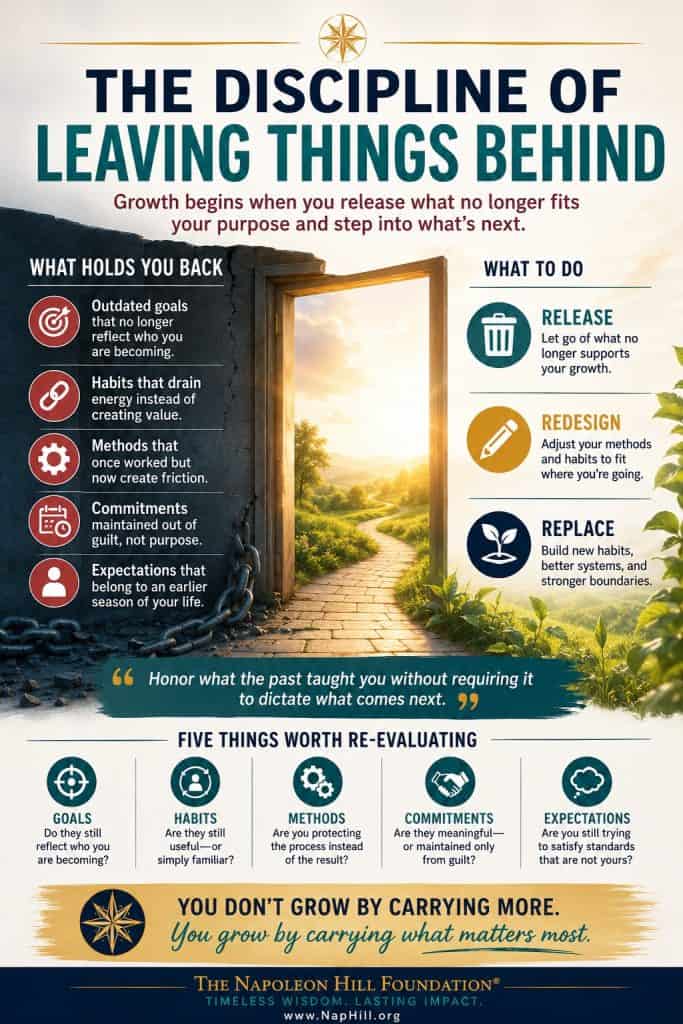
Five Things Worth Re-Evaluating
.
- Goals: Do they still reflect who you are becoming?
- Habits: Are they still useful—or simply familiar?
- Methods: Are you protecting the process instead of the result?
- Commitments: Are they meaningful—or maintained only from guilt or inertia?
- Expectations: Are you still trying to satisfy standards that no longer belong to you?
Time Already Spent Is
Not a Reason to Spend More
We often remain attached to something because we have invested so much in it. Years in a direction. Money in a project. Effort in a system. Identity in a role. But yesterday’s investment does not automatically justify tomorrow’s commitment.
Honor what the past taught you without requiring it to dictate what comes next.
Quitting and Releasing Are Not the Same
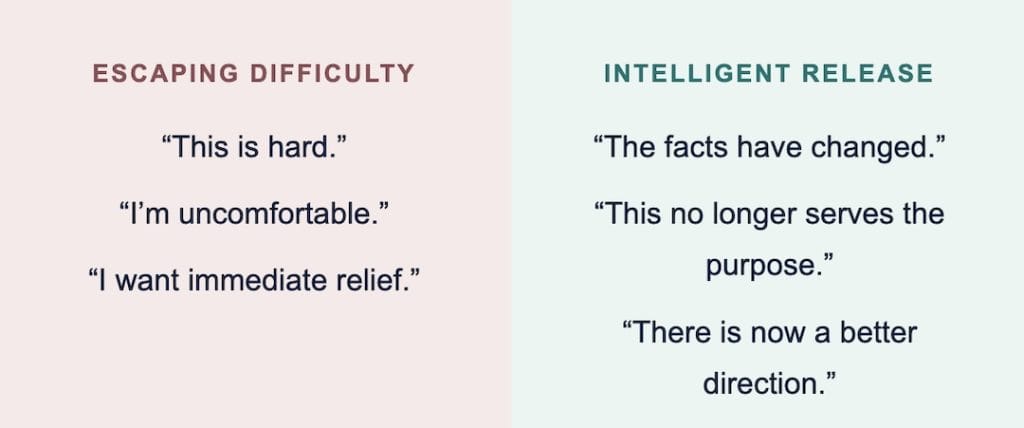
Every Release Creates Space
Ending something is not only about subtraction. It returns time. Attention. Energy. Money. Mental bandwidth. That reclaimed capacity can be directed toward the goals, relationships, habits, and opportunities that fit the person you are becoming now.
The Release Audit
- What am I maintaining simply because it is familiar?
- What once worked but now creates friction?
- What commitment belongs to an earlier season of my life?
- What would I stop doing if I were starting fresh today?
- What becomes possible if I release it?
Today’s Practice
Leave One Thing Behind
Identify one habit, method, goal, or commitment that no longer supports your present purpose. Decide whether to eliminate it, redesign it, or replace it with something better.
Growth asks us to become more capable—but it also asks us to become more selective. Carry forward what still strengthens you. Learn from what has completed its purpose. Replace what no longer works. You do not dishonor an earlier chapter by allowing it to end.
Sometimes the next level of growth begins not with what you add—but with what you finally have the discipline to leave behind.

Napoleon Hill’s Guide to Achieving Your Goals:
The Four Proven Principles of Success
Unlock the path to personal achievement and extraordinary success!
From the author of the timeless classic Think and Grow Rich comes this transformative guide that unveils four key principles of success, with practical steps on how to achieve your dreams.
Benefit from the enduring insights of one of the most influential self-help authors, Napoleon Hill. His philosophies have empowered countless individuals to take control of their lives and turn dreams into reality.
In Napoleon Hill’s Guide to Achieving Your Goals discover the four cornerstone principles for success that Hill has identified through decades of research. Learn how to incorporate these principles into your own life to unlock your full potential.
Even decades after its conception, Hill’s wisdom stands true and continues to offer value in our contemporary world. It’s a testament to the timeless relevance of Hill’s work. Reading this book will not only provide guidance and strategies for success but also ignite the motivation you need to get started and keep going. The inspiring words of Hill can push you to never give up on your dreams, regardless of the challenges you face.

4 responses to “The Discipline of Leaving Things Behind”
Self inquiry reflections to contemplate and be in divine alignment as a freed person creating joyfully in truth and surrender
Releasing what no longer serves us on the night of the full moon.
New goals, new information about who we are.
Familiar habits no longer useful.
Methods that protect the process instead of the result.
Commitments maintained from guilt and not meaning.
Satisfying standards that no longer belong to us.
We carry forward what strengthens us, learn what has completed its process, and replace what no longer works.
We honor what the past taught us without telling us what comes next.
If your closet is full of old clothes that no longer fit, are outdated, you no longer wear, or they are worn out, it’s time to clear space for a new wardrobe. It’s time to go through and make piles of “keep” “release/donate” or “replace”. If you keep accumulating there will be no room for New, and your closet will become stuffed. Currently packing up my things tonight after being at camp all summer and going through this process. Do I really need 10 tie dye shirts? No. Can I release the attachment to the item, the time and creative energy I spent on them? Yes. Because my new life is going to cost me my old one.
🙂
I’ve noticed that releasing and throwing things out really makes a difference. New things start coming in without trying. Fung shui or Poong Su in Korean is very real.
I’ve been having the hardest time releasing my clothes. (Cancel cancel) Everyone around me has been telling me I need to get rid of a lot of my wardrobe.
I read that it is from not being able to let go of the old identities of myself. I don’t know why my subconscious is holding onto it, and feels like it’s in danger when I try to go through my wardrobe.
I recently went through my entire shoes collection and boldly let go of many shoes. Now I’m experiencing opportunities that come in without me even trying. I want to dive deeper on this old identity thing. Thank you for the reminder of releasing and letting go around full moon. 🌝🙏