.
Don’t Confuse Familiar With Right
How repetition can make ideas, habits, and assumptions feel true simply because we have encountered them before.
.
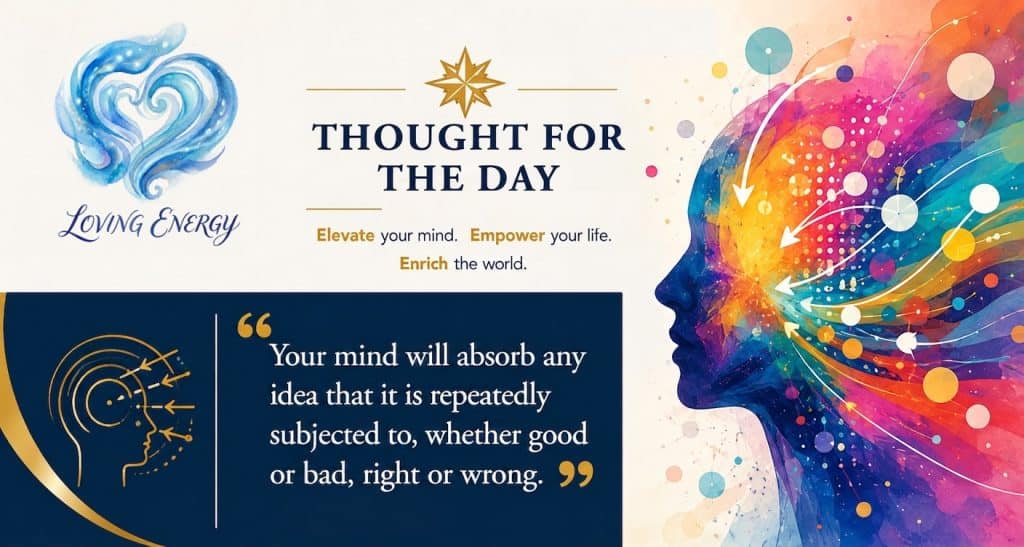
FAMILIAR ≠ TRUE
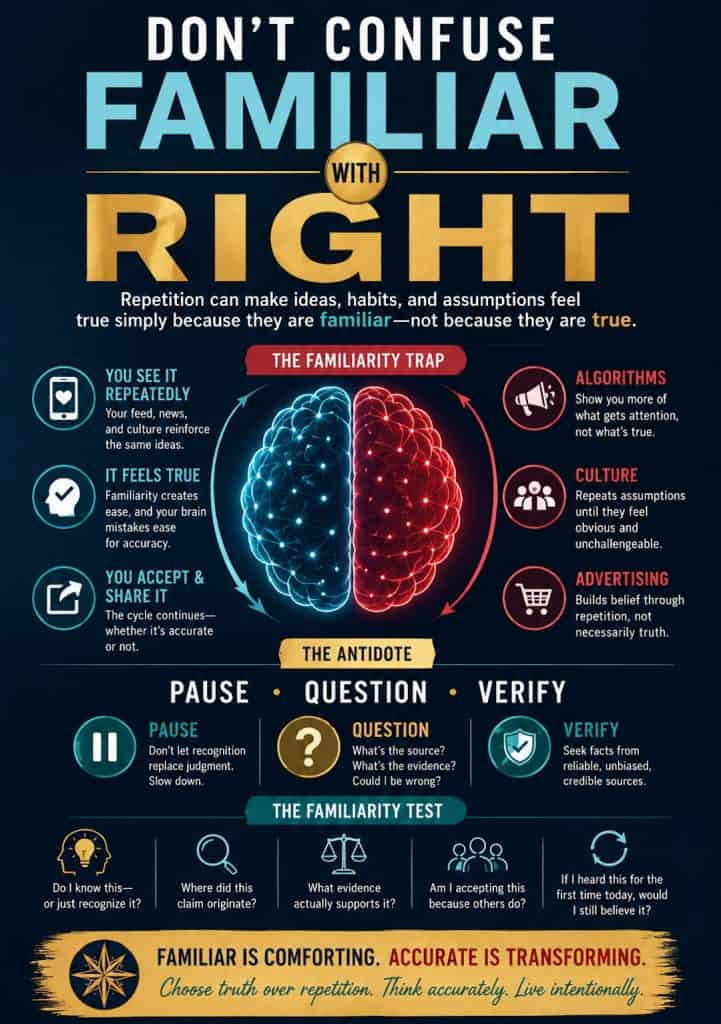
There is something comforting about familiarity. A familiar idea requires less effort to process. A familiar habit feels natural. A familiar explanation can seem obvious simply because we have heard it many times. But familiarity is not evidence. Something can be repeated for years and still be inaccurate. A habit can be normal and still be ineffective. An assumption can be widely shared and still deserve examination.
The question is not, “Have I heard this before?” The question is, “What reason do I have to believe it is true?”
Your Mind Has a Familiarity Problem
Modern psychologists have a name for something Hill’s emphasis on Accurate Thinking helps us guard against: the illusory truth effect. Simply encountering a statement repeatedly can make it feel more believable. The brain begins to recognize the information. Recognition creates familiarity. Familiarity can make the information easier to process—and that ease can be mistaken for truth.
.
Now Put That Brain on the Internet
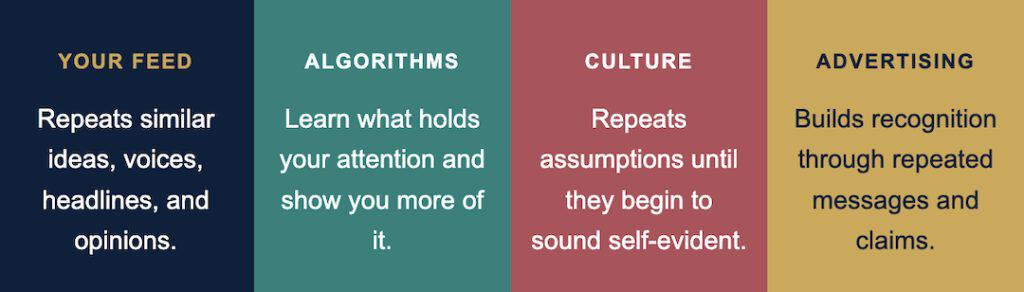
We live in an environment built around repeated exposure.
.
Napoleon Hill and Accurate Thinking
Long before social feeds and recommendation algorithms, Napoleon Hill® emphasized the importance of learning to think accurately rather than accepting ideas merely because they were popular, emotional, convenient, or repeatedly presented.
Accurate Thinking asks us to separate facts from opinions—and then examine the source, relevance, and usefulness of the information influencing our decisions. That skill may be even more valuable today because repetition can now occur at extraordinary speed.
.
Viral Is Not the Same as Verified
Imagine seeing the same claim several times in one day. One friend shares it. Then an influencer mentions it. A video repeats it. A screenshot appears somewhere else. Soon another account treats it as established fact. It can begin to feel as though you have encountered several independent pieces of evidence. But sometimes you have encountered the same unsupported claim several times.
.
Trending • Reposted • Shared • Recommended
“I keep seeing this everywhere.”
That tells you something about its circulation—not necessarily its accuracy.
The Same Problem Appears in Our Habits
Familiarity does not only affect what we believe. It can influence how we behave. “We’ve always done it this way.” “That’s just how this organization works.” “My family has always believed that.” “That’s just the kind of person I am.” Each statement may describe something familiar. None automatically proves that it is useful, accurate, or permanent.
.
Normal ≠ Necessary
Familiar Thinking “We always do it this way.” “Everyone knows that.” “I heard the same thing somewhere else.” “That’s how I’ve always been.” | Accurate Thinking “Does it still work?” “What evidence supports it?” “Where did this claim originate?” “Could I choose differently?” |
Some of Our Strongest Assumptions
Were Never Chosen
We inherit ideas about money, work, success, leadership, relationships, education, age, failure, and what is supposedly possible for someone like us. When those messages are repeated often enough, they can stop sounding like beliefs and begin sounding like facts. Accurate thinking requires occasionally reopening those assumptions for inspection.
An idea does not become true because you inherited it, repeated it, liked it, shared it, or heard it from someone you admire.
Be Especially Careful When a Message Feels Good
We naturally enjoy information that confirms what we already believe. A claim that supports our existing opinion may receive less scrutiny precisely because it feels familiar and satisfying. Accurate thinking becomes most valuable when the information tells us exactly what we hoped to hear.
.
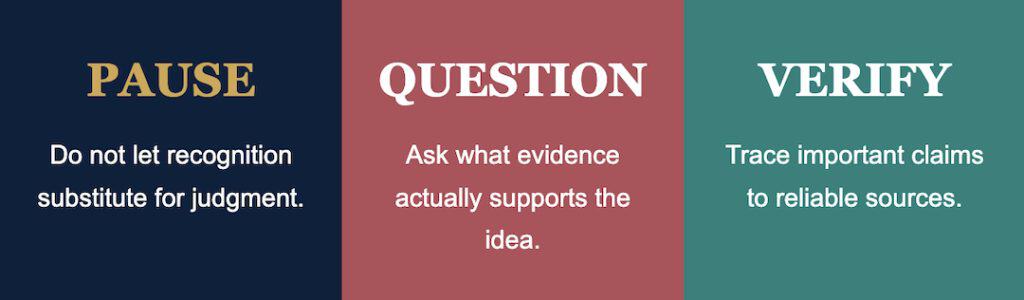
PAUSE • QUESTION • VERIFY
.
The Familiarity Test
- Do I know this—or do I merely recognize it?
- What is the original source?
- What evidence would cause me to change my mind?
- Am I accepting this because people around me accept it?
- If I encountered this idea for the first time today, would I still believe it?
.
Accurate Thinking Is Not Cynicism
Questioning assumptions does not mean distrusting everything. The goal is not to replace automatic belief with automatic disbelief. It is to replace both with judgment..
Today’s Practice
Question One Familiar Assumption
Choose one idea you have accepted for years. Instead of trying to prove it wrong, simply investigate it as though you were encountering it for the first time.
Choose one idea you have accepted for years. Instead of trying to prove it wrong, simply investigate it as though you were encountering it for the first time.
Some familiar ideas will survive examination. They deserve to. Others may need to be revised, replaced, or discarded. The purpose of accurate thinking is not to make life uncertain. It is to make our confidence better earned.
Do not ask only, “Does this sound familiar?” Ask the more important question: “Is it actually true?”2

.
Napoleon Hill’s Guide to Achieving Your Goals: The Four Proven Principles of Success
Unlock the path to personal achievement and extraordinary success!
From the author of the timeless classic Think and Grow Rich comes this transformative guide that unveils four key principles of success, with practical steps on how to achieve your dreams.
Benefit from the enduring insights of one of the most influential self-help authors, Napoleon Hill. His philosophies have empowered countless individuals to take control of their lives and turn dreams into reality.
In Napoleon Hill’s Guide to Achieving Your Goals discover the four cornerstone principles for success that Hill has identified through decades of research. Learn how to incorporate these principles into your own life to unlock your full potential.
Even decades after its conception, Hill’s wisdom stands true and continues to offer value in our contemporary world. It’s a testament to the timeless relevance of Hill’s work. Reading this book will not only provide guidance and strategies for success but also ignite the motivation you need to get started and keep going. The inspiring words of Hill can push you to never give up on your dreams, regardless of the challenges you face.

2 responses to “Don’t Confuse Familiar With Right”
I see this often as a language teacher. Students who have gotten used to misinformed ways of pronouncing something or a whole country common use of a English word not at all used in that way in English.
The past couple years I have started to questions my assumptions and understandings…even with English. I will look something up if I have the slightest doubt or the other person’s conviction I’d strong even if I’m confident of the knowledge I have to fact check myself.
I appreciate the question, “What evidence might make me change my mind!” What superb self-inquiry.
Today, I didn’t accept familiar. I asked questions, set boundaries, and made a firm decision when the boundaries were crossed.
This article had me wondering about living in the world of maya. 90-100% of what we experience is False Evidence Appearing Real, an illusion.
What experiences are real and/or illusionary? When is it appropriate to focus on things as illusion or real? Where should most of our attention go? Who is to say, how we live our lives and what we value? Why does this matter?
Familiarity is not equal to truth. For example, just because many of us grew up in a nuclear family and it is familiar, it doesn’t mean that it is the only way to live.