
Be Careful What You Become Good At
Efficiency means little if you become highly effective
at work that no longer serves your purpose.
There is a difference between becoming better at what you do and becoming better at doing what matters.
The Efficiency Trap
We naturally become better
at the things we repeatedly do
Practice creates speed. Experience creates confidence. Repetition creates systems. Eventually, something that once required considerable effort becomes almost automatic. Usually, we call that progress. And often it is. But there is a question we do not ask nearly enough: What if the thing you are becoming exceptionally good at is no longer the thing you should be doing?
A person can become highly efficient at managing unnecessary meetings. An organization can perfect a process that should have been eliminated years ago. A leader can become remarkably skilled at solving problems that should have been delegated. An employee can build an entire professional identity around responsibilities that once mattered but no longer make the best use of his or her abilities.
We can even become good at personal habits that work against us—staying constantly busy, reacting to every request, avoiding difficult decisions, managing other people’s expectations, or filling every available hour with activity.
Competence creates its own kind of attachment. Once we are known for doing something well, walking away from it can feel wasteful. We have invested time in learning it. Others depend on us for it. It has become part of how we see ourselves. So we keep improving the process instead of questioning the purpose.
.
The Modern Productivity Paradox
Technology can help us do
the wrong things faster.
We live in an age obsessed with optimization. We automate tasks, build workflows, measure performance, schedule every minute, use artificial intelligence to accelerate output, and search constantly for ways to accomplish more in less time. These tools can be extraordinarily useful. But productivity tools cannot decide what deserves our productivity.
A faster process is not necessarily a better process. More output is not necessarily more value. An automated task is not automatically a necessary task. And becoming increasingly efficient at something does not prove that the activity still deserves your time.
.
Efficiency asks
“How can I do this better and faster?”
Purpose asks
“Should I still be doing this at all?”
.
The second question is harder because its answer may require change. It may require abandoning a comfortable routine, teaching someone else a task you have mastered, changing a business model, learning an unfamiliar skill, or admitting that something which once produced results no longer does.
That can make purposeful inefficiency temporarily more valuable than comfortable efficiency. Growth often makes us beginners again.
Purpose Before Proficiency
Napoleon Hill placed definiteness of purpose ahead of mere activity.
Throughout his philosophy, Napoleon Hill emphasized having a definite purpose and organizing one’s efforts around it. That distinction matters because skill alone does not determine direction. A person may possess enormous ability and still expend that ability on work that moves him or her no closer to a meaningful objective.
This is especially important as careers and organizations evolve. The abilities that earned yesterday’s opportunity may not be the abilities required for tomorrow’s contribution. Sometimes success itself creates the trap.
You become known as the person who can always fix a certain problem, complete a certain task, manage a certain process, or carry a particular responsibility. Because you are good at it, more of it comes your way. Because more comes your way, you become even better at it. Eventually, yesterday’s competence can consume tomorrow’s capacity.
That is why periodically examining our strengths is just as important as examining our weaknesses. Ask yourself: Which of my abilities are serving my purpose—and which abilities am I continuing to use primarily because I have become good at them?
Your strengths should be tools for your purpose, not obligations that determine it.
Being capable of doing something does not
automatically mean you should continue doing it.
.
This does not mean abandoning responsibilities whenever they become uninteresting. Nor does it mean constantly chasing novelty. Discipline still requires doing necessary work, including work we may not enjoy. The distinction is purpose. If an activity remains necessary to your larger objective, excellence matters. But if the objective has changed, the environment has changed, or the work no longer produces meaningful value, improving your efficiency may simply make you better at maintaining the past.
A Better Measure of Productivity
Do not only audit your weaknesses.
Audit what you do well.
.
Look at the activities you perform most efficiently—the responsibilities you can practically do in your sleep. Those are precisely the activities that may escape scrutiny because competence makes them feel unquestionably valuable. For each one, ask: Does this still advance an important purpose? Does it create enough value to justify the time it consumes? Am I the person who needs to do it? Could it be delegated, automated, simplified, redesigned, or eliminated? And if I were starting today, knowing what I know now, would I deliberately choose to become good at this?
That last question can be revealing. We often protect old responsibilities because of the time already invested in mastering them. But past investment should not automatically determine future investment. What matters is whether the activity continues to deserve a place in the future you are trying to create.
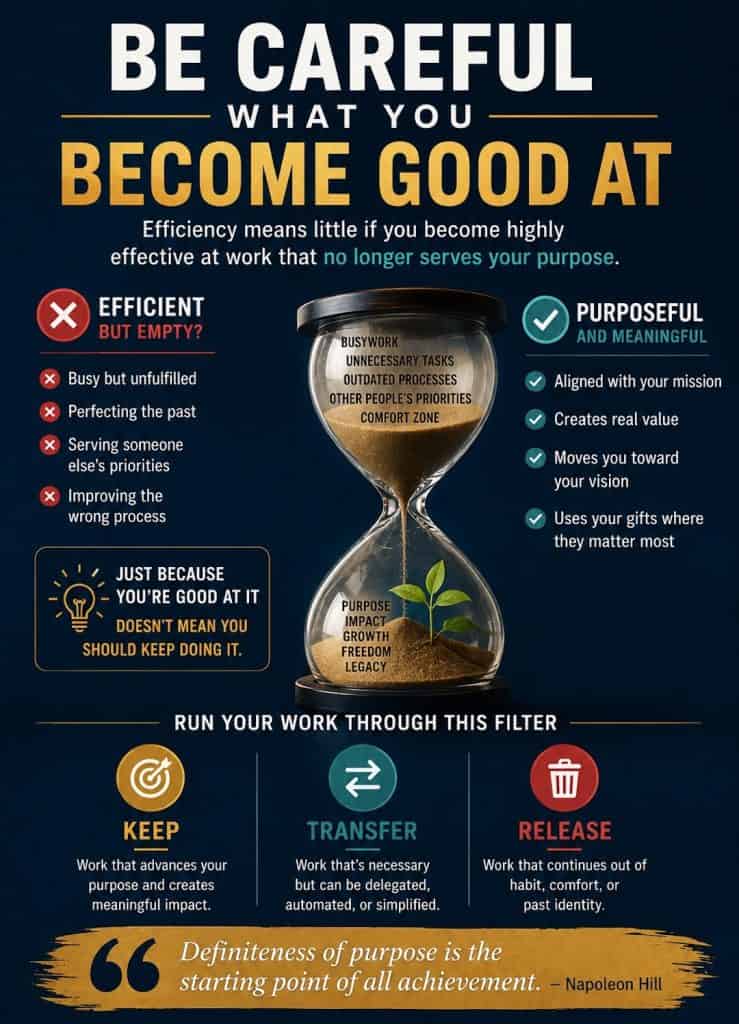
| KEEP | Work that remains aligned with your purpose and creates meaningful value. |
| TRANSFER | Necessary work that no longer requires your particular time, attention, or expertise. |
| RELEASE | Work that continues primarily because it is familiar, comfortable, or something you happen to do well. |
Releasing something you do well can be more difficult than abandoning something you do poorly. Failure gives us an obvious reason to change. Competence does not. But purpose asks more of us than competence.
.
Today’s Practice
Question One Thing You Do Well
Identify one task, habit, responsibility, or process at which you have become highly efficient. Instead of asking how to improve it, ask whether it still deserves your time.
Mastery is valuable. But mastery without direction can become a beautifully efficient detour.
Become excellent at what matters. Improve what deserves improvement. And have the courage to stop perfecting work that no longer belongs in the future you are building.
.
Think and Grow Rich
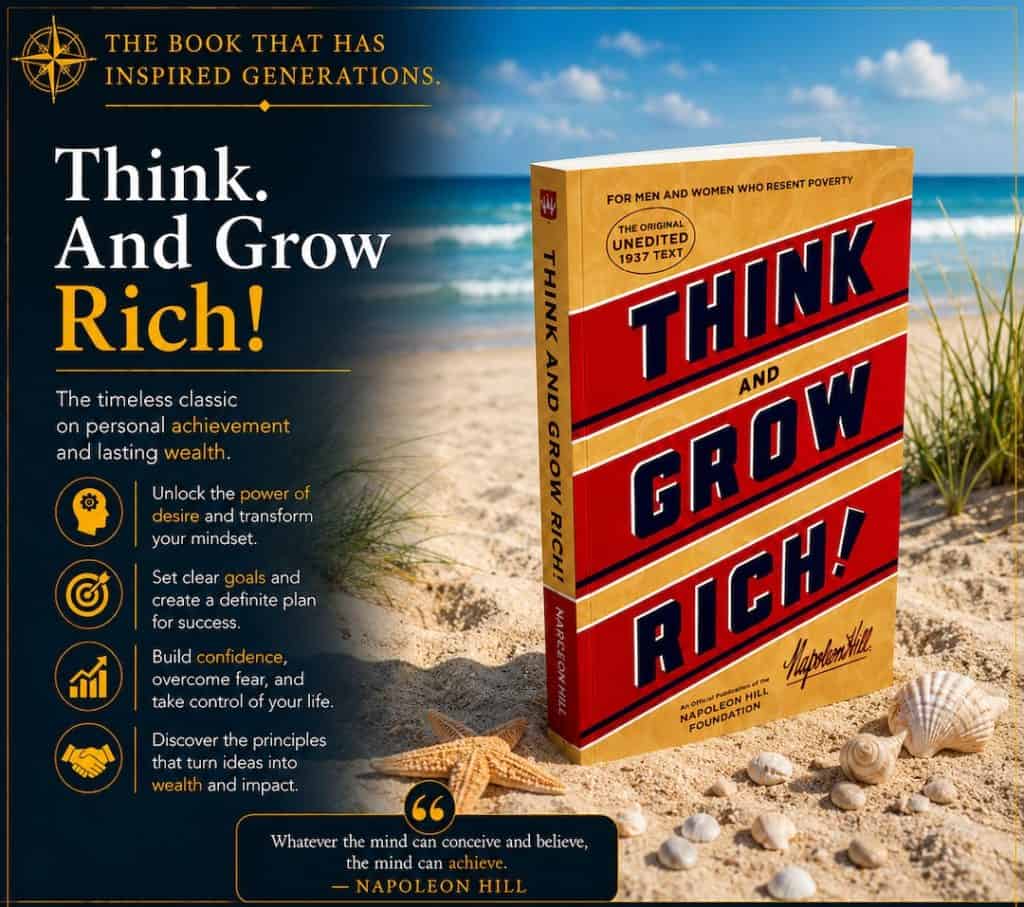
This edition of Napoleon Hill’s Classic Think and Grow Rich is a reproduction of Napoleon Hill’s personal copy of the first edition, the ONLY original version recommended by The Napoleon Hill Foundation, originally printed in March of 1937.
The most famous of all teachers of success spent a fortune and the better part of a lifetime of effort to produce the Law of Success philosophy that forms the basis of his books and that is so powerfully summarized and explained for the general public in this book.
In Think and Grow Rich, Hill draws on stories of Andrew Carnegie, Thomas Edison, Henry Ford, and other millionaires of his generation to illustrate his principles. This book will teach you the secrets that could bring you a fortune. It will show you not only what to do but how to do it. Once you learn and apply the simple, basic techniques revealed here, you will have mastered the secret of true and lasting success.
Money and material things are essential for freedom of body and mind, but there are some who will feel that the greatest of all riches can be evaluated only in terms of lasting friendships, loving family relationships, understanding between business associates, and introspective harmony which brings one true peace of mind! All who read, understand, and apply this philosophy will be better prepared to attract and enjoy these spiritual values.
BE PREPARED! When you expose yourself to the influence of this philosophy, you may experience a CHANGED LIFE which can help you negotiate your way through life with harmony and understanding and prepare you for the accumulation of abundant material riches.

2 responses to “Be Careful WhatYou Become Good At”
Ensure that we have a definite purpose and are putting our best efforts into that objective. Instead of continuing to do things the same way and doing what we’re good at, ask ourselves, if it continues to serve the purpose or are we doing it just because we got good at it.
Don’t confuse efficiency with purpose. However, be efficient at recognizing your purpose which will avoid the efficiency trap.