
The Opportunity Hidden in Being a Beginner
Why humility, curiosity, and temporary incompetence can accelerate growth.
There are things you cannot become good at without first being willing to be bad at them.
Most of us enjoy the feeling of competence. We like knowing what to do, understanding the rules, anticipating problems, and being able to trust our own experience. Then we try something new. Suddenly, simple things require concentration. We ask questions that seem obvious to everyone else. We make mistakes. We move slowly. Someone younger, less experienced, or newer to our field may know considerably more than we do. It can be uncomfortable.
But that discomfort may be one of the clearest signs that learning has begun.
The Competence Trap
Experience is valuable. But comfort with
being experienced can become limiting.
.
The better we become at something, the easier it is to remain where we already feel capable. We know how the system works. We have answers. People may even come to us for those answers. Beginning again threatens that identity.
A successful manager learning a new technology may need help from an entry-level employee. An accomplished professional entering a new field may discover that decades of experience do not translate neatly into the new environment. A business owner adapting to artificial intelligence may have to ask questions that would have sounded unnecessary only a few years ago. A parent, teacher, or leader may discover that a new generation communicates, learns, and works differently from the one he or she understands best. The temptation is to retreat to the place where we still feel knowledgeable. But growth rarely asks us to demonstrate only what we already know. It asks us to expose what we do not know yet.
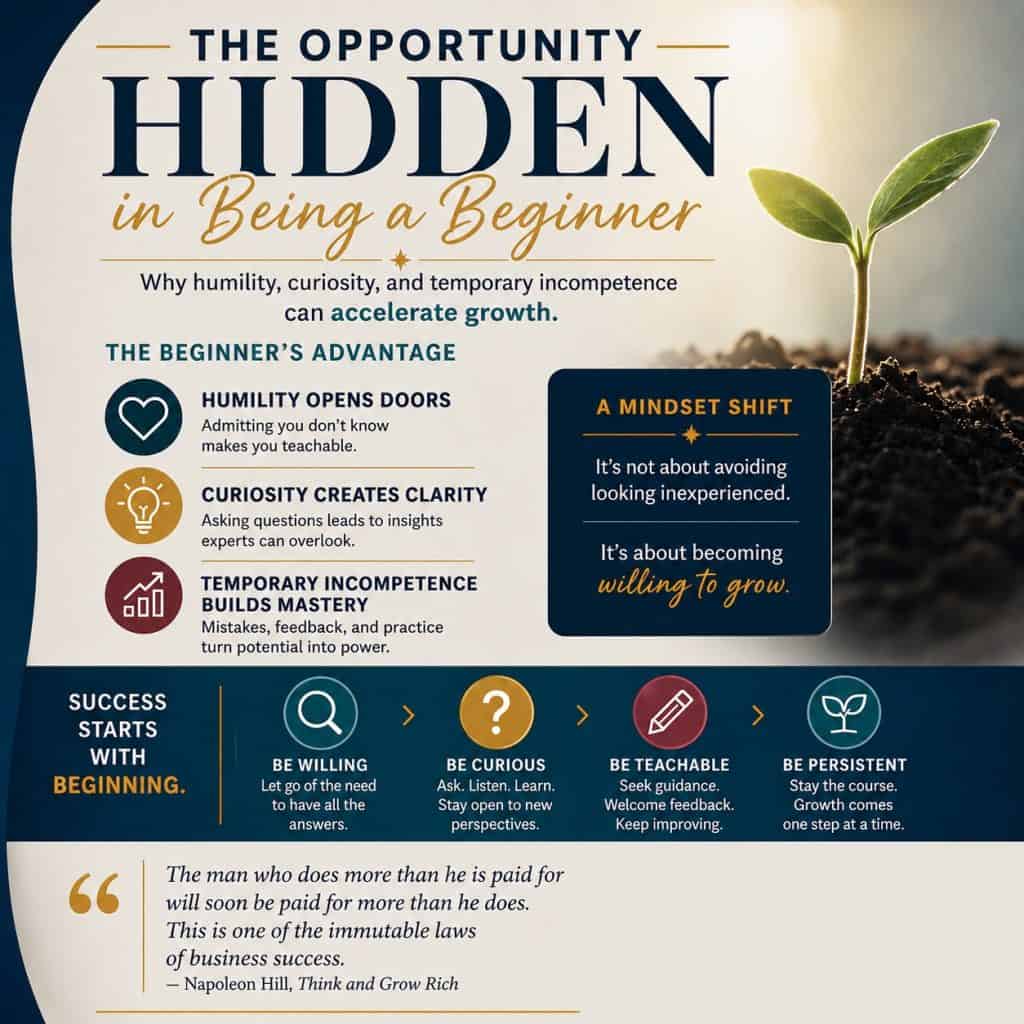
Beginner’s Advantage
“I don’t know yet” can be a far more productive sentence than pretending you already do.
Humility Makes Learning Faster
Humility is sometimes misunderstood as thinking less of yourself. In learning, it means something much more practical: being secure enough to admit the limits of what you know. The person who needs to appear knowledgeable spends energy protecting an image. The person who wants to become knowledgeable spends that energy asking questions, seeking instruction, observing carefully, and correcting mistakes.
One protects competence. The other expands it. This is one reason beginners sometimes notice things experts overlook. They have fewer assumptions about what is obvious, impossible, or “the way it has always been done.” Their questions can expose weaknesses hidden by familiarity. Curiosity turns that lack of certainty into an advantage.
Instead of asking, “How do I prove that I belong here?” the curious beginner asks, “How does this work? Why is it done this way? What am I missing? Who understands this better than I do? What can this mistake teach me?” Those questions create movement.
.
Temporary Incompetence
Being bad at something today tells you very little about what you can become tomorrow.
Napoleon Hill repeatedly treated temporary defeat as information rather than a final judgment. A setback could reveal a weakness in the plan, expose missing knowledge, redirect effort, or prepare a person for greater responsibility. The same principle applies to being a beginner.
Your first awkward attempt is not a verdict on your ability. It is information. So is the question you had to ask. So is the mistake you made. So is the correction someone gave you. Each one reduces the distance between what you understand now and what you are capable of understanding next.
| HUMILITY | Admit what you do not know without treating the admission as weakness. |
| CURIOSITY | Ask questions before old assumptions rush in to provide familiar answers. |
| PRACTICE | Allow repetition, correction, and feedback to replace awkwardness with ability. |
| GROWTH | Use what you have learned—then remain willing to become a beginner again. |
The real danger is not temporary incompetence. It is becoming so attached to competence that you stop entering rooms where you have something left to learn.
Hill’s philosophy consistently places value on learning from adversity rather than allowing temporary defeat to become permanent failure. The beginner has an opportunity to practice that principle on a smaller scale: mistake, feedback, adjustment, another attempt. That cycle is not evidence that growth has failed.
.
That cycle is growth.
.
Stay Willing to Begin Again
The ability to begin again may become one of the most valuable skills you develop.
The world changes too quickly for any of us to remain experts in everything that matters. Technologies change. Industries change. Careers change. Communities change. The people we lead change. Even our own goals and responsibilities change. Eventually, yesterday’s expertise meets tomorrow’s unfamiliar problem. At that moment, the advantage may belong not to the person who knows the most, but to the person who is most willing to learn.
That means listening to people whose experience differs from yours. Asking for help before pretending to understand. Trying something before you are certain you will be good at it. Receiving correction without turning it into a personal insult. And allowing yourself to look inexperienced long enough to actually gain experience.
.
The Beginner’s Audit
- Where have I avoided learning because I do not want to look inexperienced?
- What question have I been reluctant to ask?
- Who could teach me something if I were willing to listen?
- What would I attempt if I gave myself permission to be a beginner?
.
Do Something You Are Not Good At Yet
Choose one useful skill, technology, idea, or activity you have been postponing because you expect to feel awkward. Spend a little time learning it today. Ask one question. Make one attempt. Allow yourself to be unimpressive. You do not need to master it today.
You only need to become willing to begin.
There is no embarrassment in not knowing something you have not yet learned. The opportunity lies in what happens next. Stay humble enough to ask. Curious enough to explore. Persistent enough to practice. And confident enough to tolerate temporary incompetence while a new capability is being built.
Every expert has a past in which they did not yet know what they were doing.
.
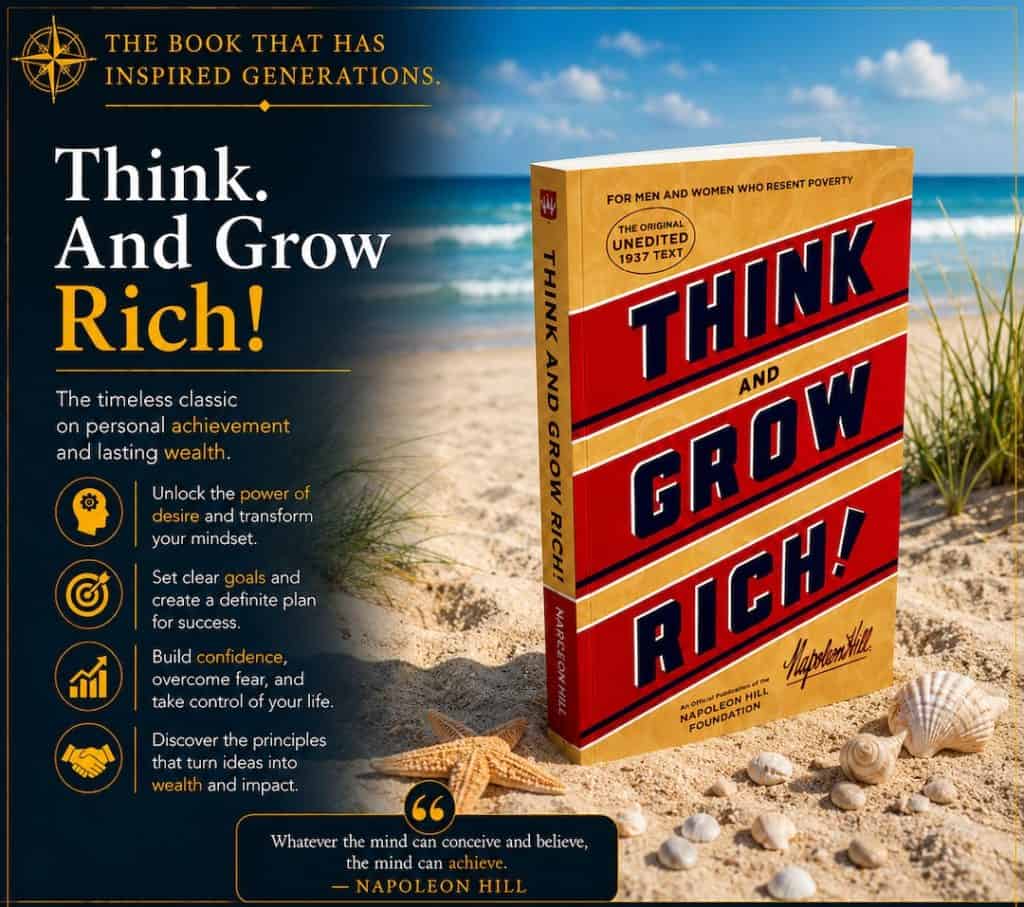
Think and Grow Rich
This edition of Napoleon Hill’s Classic Think and Grow Rich is a reproduction of Napoleon Hill’s personal copy of the first edition, the ONLY original version recommended by The Napoleon Hill Foundation, originally printed in March of 1937.
The most famous of all teachers of success spent a fortune and the better part of a lifetime of effort to produce the Law of Success philosophy that forms the basis of his books and that is so powerfully summarized and explained for the general public in this book.
In Think and Grow Rich, Hill draws on stories of Andrew Carnegie, Thomas Edison, Henry Ford, and other millionaires of his generation to illustrate his principles. This book will teach you the secrets that could bring you a fortune. It will show you not only what to do but how to do it. Once you learn and apply the simple, basic techniques revealed here, you will have mastered the secret of true and lasting success.
Money and material things are essential for freedom of body and mind, but there are some who will feel that the greatest of all riches can be evaluated only in terms of lasting friendships, loving family relationships, understanding between business associates, and introspective harmony which brings one true peace of mind! All who read, understand, and apply this philosophy will be better prepared to attract and enjoy these spiritual values.
BE PREPARED! When you expose yourself to the influence of this philosophy, you may experience a CHANGED LIFE which can help you negotiate your way through life with harmony and understanding and prepare you for the accumulation of abundant material riches.

3 responses to “The Opportunity Hidden in Being a Beginner”
I know nothing, yet enough, there is no-thing to know only to experience through unknown becomes familiar in surrender of transmuting past knows
The world is changing faster than ever. Instead of staying comfortable in what we do know, be comfortable with learning a new skill that you’ve been putting off. Be curious and ask questions. Take action and practice, even make mistakes. Grow by your willingness to keep learning new skills etc.
I love the release statement, “I don’t know yet.” You’re humble to your incompetence, which sets off curiosity. You then repeatedly practice the new skill until mastery. You then start the cycle again. Perpetual growth at its finest.