
.
The Difference Between
Motion and Progress
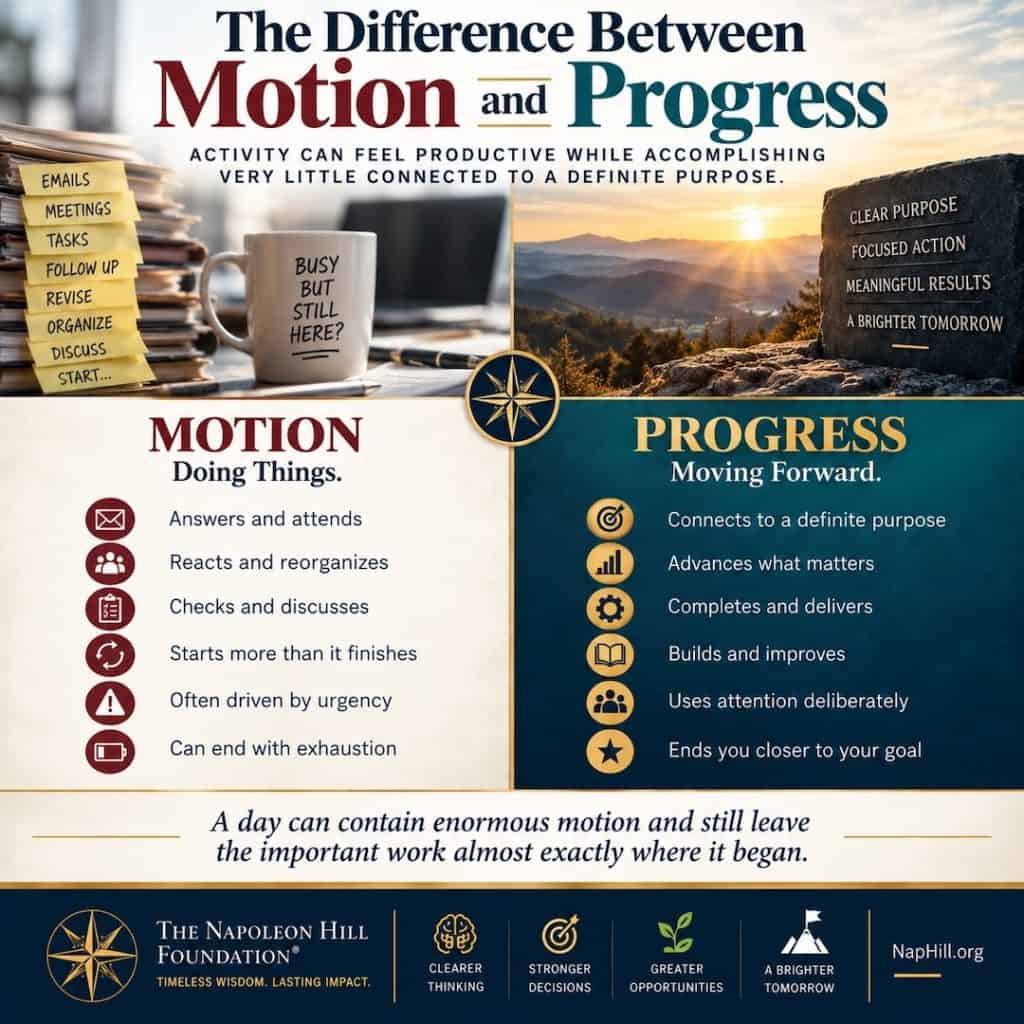
Activity can feel productive while accomplishing
very little connected to a definite purpose.
.
The Busyness Trap
A full day and a productive day are not necessarily the same thing.
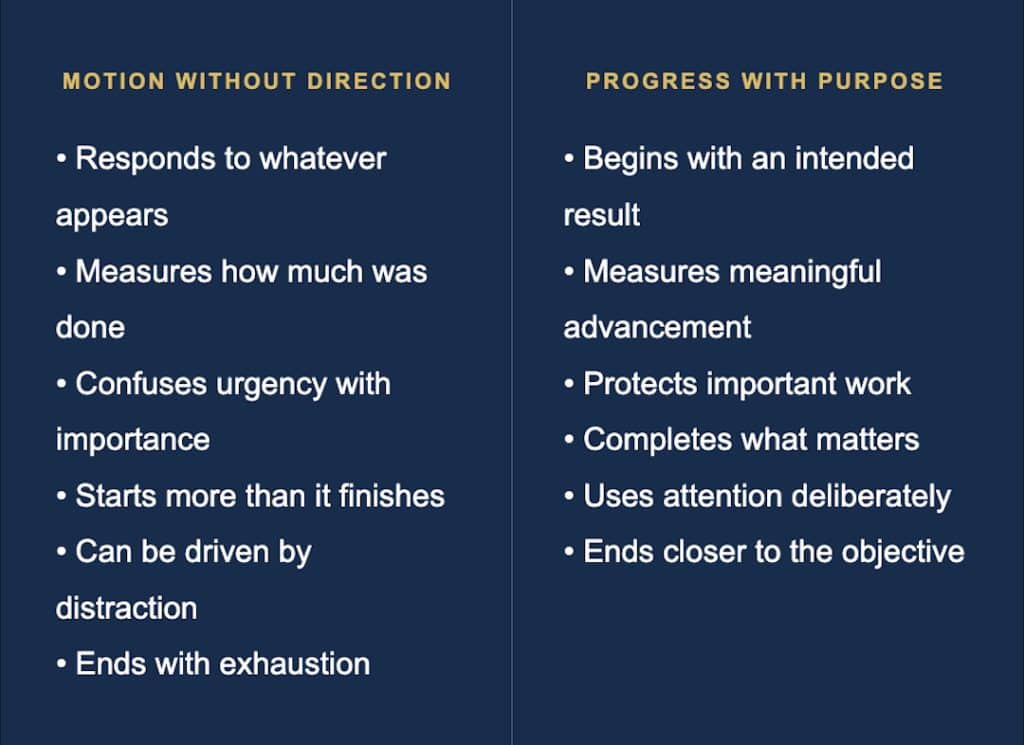
It is entirely possible to work hard all day and finish exhausted without making meaningful progress on the thing that matters most. You answered messages. You attended meetings. You reorganized files. You checked several things. You solved small problems as they appeared. You helped someone else with a task. You started something, switched to something else, returned to the first thing, and then handled three interruptions you never expected. None of those activities is automatically wasteful. Some may be necessary. The problem begins when activity itself becomes our measurement of effectiveness.
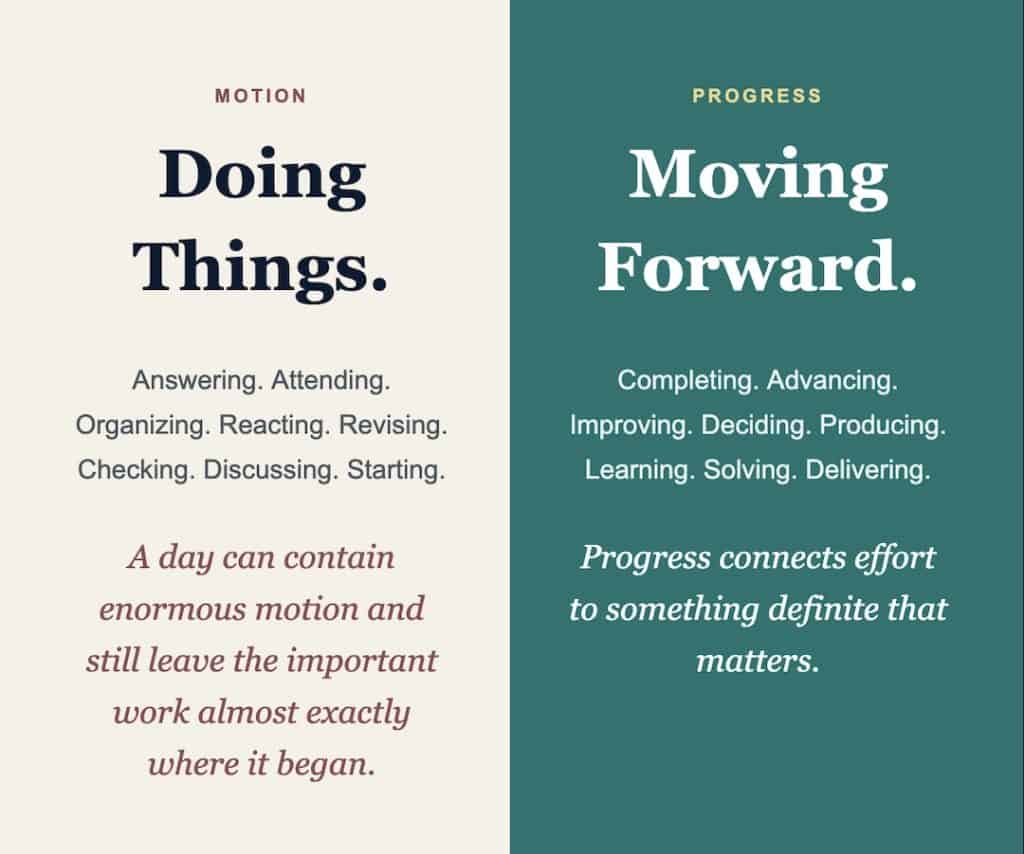
Motion asks, “What did I do?”
Progress asks, “What did this move forward?”
That second question is more demanding because it requires a destination. You cannot determine whether you are making progress unless you know what you are trying to accomplish. Imagine walking ten miles without knowing where you intend to go. Ten miles is considerable activity. It may require effort, endurance, and time. But distance traveled alone cannot tell you whether you are closer to where you need to be.
.
Movement becomes progress
only when it has direction.
This is why busyness can be deceptive. It gives us many of the sensations associated with productive work—effort, urgency, fatigue, completed tasks—without necessarily producing the result that justified the work in the first place. Sometimes motion is even more comfortable than progress. Progress may require the difficult phone call, the final decision, the uncomfortable conversation, the finished proposal, the sales request, the first draft, or the risk of putting completed work in front of someone who can judge it. Preparing to do those things can feel safer than actually doing them.
.
Definiteness gives effort
somewhere to go.
Napoleon Hill placed Definiteness of Purpose at the center of his philosophy of achievement. That matters enormously when we consider the difference between motion and progress. A definite purpose creates a standard against which activity can be judged. Once you know what you are trying to accomplish, a useful question becomes possible:
.
Is what I am doing moving me
toward what I say I want?
,
This does not mean every minute must produce a visible result. Planning matters. Research matters. Rest matters. Learning matters. Conversations matter. Reflection matters. Some worthwhile work produces results slowly, and some necessary work simply keeps life and organizations functioning. The distinction is not between action and thinking. It is between activity that serves a purpose and activity that has become disconnected from one.
.
.
Hill’s principle of Controlled Attention strengthens the same idea. Purpose identifies what deserves our effort; controlled attention helps us direct our mental energy toward it. Without that direction, the priorities of other people, incoming messages, minor problems, habits, and distractions can quietly decide how the day will be spent.
.
From Activity to Advancement
Give your work a destination.
Before filling another day with activity, identify one meaningful result that would make the day different when it is finished. Not ten priorities. Not an entire task list. Start with one result connected to something important.
.
The Progress Filter
Before giving something your time, ask:
- What am I actually trying to accomplish?
- What would meaningful progress look like today?
- Is this activity directly supporting that result?
- Am I doing this because it matters—or because it is easier than the work that matters?
- If I continue spending my time this way, where will it actually take me?
.
Three Ways to Create More Progress
.
DEFINE THE RESULT.
Replace “work on the project” with something observable: finish the first draft, contact three prospects, make the decision, complete the application, resolve the problem, or deliver the proposal.
PROTECT THE IMPORTANT WORK.
Do not automatically give your best attention to whatever arrives first. Reserve some of it for the work connected to your larger purpose.
MEASURE MOVEMENT, NOT BUSYNESS.
At the end of the day, do not ask only how much you did. Ask what changed because you did it.
Today’s Practice
Choose One Progress-Making Action.
Look at what you intend to do today. Circle the one action most directly connected to an important purpose or result. Then give that action a protected period of attention before the day’s smaller demands consume the time available for it.
There will always be things to answer, organize, check, attend, fix, and manage. Some are necessary. But a life filled entirely with necessary activity can still leave its most important purposes unattended. The goal is not to eliminate motion. The goal is to give motion direction.
Being busy tells you that you moved.
Progress tells you that you moved something that matters.

.
Napoleon Hill’s Guide to Achieving Your Goals: The Four Proven Principles of Success
Benefit from the enduring insights of one of the most influential self-help authors, Napoleon Hill. His philosophies have empowered countless individuals to take control of their lives and turn dreams into reality.
In Napoleon Hill’s Guide to Achieving Your Goals discover the four cornerstone principles for success that Hill has identified through decades of research. Learn how to incorporate these principles into your own life to unlock your full potential.
Featuring an introduction from the CEO of the Napoleon Hill Foundation, Don Green, this never-before-published book offers tangible, easy-to-implement strategies for setting goals and overcoming obstacles. It’s not just about theory; it’s a practical guide that translates Hill’s philosophies into actionable steps. The book includes beautifully designed quotes to remember and discussion questions for personal use or group study.
Even decades after its conception, Hill’s wisdom stands true and continues to offer value in our contemporary world. It’s a testament to the timeless relevance of Hill’s work. Reading this book will not only provide guidance and strategies for success but also ignite the motivation you need to get started and keep going. The inspiring words of Hill can push you to never give up on your dreams, regardless of the challenges you face.

2 responses to “The Difference Between Motion and Progress”
Motion requires meaningful purpose to turn it into progress. If we don’t have a target, we will never get there.
What DO you want? What do YOU want?
☆*: .。. o(≧▽≦)o .。.:*☆
“Sometimes motion is even more comfortable than progress” is something I can admit has been the case in my life, something I can transmute. Question #4 in the progress filter reinforces this.
The motion without direction list really made it clear that I often live in this way and it’s getting me nowhere fast. Time to get then on direction.