
.
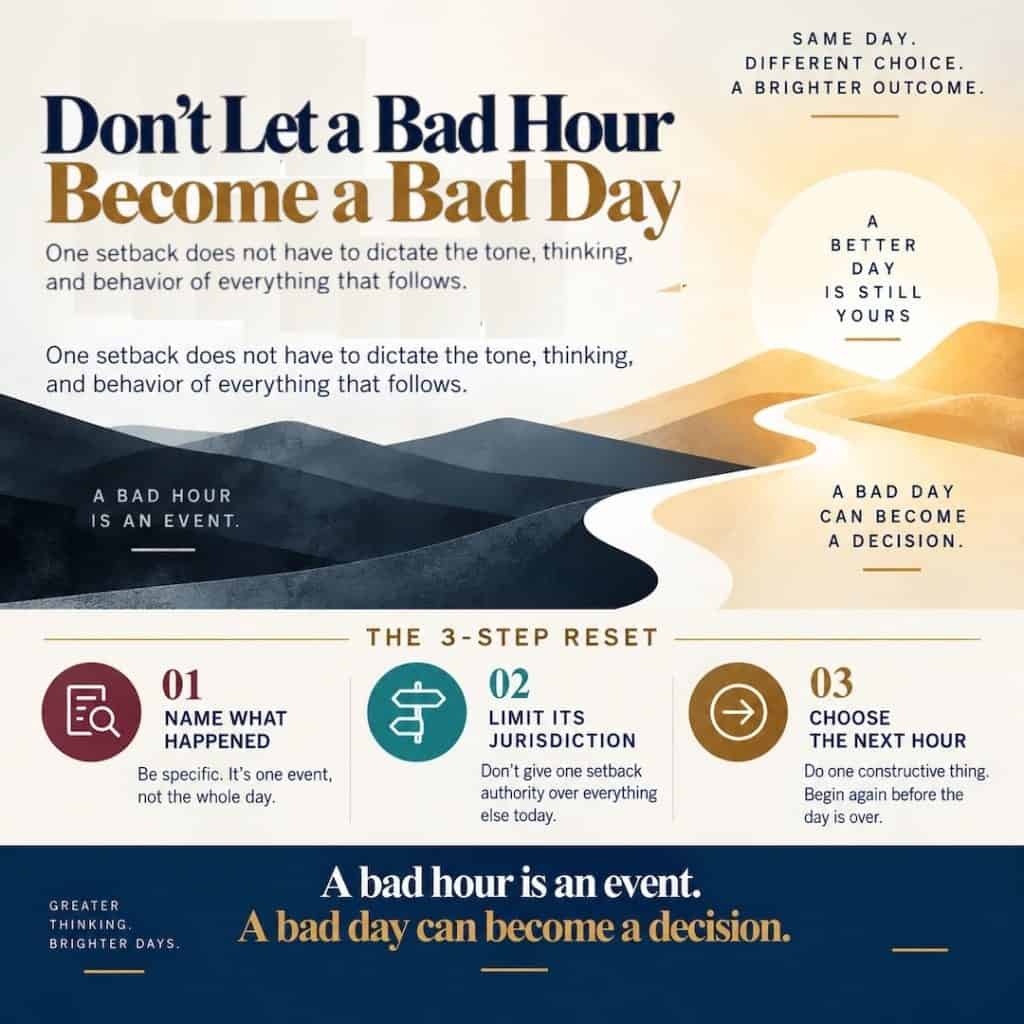
Don’t Let a Bad Hour
Become a Bad Day
One setback does not have to dictate the tone,
thinking, and behavior of everything that follows.
Something went wrong.
That does not mean everything is going wrong.
The meeting went badly. You made a mistake before breakfast. Someone sent an upsetting message. Traffic made you late. A customer complained. You received disappointing news. A conversation did not go the way you hoped. For the next hour, you are frustrated. That reaction is human.
The real question is what happens when the hour is over.
When One Moment Starts Taking Over
A setback has a beginning.
We sometimes give it a much larger ending.
The mind has a tendency to connect events. A difficult morning can become, “Today is terrible.” One mistake becomes, “I cannot get anything right.” One disagreement becomes, “Everybody is irritating me.” One piece of bad news makes every ordinary inconvenience that follows feel like further evidence that the day has turned against us. Notice what changed. The first event was real. The rest may be interpretation.
The setback is one event.
The story you build around it can become the rest of the day.
This is why a bad hour can create damage far beyond the original problem. Frustration from one situation leaks into another. We become impatient with someone who had nothing to do with the setback. We rush work that still deserves care. We abandon a healthy plan because the day “already feels ruined.” We stop noticing what is still going well because our attention has narrowed around what went wrong. The problem is no longer only the original event
We may eventually start giving the setback authority over unrelated parts of the day.
Napoleon Hill’s philosophy offers several useful ways to interrupt that pattern:
A Positive Mental Attitude does not require pretending nothing unpleasant happened. It asks us not to surrender the direction of our thinking simply because something difficult occurred.
Controlled Attention reminds us that what receives our continuing focus matters. A setback deserves whatever attention is necessary to understand or correct it. It does not automatically deserve the rest of the afternoon.
And Hill’s principle of Learning from Adversity and Defeat specifically asks us to examine our attitude toward setbacks and search for what can be learned or recovered from them. Hill’s principles acknowledge that this is not always easy when disappointment is fresh, but treats that response as an important part of personal achievement.
You are allowed to have a bad moment.
You do not have to promote it to management of the entire day.
The Mental Reset
Do not wait for tomorrow to begin again.
We often treat a day as though it were one indivisible unit. Once it has gone badly, we decide the whole thing is lost and promise ourselves we will start fresh tomorrow. But a reset does not require midnight.
| 01 | NAME WHAT HAPPENED Be specific. “The presentation went badly” is more accurate and manageable than “Everything is going wrong.” |
| 02 | LIMIT ITS JURISDICTION Ask what the setback actually affects. Do not automatically extend its authority to your next conversation, your next task, your health choices, or the rest of your day. |
| 03 | CHOOSE THE NEXT HOUR Do one constructive thing next. Make the call. Finish the task. Take the walk. Apologize. Correct the error. Eat the planned meal. Begin again before the day is over. |
This approach does not erase real disappointment. Some events genuinely deserve grief, concern, anger, or time to process. The point is not to force yourself into cheerfulness. It is to keep one difficult event from automatically deciding how you will handle everything else.
.
Today’s Practice
Put a Period Where You Usually Put a Comma.
When something goes wrong today, describe it as one complete event:
“That was disappointing.”
“That conversation went badly.”
“I made a mistake.”
“That hour was difficult.”
Then put a mental period after it rather than automatically adding: “
…and now the entire day is ruined.”
.
A bad hour is an event.
A bad day can become a decision.
When you can, choose again
before the next hour begins.
.

Think and Grow Rich:
In 10 Minutes a Day
Now you can quickly and effectively study and put into practice the greatest personal development program of all time. In only ten minutes a day, you can begin to implement the success principles that have made more millionaires and top influencers than any other achievement philosophy.
Fame? Fortune? Impactful service? More meaningful relationships? You can have anything that you want in life when you discover the secret contained in Napoleon Hill’s Think and Grow Rich.
Originally published in 1937, Think and Grow Rich helped end the Great Depression with its 13 steps to amass riches. It holds the keys to financial independence, harmonious relationships, power, happiness, fulfillment, and peace of mind. All forms of wealth can be yours if you are willing to pay the price…and that is, to THINK—to enlarge your mind, take control of your thoughts, and leverage the power of the vast mental resources available to you in order to translate your greatest desires into their material equivalent.
As Hill said, “There is no point in having such a great potential for achievement unless you do something to convert it into an actuality.” Think and Grow Rich in Ten Minutes a Day extracts the key principles, instructions, and stories from Hill’s original, unedited masterpiece and provides updated, relevant examples—in modernized, easily accessible language—so that all readers, regardless of how busy they are, can benefit from the timeless wisdom found in Hill’s book. Action items added to the original text will help readers expertly apply each chapter’s lessons.
Your master-key to success is already in your hands! Let this book show you how to use it efficiently and effectively to unlock the storehouses of riches that are within your reach. Harness the power of thought to distinguish yourself like you never imagined possible…for “anything the mind can believe, it can achieve!”

4 responses to “Don’t Let a Bad Hour Become a Bad Day”
It’s not what happens, it’s how we respond, deal with it and recover from what happened that matters. You, and only you, are responsible for everything in your life…including our reactions to hiccups in the day.
I was just reading Your Wish Is Your Command book this afternoon and we get what we think about most of the time. If your energy and attention is directed toward what happened earlier in the day, and we’re feeling bad about it, we are vibrating at that frequency and will attract more of what we don’t want. Just like animals do, we need to shake it off and move on with the day.
Also makes me think of….”Why wait? Laugh now.” When we know that we are at cause for everything and anything that happens in our life…we are empowered to create a different reality for ourselves. Choose to FEEL GOOD NOW and your day will transform.
It’s so easy to spiral downwards from one negative judgement of an event, something as simple as stubbing your toe or spilling your coffee, that I love the concept of interruption. It doesn’t deny that it’s a natural tendency, an unrealistically tell us to never have a negative thought again, but rather tells us we can put a kink in the flow, put a wrench in the spoke and cut it out before it expands too much.
Name what happened and move on. “I missed the bus. Oh well”. As much as we can convince ourselves otherwise, nothing is the end of the world.
We all make mistakes. Learn from them. Pick yourself up and choose one constructive action. 🙏🏻
Embrace the stepping stones which makes us stronger
Courageously get back up with teachability to adjust alignment