
.
Your Next Level May Require a Different You
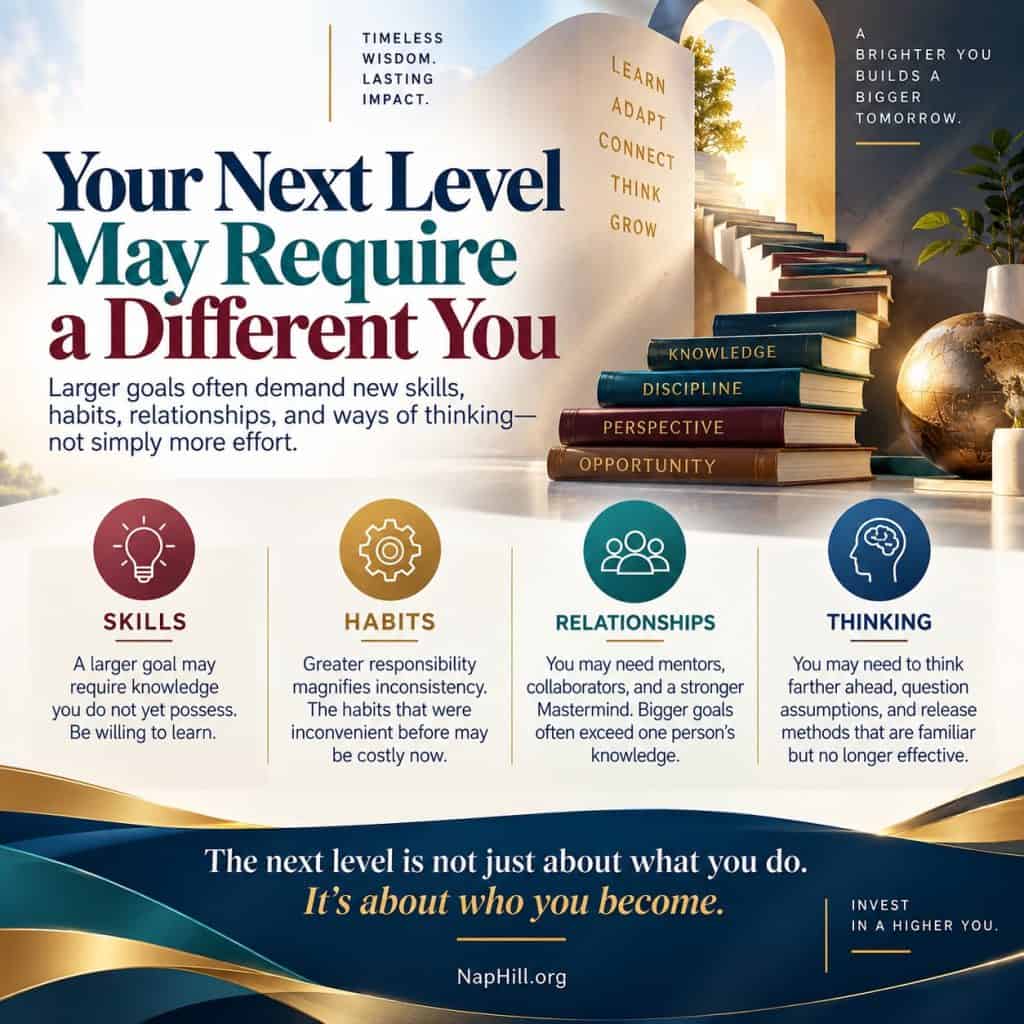
Larger goals often demand new skills, habits, relationships, and ways of thinking—not simply more effort.
Sometimes the obstacle is not a lack of effort. Sometimes the goal has simply outgrown your current operating system.
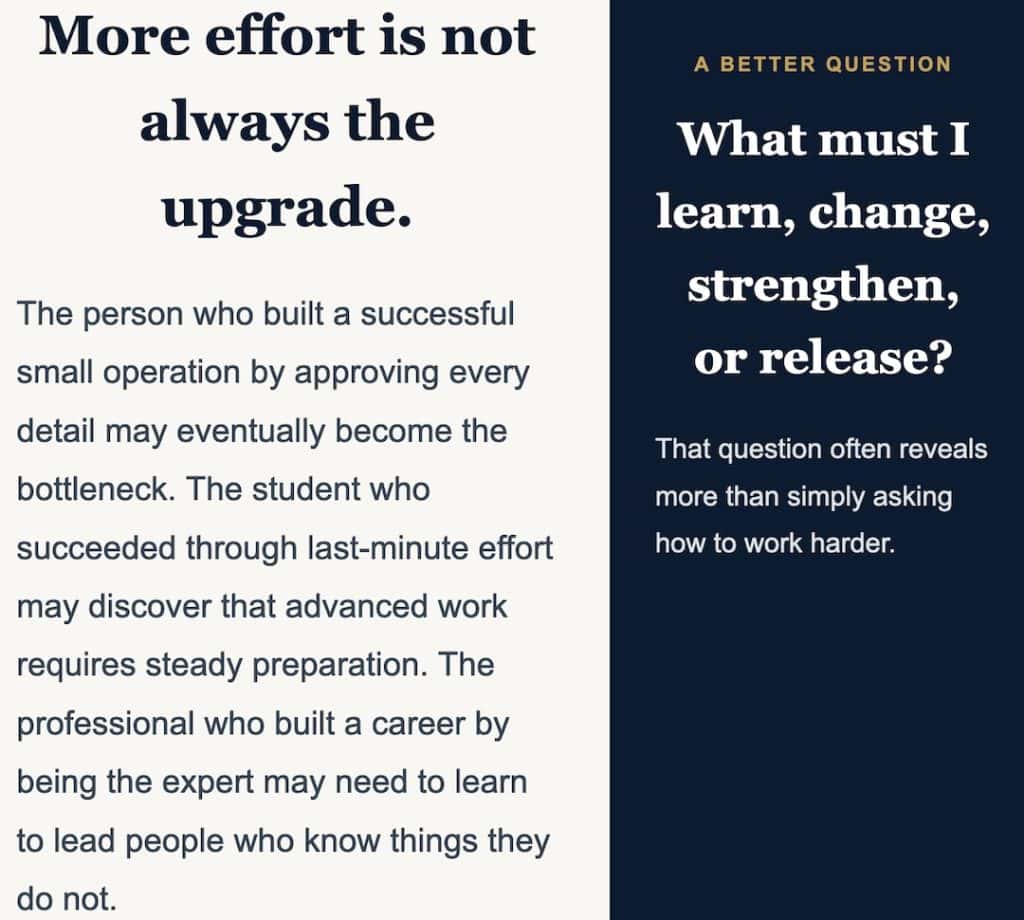
Hard work matters. Persistence matters. Showing up matters. But there comes a point when doing more of what you already know how to do produces smaller and smaller returns. A larger responsibility may require you to delegate instead of doing everything yourself. A growing organization may require systems rather than memory. Leadership may demand stronger communication rather than deeper technical skill. A new career may require you to become a beginner again. What worked before was not necessarily wrong.
It may simply belong to an earlier stage.
Expanding Your Capacity
The Goal Grows.
Your Capacity Has to Grow With It.
A useful way to think about growth is to ask not only what the goal requires, but what kind of person is capable of handling it well.
| Skills | A larger goal may require abilities you do not yet possess: leadership, communication, technology, financial literacy, negotiation, writing, organization, or specialized technical knowledge. |
| Habits | Greater responsibility magnifies inconsistency. The habit that was mildly inconvenient before may become costly when more people, time, money, or opportunity depend on you. |
| Relationships | You may need mentors, specialists, peers, collaborators, or a stronger Mastermind. A bigger goal often exceeds the knowledge available inside one person. |
| Thinking | Perhaps the greatest shift is mental: planning farther ahead, tolerating temporary incompetence, making decisions with incomplete information, questioning assumptions, and releasing methods that are familiar but no longer effective. |
.
Achievement Should Develop the Achiever
Napoleon Hill’s philosophy is not built around effort alone. Its principles repeatedly call for development: greater self-discipline, stronger relationships, personal initiative, improved thinking, controlled attention, flexibility, specialized knowledge, and cooperation with other minds. Hill’s writings on Controlled Attention connect the principle with growth in self-reliance, imagination, creative vision, personal initiative, enthusiasm, and the Mastermind Alliance. And Hill makes another point plainly: your education is never complete.
| Your Next-Level Development Plan |
| Name the capacity gap. What will the next level require that your current habits or skills do not yet provide? |
| Find the teacher. Who already understands what you need to learn? |
| Replace one outdated habit. Do not merely add another responsibility. Change one behavior that no longer scales. |
| Practice before the opportunity arrives.B egin behaving like the person capable of handling the next level before circumstances force the change. |
Your Next-Level Development Plan
Name the capacity gap.What will the next level require that your current habits or skills do not yet provide? Find the teacher.Who already understands what you need to learn? Replace one outdated habit.Do not merely add another responsibility. Change one behavior that no longer scales. Practice before the opportunity arrives.Begin behaving like the person capable of handling the next level before circumstances force the change.
Your next level may not need more of the current you.
It may need a more developed you.

Napoleon Hill’s How to Outwit the Six Ghosts of Fear: End Self-Sabotage and Take Control of Your Destiny
Fear is the invisible enemy that robs people of their dreams, decisions, and destiny. In How to Outwit the Six Ghosts of Fear, legendary success thinker Napoleon Hill reveals the six universal fears that haunt our lives—fear of poverty, criticism, ill health, loss of love, old age, and death—and shows you how to defeat them once and for all.
Drawn from Hill’s groundbreaking work Think and Grow Rich, this standalone guide offers timeless wisdom, practical steps, and deep psychological insight into the fear-driven thoughts and habits that sabotage success.
Inside, you’ll discover:
- How indecision and doubt lead to fear—and how to interrupt the cycle
- A detailed analysis of the six most common fears and how they control your actions
- Powerful self-analysis questions to uncover and confront your own limiting beliefs
- How to build immunity to negative influences and reclaim control of your thoughts
- The one thing you do control—your mind—and how it determines your destiny
“The only thing you can control is your mind.” —Napoleon Hill
If you’re ready to conquer fear and unlock the power of your mind, How to Outwit the Six Ghosts of Fear is your ultimate guide to personal power, resilience, and success.

One response to “Your Next Level May Require a Different You”
This is what I’m taking away groom this blog post today:
“Begin behaving like the person capable of handling the next level before circumstances force the change.”
Thank you. 🙏