.
Creative Vision.
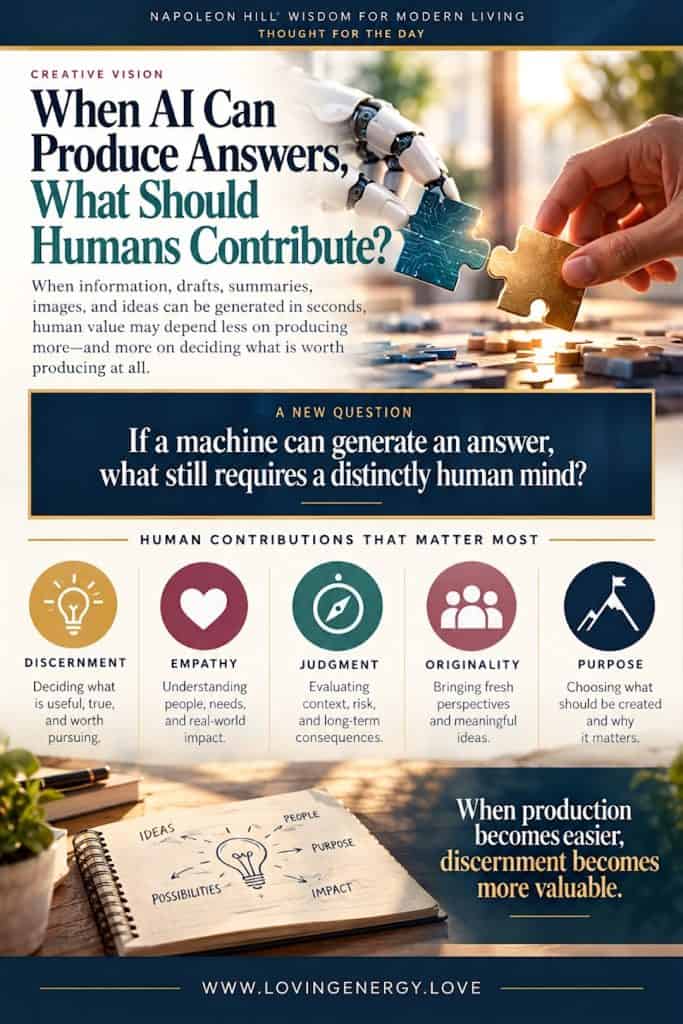
When AI Can Produce Answers,
What Should Humans Contribute?
When information, drafts, summaries, images, and ideas can be generated in seconds, human value may depend less on producing more—and more on deciding what is worth producing at all.
.
A New Question
If a machine can generate an answer, what still requires a distinctly human mind?
.
rtificial intelligence is changing the speed at which ideas can be developed. A person can now generate a first draft, summarize a complicated subject, brainstorm possibilities, create images, analyze information, or explore different approaches in a fraction of the time those tasks once required. That does not make human contribution less important. It changes where that contribution matters most. An answer can be fluent and still be wrong. An idea can be impressive and still be unnecessary. A piece of content can be polished and still lack originality, empathy, judgment, or purpose.
.
When production becomes easier, discernment becomes more valuable
.
The Human Advantage
The future may reward people who know how to think beyond the answer they are given.
AI can generate possibilities. Humans still have to decide which possibilities deserve attention. That requires judgment. It requires understanding context, consequences, people, values, and the difference between something that is merely possible and something that is actually wise.
.
What Becomes More Valuable
- Judgment — knowing which answer is useful, accurate, appropriate, or incomplete.
- Imagination — asking questions that have not yet been asked and seeing possibilities beyond familiar patterns.
- Ethics — deciding not only what can be done, but what should be done.
- Empathy — understanding the human impact of a decision rather than only its efficiency.
- Originality — bringing lived experience, perspective, taste, and personal insight to the work.
.
This is where Creative Vision becomes especially important. Creative Vision is not simply producing something novel. It is recognizing possibilities, making connections, and seeing beyond existing conditions toward something more useful, meaningful, or valuable. A tool may help generate twenty ideas. The human task is deciding which one deserves to become real—and why.
.
The most valuable person in the room may not be the one with the most answers, but the one who can recognize the right question.
.
Creative Vision asks us to do more
than repeat what already exists.
.
Napoleon Hill repeatedly emphasized imagination as part of the process through which ideas are shaped into achievement. That principle may be even more relevant in an era when tools can quickly reproduce patterns, summarize existing knowledge, and generate endless variations. The challenge is not simply to produce more. It is to use imagination deliberately—to combine knowledge with judgment, values, curiosity, and lived experience in ways that create something genuinely useful.
.
The Human Contribution Check
Before accepting the next
AI-generated answer, ask:
- What judgment does this still require from me?
- What context might the system not fully understand?
- Who could be affected by this decision?
- What is missing that only experience or empathy might reveal?
- What can I add that makes this distinctly mine?
.
Today’s Practice
Do Not Stop at the First Answer.
The next time you use AI to generate an idea, draft, recommendation, or solution, treat the output as a starting point rather than a finished product. Question it. Improve it. Add context. Remove what does not fit. Consider consequences. Bring your own experience into the result. Then ask one final question:
What did I contribute that the tool could not?
.
AI may expand what we can produce.
Creative Vision determines what is worth creating.