
.
What Are You Rehearsing in Your Mind?
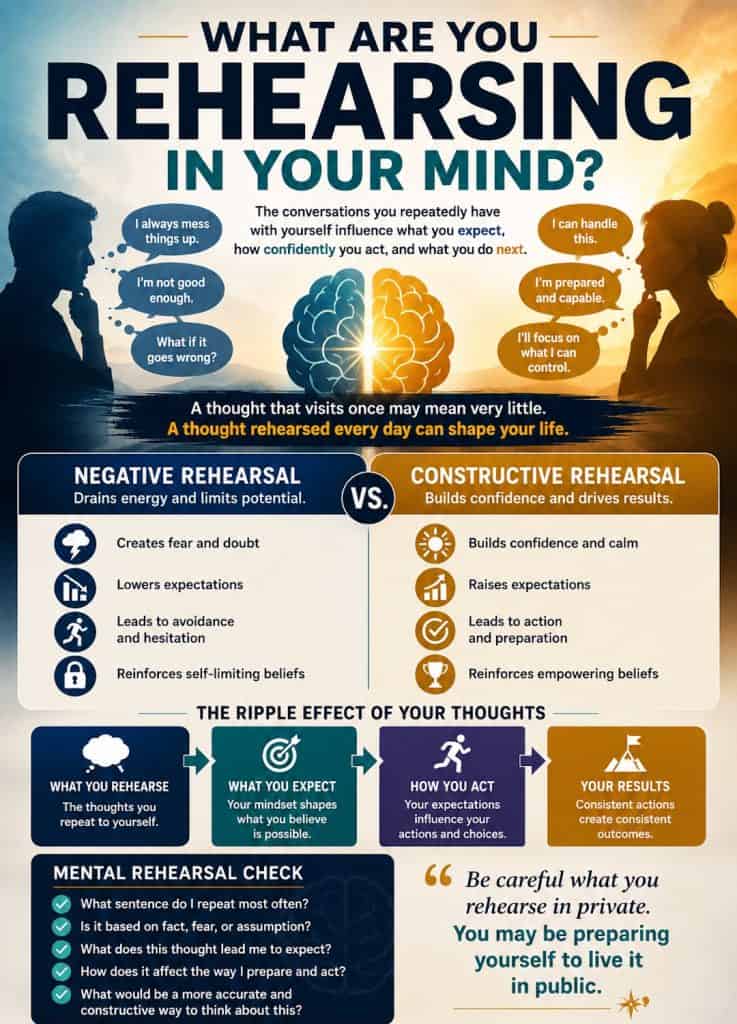
The conversations you repeatedly have with yourself can influence what you expect, how confidently you act, and what you do next.
A thought that visits once may mean very little. A thought rehearsed every day can begin to shape the way you approach your life.
Long before an important conversation takes place, many of us have already held it dozens of times in our minds. We imagine what the other person will say. We predict how the meeting will go. We anticipate rejection. We replay an old mistake. We picture ourselves stumbling over the presentation, losing the opportunity, or discovering that we were never as capable as other people thought.
Sometimes we rehearse the opposite. We remind ourselves that we have prepared. We imagine responding calmly when something unexpected happens. We remember difficult situations we have handled before. We direct our attention toward what we can control.
Neither kind of internal conversation guarantees an outcome. Positive thinking cannot make every obstacle disappear, and worrying about something does not make it inevitable. But repeated thought can influence the person who eventually walks into the situation.
The question is not whether you talk to yourself. The question is what that conversation is training you to expect.
The Quiet Rehearsal
What you repeatedly predict
can influence how you prepare.
Imagine two people preparing for the same difficult presentation. The first spends several days thinking, “I always get nervous. They are going to ask something I cannot answer. Everyone will notice that I do not belong in that room.” Those thoughts may change behavior before the presentation ever begins. The person may avoid practicing because thinking about the presentation is uncomfortable. Sleep may suffer. Attention may become fixed on possible embarrassment rather than the message that needs to be communicated.
The second person may feel the same nervousness but rehearse a different conversation: “I know this material. I can prepare for the questions most likely to come up. If I do not know an answer, I can say so and follow up. My job is not to be perfect. My job is to communicate clearly.” That conversation does not magically eliminate uncertainty. What it can do is direct attention toward preparation and useful action.
.
Watch the Pattern
Repeated thoughts influence expectations. Expectations influence preparation. Preparation influences behavior.
This is one reason internal language matters. Consider the difference between “I failed at this” and “I am a failure.” One describes an event. The other turns an event into an identity. Compare “This is difficult” with “I cannot do this.” Compare “I am nervous” with “I always fall apart under pressure.” Compare “I made a poor decision” with “I cannot trust myself.” Small changes in language can represent enormous changes in interpretation.
Be careful when a temporary experience begins appearing in your internal conversation as a permanent definition of who you are.
Hill understood that the mind is
influenced by what it repeatedly receives
Throughout Napoleon Hill’s philosophy, thought is not treated as a passing background activity. He repeatedly asks the individual to become more deliberate about the ideas, purposes, beliefs, fears, and influences allowed to occupy the mind.
Foundation teaching on Definiteness of Purpose describes successful people as devoting a large share of their thoughts and efforts toward a chosen end. Its material on Applied Faith likewise describes faith as a state of mind that becomes useful when translated into practice. The practical lesson is not that we should fill our minds with pleasant statements we do not believe. Effective mental rehearsal must remain connected to reality.
Telling yourself “Nothing can go wrong” is not confidence. Something can go wrong. A stronger internal conversation might be: “Something unexpected may happen, and I can prepare well enough to respond intelligently if it does.” “I will definitely succeed” may be impossible to know. “I will give this my strongest prepared effort, learn from the result, and adjust if necessary” gives the mind something useful to work with.
| NOTICE | Listen for the sentence you keep repeating when you think about the situation. |
| TEST | Ask whether the thought is factual, exaggerated, assumed, or simply familiar. |
| REWRITE | Replace an unhelpful exaggeration with language that is accurate, constructive, and actionable. |
| REHEARSE | Repeat the more useful thought and support it with preparation and action. |
The most useful inner voice is not the one that flatters you. It is the one that helps you see clearly and act constructively.
Change the Rehearsal
Pay attention to the conversations
no one else can hear.
Some of the most influential conversations in your life may never be spoken aloud. They happen while driving home from work. Before an important meeting. After reading an email. While lying awake at night. Before making the telephone call you have been postponing. After someone criticizes you. When an opportunity appears that seems slightly larger than your present confidence. Because those conversations are private, they can continue for years without ever being challenged.
“I am not good with money.”
“People like me do not get opportunities like that.”
“I always mess things up.”
“I am too old to learn this.”
“No one will take me seriously.”
When repeated often enough, statements like these can stop sounding like interpretations and begin sounding like facts. That is the moment to examine them.
.
The Mental Rehearsal Audit
- What sentence have I repeated most often to myself lately?
- Does that sentence describe a fact, a fear, an assumption, or an old experience?
- What does this thought lead me to expect?
- How does that expectation affect the way I prepare or behave?
- What would be a more accurate and constructive way to describe the same situation?
TODAY’S PRACTICE
Rewrite One Repeated Thought
Catch one unhelpful sentence you repeatedly tell yourself. Write it down exactly as it appears in your mind. Then rewrite it so that it is both more accurate and more useful. Do not make it artificially positive. Make it something you can believe and act upon.
You cannot prevent every fearful, doubtful, or discouraging thought from entering your mind. Nor do you need to. The greater responsibility is deciding which thoughts deserve rehearsal. Notice what you repeat. Question what is inaccurate. Replace what unnecessarily limits you. Then give your mind language that points toward preparation, possibility, and constructive action.
Be careful what you rehearse in private. You may be preparing yourself to live it in public.

.
Napoleon Hill’s Speak It Into Reality: Achieve Your Goals Through the Power of Faith and Words
Discover the power of autosuggestion with Speak It Into Reality, a guide inspired by Napoleon Hill’s timeless principles. Learn how the words you speak and the thoughts you hold can reprogram your subconscious, empowering you to achieve your greatest goals. This book dives into the science and philosophy behind autosuggestion, revealing how faith, belief, and repetition can shape your reality. Learn how to:
- Craft affirmations that rewire your subconscious for success.
- Develop unwavering faith in your goals and dreams.
- Leverage the emotions of love and confidence to amplify your affirmations.
- Overcome negative thought patterns and replace them with positive intentions.
Whether you’re striving for financial success, personal growth, or spiritual fulfillment, this book provides the tools to transform your mindset and speak your dreams into existence. Start changing your reality—one word at a time.
