
.
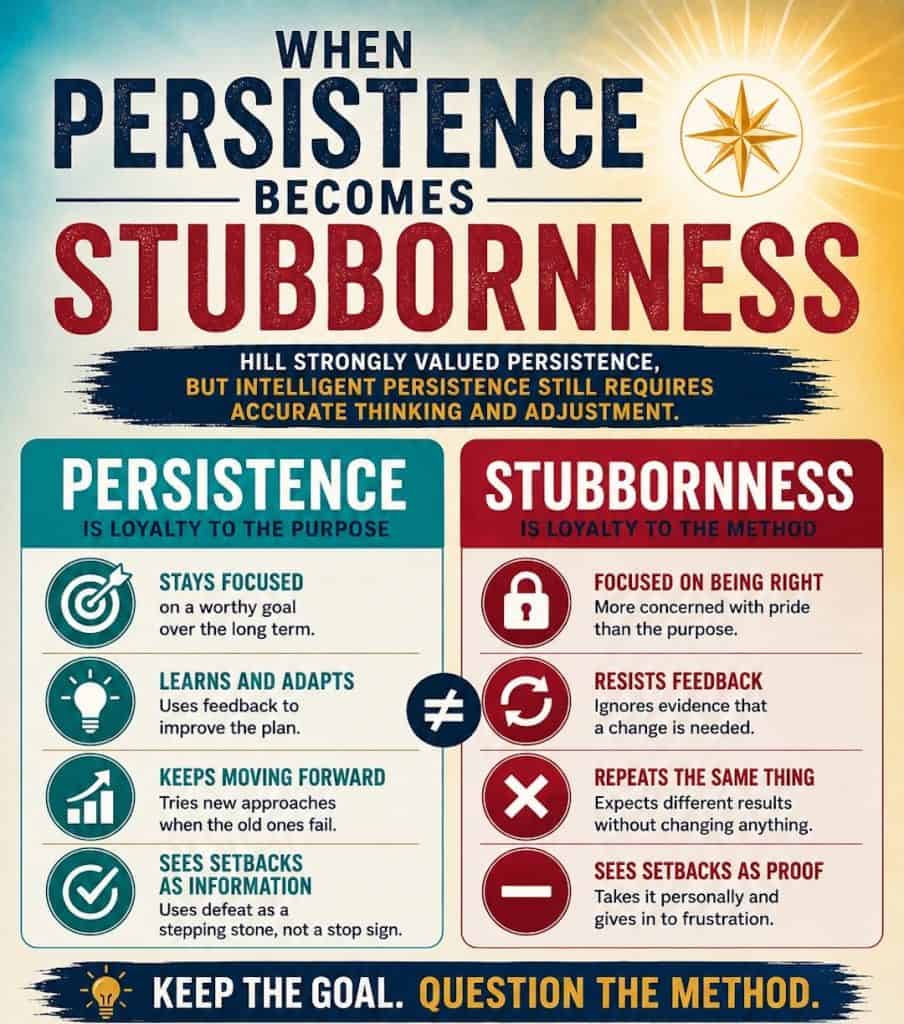
When Persistence Becomes Stubbornness
Hill strongly valued persistence, but intelligent persistence still requires accurate thinking and adjustment.
Persistence means refusing to abandon a worthwhile purpose. It does not require repeating the same unsuccessful method forever.
Persistence is one of the most admired qualities in Napoleon Hill’s philosophy. Keep going. Refuse to accept temporary defeat as final. Continue when enthusiasm fades. Stay with the goal when progress is slow. Those lessons matter because worthwhile goals almost always encounter difficulty. But persistence can be misunderstood. There comes a point when continuing to do exactly the same thing despite mounting evidence is no longer determination. It is refusal to learn.
The goal may deserve persistence even when the current plan does not.
Know What You Are Actually Protecting
Be persistent about the purpose; not emotionally attached to every plan.
Suppose a business owner has a definite goal of reaching a new group of customers. One campaign produces little response. A second attempt using essentially the same approach performs just as poorly. Persistence does not require launching the same campaign a third, fourth, and fifth time simply to prove determination. The purpose may still be sound. The audience may still be valuable. But the message, channel, offer, timing, or assumptions behind the plan may need to change. The same is true personally. You may remain committed to improving your health while changing the routine. Remain committed to a career objective while learning a different skill. Remain committed to solving a problem while abandoning the first solution you imagined.
.
The Distinction
Persistence says, “I will find a way.” Stubbornness says, “It must be this way.”.
.
Repeated effort is useful only when feedback is allowed to improve the next effort.
Failure provides information. A poor result may tell you the timing was wrong. The market changed. Your information was incomplete. A skill needs improvement. The assumptions behind the strategy were incorrect. The objective itself may even deserve reconsideration. If each unsuccessful attempt produces the same behavior with no new analysis, persistence has stopped functioning as a strength. Effort should accumulate wisdom, not merely repetition.
The Hill Connection
Persistence needs Accurate Thinking beside it.
Napoleon Hill® did not build his philosophy around one principle operating alone. Persistence works alongside Accurate Thinking, Organized Planning, Self-Discipline, and the ability to learn from adversity and defeat. That combination matters.
Accurate Thinking requires us to distinguish facts from assumptions and useful evidence from wishful thinking. Learning from defeat requires us to examine what the setback may be telling us. Planning requires us to organize what we have learned into a better next attempt. Persistence then supplies the determination to try again.
| OBSERVE | Look honestly at the result instead of defending the original plan. |
| QUESTION | Ask which assumptions, methods, or circumstances may have contributed to the result. |
| ADJUST | Change the method when the evidence gives you a sound reason to do so. |
| PERSIST | Return to purposeful action with a stronger plan and better information. |
Foundation material even asks how quickly a person searches for the useful lesson in temporary defeat and whether more time is spent carrying out plans or brooding over obstacles. That is persistence paired with learning—not persistence as mechanical repetition.
Changing the plan is not always quitting. Sometimes changing the plan is what allows persistence to continue intelligently.
Know When to Adjust
Ask whether you are protecting the goal—or protecting your pride.
One reason stubbornness is difficult to recognize is that it can look admirable from the inside. You have invested time. You announced the plan publicly. You defended the decision. Other people may have questioned it. Changing direction can feel like admitting they were right and you were wrong. So pride quietly becomes part of the decision. Accurate thinking requires separating the question, “Will changing this make me look inconsistent?” from the more important question, “What do the facts now suggest is the wisest course?” Strong people can change a method without changing their commitment to the larger objective.
.
The Persistence Check
- Is the purpose still worthwhile?
- What has the evidence from my previous attempts taught me?
- Am I changing nothing simply because changing would feel like admitting a mistake?
- What part of the plan should remain—and what part deserves adjustment?
- If I were beginning today with everything I now know, would I choose the same approach?
Today’s Practice
Keep the Goal. Question the Method.
Choose one goal where progress has stalled. Instead of asking whether you should give up, identify one assumption, strategy, habit, or method that could be tested or changed before your next attempt.
There will be times when persistence means continuing exactly as planned because the evidence says the strategy is sound and simply needs more time. There will be other times when the most persistent thing you can do is admit that the current approach is not working. The wisdom lies in knowing the difference
Hold tightly to a worthy purpose. Hold your methods loosely enough to improve them.

.
Napoleon Hill’s Speak It Into Reality: Achieve Your Goals Through
the Power of Faith and Words
Discover the power of autosuggestion with Speak It Into Reality, a guide inspired by Napoleon Hill’s timeless principles. Learn how the words you speak and the thoughts you hold can reprogram your subconscious, empowering you to achieve your greatest goals. This book dives into the science and philosophy behind autosuggestion, revealing how faith, belief, and repetition can shape your reality. Learn how to:
- Craft affirmations that rewire your subconscious for success.
- Develop unwavering faith in your goals and dreams.
- Leverage the emotions of love and confidence to amplify your affirmations.
- Overcome negative thought patterns and replace them with positive intentions.
Whether you’re striving for financial success, personal growth, or spiritual fulfillment, this book provides the tools to transform your mindset and speak your dreams into existence. Start changing your reality—one word at a time.

2 responses to “When Persistence Becomes Stubbornness”
Whether your purpose relates to financial abundance, personal growth or spiritual awakening, always return to your purpose/your goal and be persistent with it.
If a plan missed the mark, come up with an alternative plan. Don’t let emotional attachment and pride get in the way of change. Be accepting of feedback.
The situation is the boss, be willing to make adjustments to the plan as the situation calls for.
My favorite parts:
Be persistent about the purpose; not emotionally attached to every plan.
Persistence says, “I will find a way.” Stubbornness says, “It must be this way.”
Sometimes changing the plan is what allows persistence to continue intelligently.
Ask whether you are protecting the goal—or protecting your pride.
Keep the goal, question the method.
☀️
I agree with everything because if people stuck with their old ways just because these felt familiar, the humanity wouldn’t evolve. There are always better and more efficient ways to achieve the same things. I will always be seeking a better way to do things!