
The Skill of Recovering Quickly
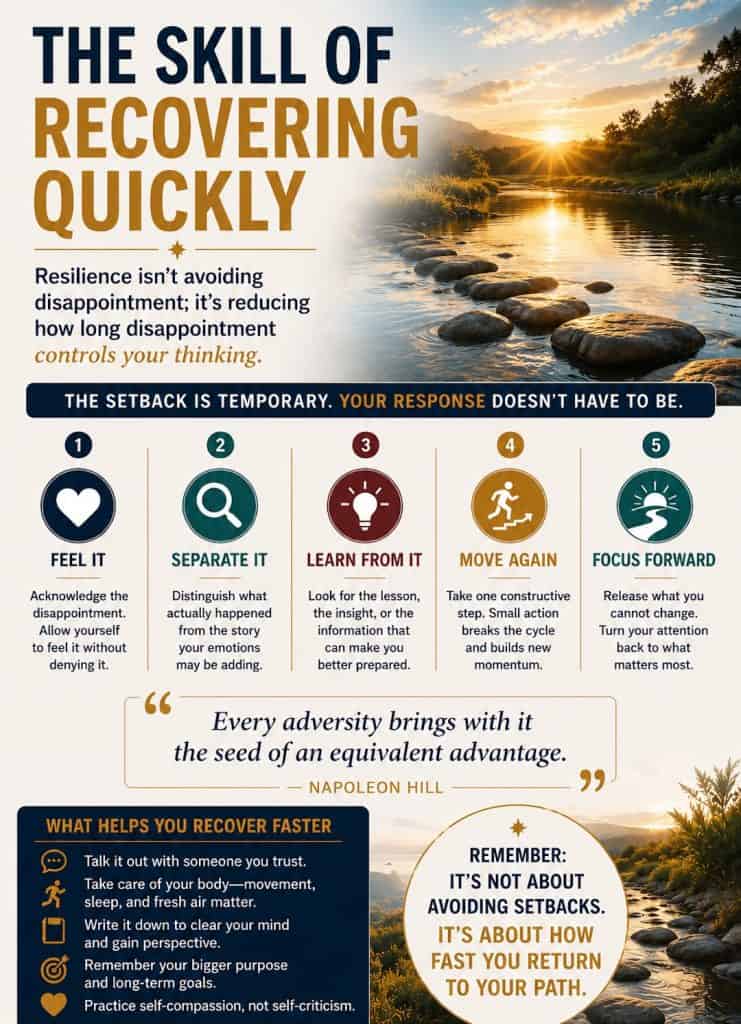
Resilience isn’t avoiding disappointment.
It’s reducing how long disappointment
controls your thinking.
The goal is not to become unaffected by setbacks. It is to become better at finding your footing after they happen.
Disappointment is part of any life that contains ambition. The proposal is rejected. The opportunity goes to someone else. The plan fails. A trusted person disappoints you. The result you worked toward does not arrive. Something you believed was certain suddenly changes. Those moments hurt precisely because something mattered.
Resilience does not require pretending otherwise. It does not mean forcing yourself to feel positive five minutes after receiving bad news. It does not mean denying frustration, anger, sadness, or embarrassment.
The more useful question is: How long will this disappointment be allowed to direct the rest of my thinking?
The Recovery Gap
The setback may last a moment.
Its mental afterlife can last much longer.
A difficult event occurs once. Yet the mind can replay it dozens of times. We revisit the conversation. Imagine what we should have said. Rehearse the unfairness. Predict that the same thing will happen again. Question our judgment. Compare ourselves with the person who succeeded instead. At some point, the original disappointment is no longer the only thing causing pain. Repetition begins extending its influence
.
The Shift
You may not control the disappointment.
You can gradually reclaim control of the
attention you keep giving it.
The Recovery Gap
The setback may last a moment.
Its mental afterlife can last much longer.
A difficult event occurs once. Yet the mind can replay it dozens of times. We revisit the conversation. Imagine what we should have said. Rehearse the unfairness. Predict that the same thing will happen again. Question our judgment. Compare ourselves with the person who succeeded instead. At some point, the original disappointment is no longer the only thing causing pain. Repetition begins extending its influence.
The Shift
You may not control the disappointment. You can gradually reclaim control of the attention you keep giving it.
Recovering quickly does not
mean rushing the emotion.
There is a difference between processing disappointment and feeding it. Processing asks: What happened? What do I feel? What does this mean? What can I learn? What must I do next? Feeding it asks the same painful questions repeatedly without producing new information. The skill is learning to recognize when reflection has stopped producing insight and has started becoming mental captivity.
.
Defeat is an event. It does not
have to become an identity
Napoleon Hill devoted an entire principle to learning from adversity and defeat. His emphasis was not on avoiding setbacks, because he understood that people pursuing meaningful achievement inevitably encounter them. The important distinction is what happens afterward.
Hill encouraged people to search for useful information inside defeat rather than automatically interpreting it as final failure. A setback may expose a weakness in the plan, reveal missing knowledge, redirect effort, strengthen determination, or force a person to reconsider an assumption that had gone unchallenged. That perspective does not make disappointment pleasant. It makes disappointment usable.
| FEEL IT | Acknowledge the disappointment instead of pretending it does not matter. |
| SEPARATE IT | Distinguish what actually happened from the larger conclusions emotion may be adding. |
| LEARN FROM IT | Extract whatever information can improve the next decision, effort, or plan. |
| MOVE AGAIN | Take one constructive action before disappointment becomes your permanent mental environment. |
Resilience begins when disappointment
stops being the conclusion and becomes
information for what comes next.
Shorten the Recovery Time
You do not have to recover instantly.
Aim to recover more intelligently
Resilience improves through practice. A disappointment that once consumed a month may eventually consume a week. Something that once ruined a week may someday cost you an afternoon. A frustrating conversation that once followed you home may eventually be processed, learned from, and left where it occurred. That is progress.
The objective is not emotional numbness. In fact, people who care deeply about their work, relationships, and goals will continue to experience disappointment. The improvement lies in developing a reliable way back.
- What actually happened—and what am I adding to the story?
- Is there anything useful left for me to learn from this?
- What part of this situation is still within my control?
- What would one constructive next step look like?
- What am I ready to stop mentally rehearsing?
Today’s Practice
Take One Step Back Into Motion
Think of one recent disappointment that is still occupying more attention than it deserves. Identify one lesson, one thing outside your control, and one constructive action you can take now.
Some disappointments take longer to process than others. Some losses change us permanently. There is no universal timetable for grief, hurt, or recovery. But in the ordinary setbacks of work, ambition, relationships, and daily life, we can become more skilled at noticing when disappointment has already delivered its message and is now simply repeating itself. Feel what needs to be felt. Learn what can be learned. Repair what can be repaired.
Then reclaim your attention and return it to the future.
.
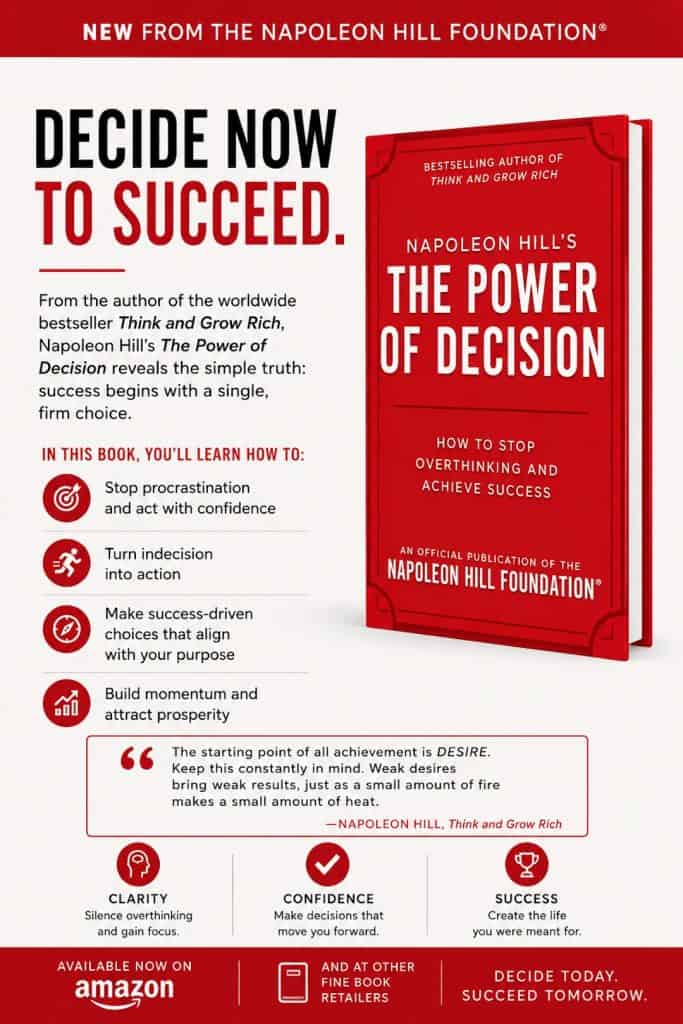
Napoleon Hill’s The Power of Decision: How to Stop Overthinking and Achieve Success
From the author of the worldwide bestseller Think and Grow Rich, Napoleon Hill’s Power of Decision reveals the simple truth: success begins with a single, firm choice. In this newly released compilation, The Napoleon Hill Foundation brings back Hill’s essential guide to overcoming doubt, banishing hesitation, and replacing overthinking with decisive action.
Packed with wisdom and practical steps, Hill shows you how to:
- Stop procrastination and act with confidence
- Turn indecision into action
- Make success-driven choices that align with your purpose
- Build momentum and attract prosperity
When you’re chasing personal goals, business success, or a more fulfilling life, The Power of Decision is your roadmap and motivation to clarity and achievement.
.
Decide today — Succeed tomorrow.
.

One response to “The Skill of Recovering Quickly”
One lesson that I learned from a recent disappointment was you can never control what others do. You can change how you perceive the disappointment by asking what did I learn? Distinguish what happened from emotional conclusions I am adding to it. Go back into neutrality.