
Success Needs
Maintenance.
Achievement is not a permanent condition. Much of what we work hard to build can weaken when we stop caring for it.

.
The Part of Success We Talk About Less
We celebrate the finish line.
Life continues the next morning.
Much of our language about success is built around arrival. Earn the degree. Get the promotion. Build the business. Reach the goal. Develop the skill. Repair the relationship. Improve your health. Establish a good reputation. Those accomplishments matter. But there is a problem hidden inside the idea of arrival:
Many of the things worth achieving are not things we get to keep automatically.
A friendship can survive years and still become distant through neglect. Expertise earned over decades can become dated when a profession changes. A respected organization can become irrelevant if it assumes yesterday’s reputation guarantees tomorrow’s support. Physical ability can decline when the habits that helped create it disappear. Even trust has a maintenance schedule. A reputation may take years to establish, yet the behavior that created that reputation must continue if people are expected to keep believing in it.
.
Success has two very different jobs:
Creation asks: What must I do to build this?
Maintenance asks: What must I continue doing so that what I built remains valuable?
,.
The second question is easy to overlook because maintenance rarely feels as exciting as achievement. There is no ribbon-cutting ceremony for remaining dependable. Nobody hands you a trophy because you kept learning after becoming experienced. A twenty-year friendship does not survive because someone celebrated its twentieth anniversary; it survives because two people continued doing the things relationships require. Maintenance is usually quiet.
Its results become most obvious when it stops.
Six Things That Do Not Maintain Themselves
Where might neglect be quietly creating a maintenance debt?
Maintenance debt builds when something important receives less attention than it needs. At first, very little may seem wrong. Eventually, however, the accumulated neglect becomes harder—and often more expensive—to correct.
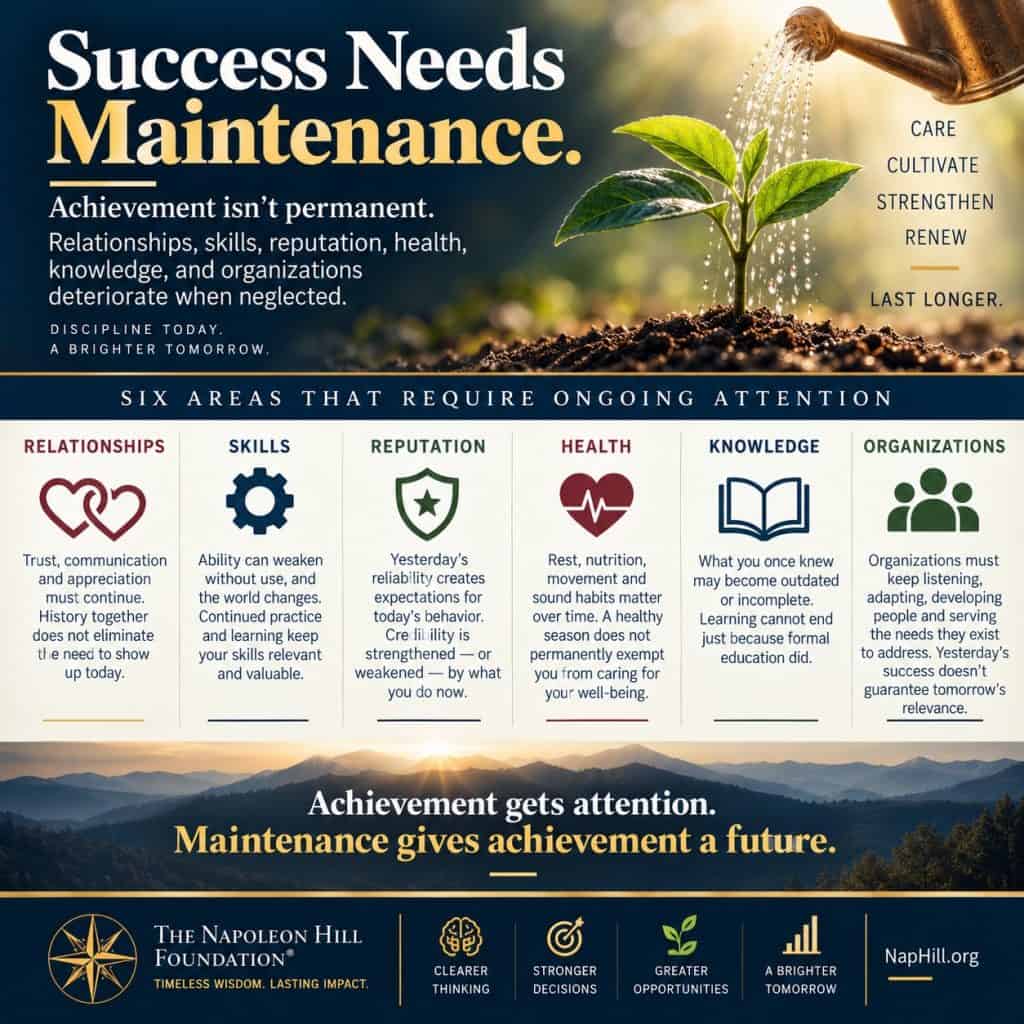
| 01 | Relationships | Trust, attention, appreciation, communication, and shared experience must continue. History together does not eliminate the need to show up today. |
| 02 | Skills | Ability can weaken without use, while tools and expectations change. Experience remains valuable, but experience combined with continued practice is far more useful. |
| 03 | Reputation | Yesterday’s reliability creates expectations for today’s behavior. Credibility is strengthened—or weakened—by what happens after people begin trusting you. |
| 04 | Health | Rest, movement, nutrition, appropriate medical care, stress management, and other sound habits matter over time. A healthy period of life does not permanently exempt us from caring for ourselves. |
| 05 | Knowledge | What you once knew may remain true, become incomplete, or be replaced by better information. Learning cannot end merely because formal education did. |
| 06 | Organizations | Organizations must keep listening, learning, communicating, serving, developing people, and examining whether their work still meets the needs they exist to address |
Neglect is rarely dramatic at first.
That is precisely why it is so easy to tolerate.
The relationship does not collapse after one missed call. Expertise does not disappear after one month without study. An organization does not become outdated after one missed opportunity to adapt. Health does not usually change because of one imperfect day. Deterioration often works through accumulation. Small omissions become patterns. Patterns become conditions. Eventually we are forced to repair something that would have been easier to maintain.
.
Success was never meant to become an excuse to stop practicing the principles that helped create it.
Napoleon Hill’s philosophy repeatedly emphasizes habits, continued learning, self-discipline, personal initiative, accurate thinking, harmonious relationships, and purposeful action. One of the principles is explicitly titled Maintenance of Sound Health—not merely achieve it.
That single word—maintain—contains an important lesson.
Success principles are not emergency tools that we use until life improves and then place back on a shelf. Their value comes through continued application. The discipline that helped create an accomplishment may also be necessary to preserve it.
The Success Maintenance Check
What have you built that
now needs attention?
01. What important part of my life is currently working well?
02. What habits or actions helped make it strong?
03. Have I stopped doing any of those things because I assume the result is now secure?
04. Where can I see an early sign of neglect—not a crisis, but a warning?
05. What small act of maintenance would be easier today than a major repair later?
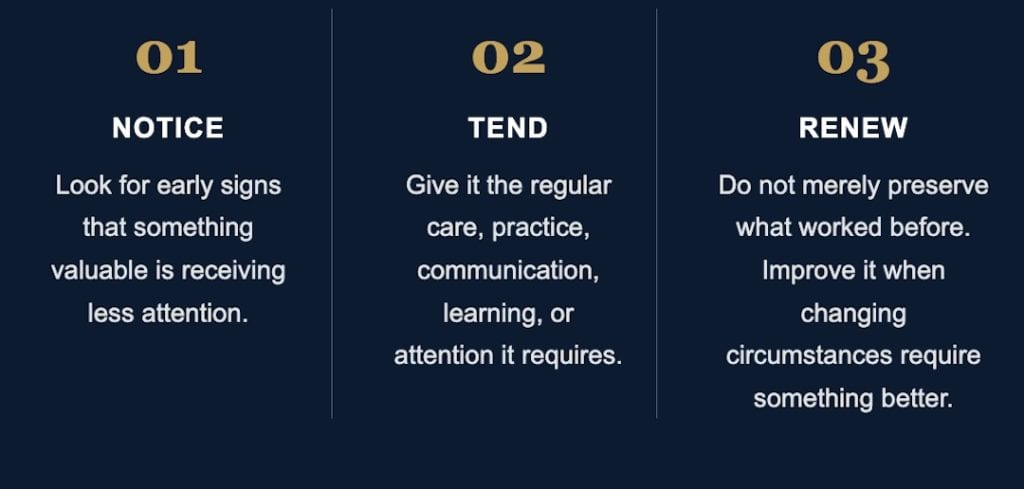
Today’s Practice
Maintain Something Before You Have to Repair It.
Choose one thing that is currently going well—a relationship, skill, responsibility, aspect of your health, area of knowledge, or part of an organization you help lead.
Do one small thing today that helps keep it strong. Make the call. Practice the skill. Read the update. Express the appreciation. Schedule the checkup. Review the process. Ask the question. Fix the small problem.
There is wisdom in knowing how to build. There is another kind of wisdom in knowing how to preserve, strengthen, and renew what has already been built.
Do not wait for distance before tending a relationship. Do not wait for obsolescence before learning. Do not wait for lost trust before protecting your reputation. Do not wait for dysfunction before examining an organization. And where possible, do not wait for a health crisis before giving your well-being appropriate attention.
Achievement gets attention.
Maintenance gives achievement a future.

Napoleon Hill’s Guide to Achieving Your Goals:
The Four Proven Principles of Success
Benefit from the enduring insights of one of the most influential self-help authors, Napoleon Hill. His philosophies have empowered countless individuals to take control of their lives and turn dreams into reality.
In Napoleon Hill’s Guide to Achieving Your Goals discover the four cornerstone principles for success that Hill has identified through decades of research. Learn how to incorporate these principles into your own life to unlock your full potential.
Featuring an introduction from the CEO of the Napoleon Hill Foundation, Don Green, this never-before-published book offers tangible, easy-to-implement strategies for setting goals and overcoming obstacles. It’s not just about theory; it’s a practical guide that translates Hill’s philosophies into actionable steps. The book includes beautifully designed quotes to remember and discussion questions for personal use or group study.
Even decades after its conception, Hill’s wisdom stands true and continues to offer value in our contemporary world. It’s a testament to the timeless relevance of Hill’s work. Reading this book will not only provide guidance and strategies for success but also ignite the motivation you need to get started and keep going. The inspiring words of Hill can push you to never give up on your dreams, regardless of the challenges you face.

2 responses to “Success Needs Maintenance.”
Thank you for the reminder to put some loving attention and Care into our important relationships and projects. If we are not growing, we are dying.
Thank You Beloved….