
The Hidden Cost of
Unfinished Decisions
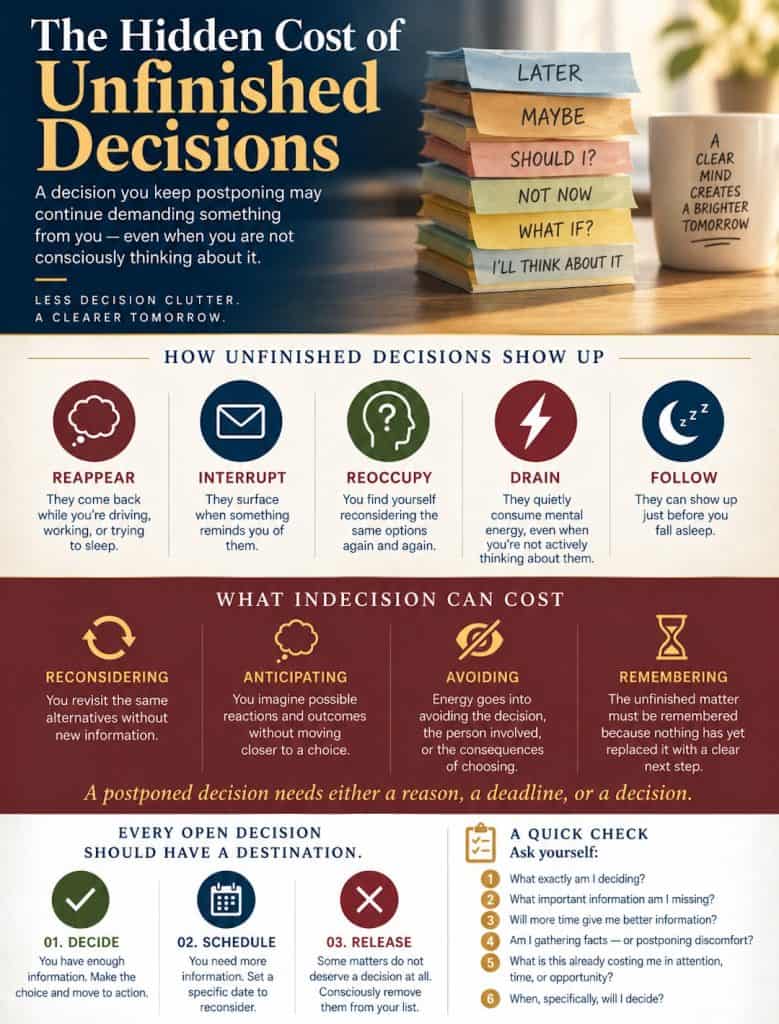
A decision you keep postponing may continue demanding something from you—even when you are not consciously thinking about it..
Not deciding can feel like postponing a problem. Sometimes it merely postpones the decision while allowing the problem to keep occupying space.
| Decision Still Open | Attention Still Returning | Energy Still Being Spent |
.
The Decision You Haven’t Made
Some unfinished business
follows us around quietly.
You need to decide whether to accept an opportunity. You have been meaning to have a difficult conversation. A repair needs to be scheduled. An application sits unfinished. You know you need to choose between two approaches at work. A financial decision has been waiting for weeks. You are not thinking about these things every minute. Yet they have a curious way of returning.
They surface while you are driving. They interrupt another task. They reappear when someone mentions a related subject. You remember them just before falling asleep. You see an email and think, I still need to deal with that. The decision may have been removed from today’s schedule, but it has not necessarily been removed from your mental workload.
Every time an unfinished decision returns to mind, you may have to reconsider something you could have already resolved.
Psychologists have long studied our tendency to remember or return mentally to unfinished tasks. The details are more complicated than the popular claim that every unfinished task constantly occupies the brain, but everyday experience reveals something useful: unresolved matters can repeatedly capture our attention because they still require something from us. A completed decision changes the question from “What am I going to do?” to “What do I do next?”
That difference can be surprisingly freeing.
What Indecision Can Cost
The price of postponement is not always visible.
When we think about the cost of delaying a decision, we usually think about the obvious consequences: a missed deadline, a lost opportunity, a late fee, an unanswered message, or someone else making the choice for us. But there can be another cost—the repeated attention required to keep encountering the same unresolved question.
| Reconsidering | You repeatedly revisit the same alternatives without adding meaningful new information. |
| Anticipating | You spend time imagining possible reactions and outcomes without moving closer to a choice. |
| Avoiding | Energy goes into avoiding the decision, the person involved, or the consequences of choosing. |
| Remembering | The unfinished matter must repeatedly be remembered because nothing has yet replaced it with a clear next step. |
his does not mean every decision should be made immediately. Some decisions deserve research. Others require advice, reflection, additional facts, or simply enough time for emotions to settle. Waiting for information is different from avoiding a decision. If you know what you are waiting for and when you will reconsider the issue, you have created a process. If you are simply telling yourself, “I’ll deal with it later,” the decision remains open without a boundary.
A postponed decision needs either a reason,
a deadline, or a decision.
Decision becomes meaningful
when thought turns into direction.
Napoleon Hill placed considerable emphasis on the ability to reach decisions. In his teaching on Definiteness of Purpose, successful people are described as making decisions promptly once the necessary facts are available and then holding firmly to those decisions rather than continually drifting between alternatives. The important qualification is once the facts are available.
Decisiveness is not recklessness. Accurate thinking still matters. A person who chooses before obtaining essential information may simply be acting impulsively. But gathering the same information repeatedly because we are afraid to commit is something different. There comes a point when more thinking is no longer producing better thinking. At that point, the discipline is to decide.
.
The Unfinished Decision Check
Choose one decision you
keep carrying around and ask:
- What exactly am I deciding?
- What important information am I genuinely missing?
- Will more time realistically give me better information?
- Am I gathering facts—or postponing discomfort?
- What is this unfinished decision already costing me in attention, time, or opportunity?
- When, specifically, will I decide?
.
Every open decision should
eventually have a destination.
| 01 | DECIDE You have enough information. Make the choice and move to action. |
| 02 | SCHEDULE You genuinely need more information. Identify what is missing and set a specific date to reconsider. |
| 03 | RELEASE Some matters do not deserve a decision at all. Consciously remove them from your list instead of repeatedly reconsidering them |
Today’s Practice
Close One Open Decision
Think of one decision that has returned to your mind several times during the past week. If you already have the information you need, make the best decision you can with what you know today. If important information is genuinely missing, write down exactly what you need and set a date for making the decision. Then notice what happens when “I still need to decide” becomes “I know what happens next.”
Not every decision will be comfortable. Not every decision will prove perfect. And sometimes new facts will give you a legitimate reason to revise a choice later. The goal is not to become someone who decides hastily. It is to become someone who recognizes when thoughtful consideration has quietly turned into indefinite postponement. There may be something on your mind today that does not need another week of thinking.
Make the decision.
Schedule the decision.
Or release the decision.

Napoleon Hill’s Guide to Achieving Your Goals:
The Four Proven Principles of Success
Benefit from the enduring insights of one of the most influential self-help authors, Napoleon Hill. His philosophies have empowered countless individuals to take control of their lives and turn dreams into reality.
In Napoleon Hill’s Guide to Achieving Your Goals discover the four cornerstone principles for success that Hill has identified through decades of research. Learn how to incorporate these principles into your own life to unlock your full potential.
Featuring an introduction from the CEO of the Napoleon Hill Foundation, Don Green, this never-before-published book offers tangible, easy-to-implement strategies for setting goals and overcoming obstacles. It’s not just about theory; it’s a practical guide that translates Hill’s philosophies into actionable steps. The book includes beautifully designed quotes to remember and discussion questions for personal use or group study.
Even decades after its conception, Hill’s wisdom stands true and continues to offer value in our contemporary world. It’s a testament to the timeless relevance of Hill’s work. Reading this book will not only provide guidance and strategies for success but also ignite the motivation you need to get started and keep going. The inspiring words of Hill can push you to never give up on your dreams, regardless of the challenges you face.
