
Thought for the Day / Modern Living
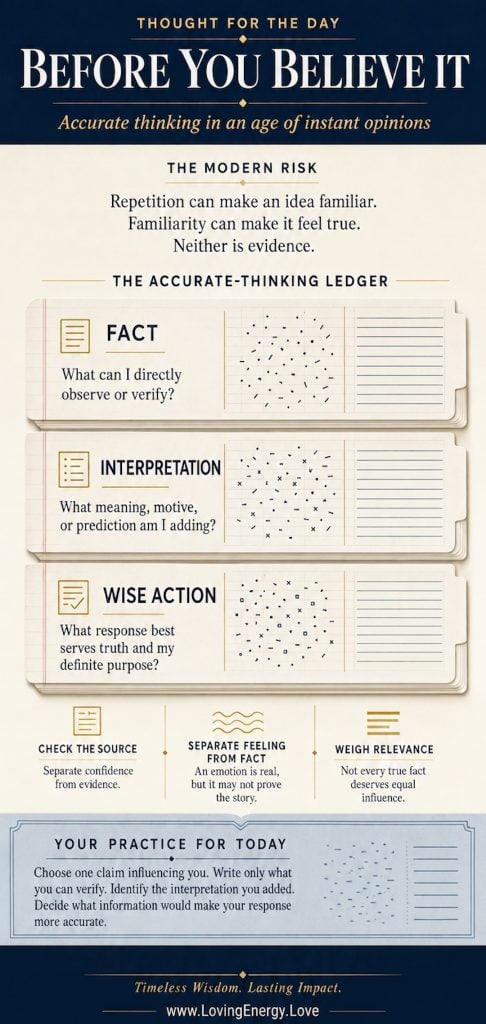
Before You Believe It

Modern life rewards speed. News reaches us instantly. Opinions form within minutes. A headline, a short video, or a confident voice can create the feeling that we understand a situation before we have examined it. The result is not merely misinformation. It is hurried judgment—and hurried judgment can shape decisions, relationships, and reputations.
Napoleon Hill identified Accurate Thinking as one of the essential principles of achievement. Its purpose is not to make us suspicious of everything or detached from human feeling. It is to help us separate facts from opinions, relevant information from distraction, and evidence from the stories we add to it.
Accurate thinking is the discipline of giving truth enough time to become visible. In modern living, that pause may be one of the most practical forms of self-leadership
The Modern Risk
Repetition can make an idea familiar. Familiarity can make it feel true. Neither is evidence.
Information is not the same as truth.
nformation becomes useful only after we consider its source, its evidence, and its relevance. A claim may be confidently expressed and widely repeated while still resting on assumption. Accurate thinkers ask where the information originated, whether it can be independently confirmed, and what important context may be missing.
This does not require endless research before every small decision. It requires proportion. The greater the consequence, the stronger the evidence should be.
Emotional Accuracy
Separate the feeling from the fact.
Feelings are real experiences, but they are not always reliable evidence about another person’s motives or the meaning of an event. “I feel overlooked” describes an emotional truth. “They intentionally excluded me” is an interpretation that may or may not be factual.
Accurate thinking allows both honesty and restraint. We can acknowledge the emotion without allowing it to complete the story. That distinction protects relationships from accusations, protects decisions from fear, and gives curiosity room to replace certainty.
A Useful Distinction
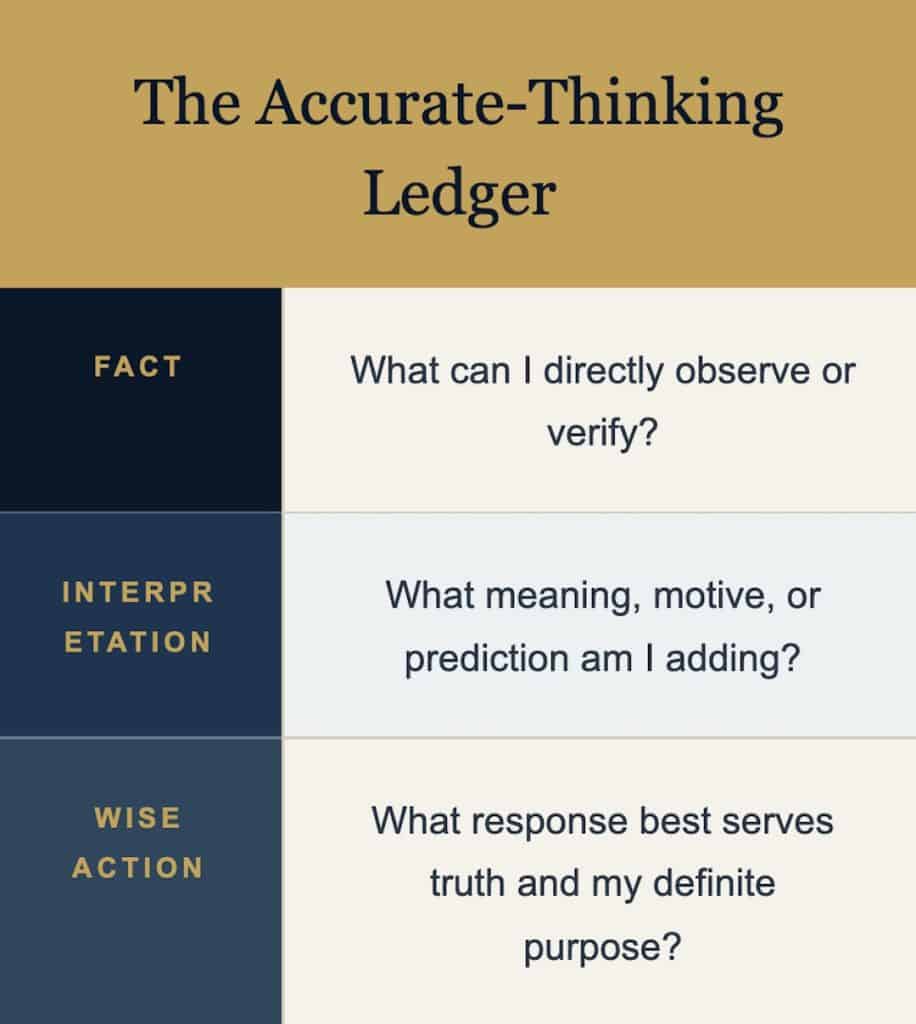
A fact describes what happened. An interpretation explains what we believe it means.
Not every true fact deserves equal weight.
Hill’s principle also asks us to distinguish important facts from unimportant ones. A detail can be accurate and still have little bearing on the decision before us. Modern information systems often elevate what is surprising, emotional, or recent rather than what is relevant.
Purpose helps assign proper weight. Ask whether the information materially changes the decision, whether it is within your influence, and whether it will still matter after the emotion of the moment passes.
Seek challenge, not merely agreement.
independent thinking does not require isolation. A strong Master Mind alliance improves judgment by bringing different knowledge, experience, and perspective to the same question. Its value disappears when every member is expected to agree.
Invite thoughtful disagreement. Ask what evidence would change your mind. Listen for information, not merely confirmation. Intellectual independence is the ability to learn from others without surrendering responsibility for the conclusion.
Your Practice for Today
Choose one claim, concern, or assumption influencing you today. Write down only what you can verify. Then identify the interpretation you have added. Before acting, decide what additional information would make your response more accurate, fair, and useful.
A Thought to Carry Forward
Clear thinking does not remove uncertainty. It keeps uncertainty from making the decision for you.

Napoleon Hill’s Guide to Achieving Your Goals: The Four Proven Principles of Success
From the author of the timeless classic Think and Grow Rich comes this transformative guide that unveils four key principles of success, with practical steps on how to achieve your dreams.
Benefit from the enduring insights of one of the most influential self-help authors, Napoleon Hill. His philosophies have empowered countless individuals to take control of their lives and turn dreams into reality.
In Napoleon Hill’s Guide to Achieving Your Goals discover the four cornerstone principles for success that Hill has identified through decades of research. Learn how to incorporate these principles into your own life to unlock your full potential.
This never-before-published book offers tangible, easy-to-implement strategies for setting goals and overcoming obstacles. It’s not just about theory; it’s a practical guide that translates Hill’s philosophies into actionable steps. The book includes beautifully designed quotes to remember and discussion questions for personal use or group study.
Even decades after its conception, Hill’s wisdom stands true and continues to offer value in our contemporary world. It’s a testament to the timeless relevance of Hill’s work. Reading this book will not only provide guidance and strategies for success but also ignite the motivation you need to get started and keep going. The inspiring words of Hill can push you to never give up on your dreams, regardless of the challenges you face.
