
.
Borrowed
Ambition
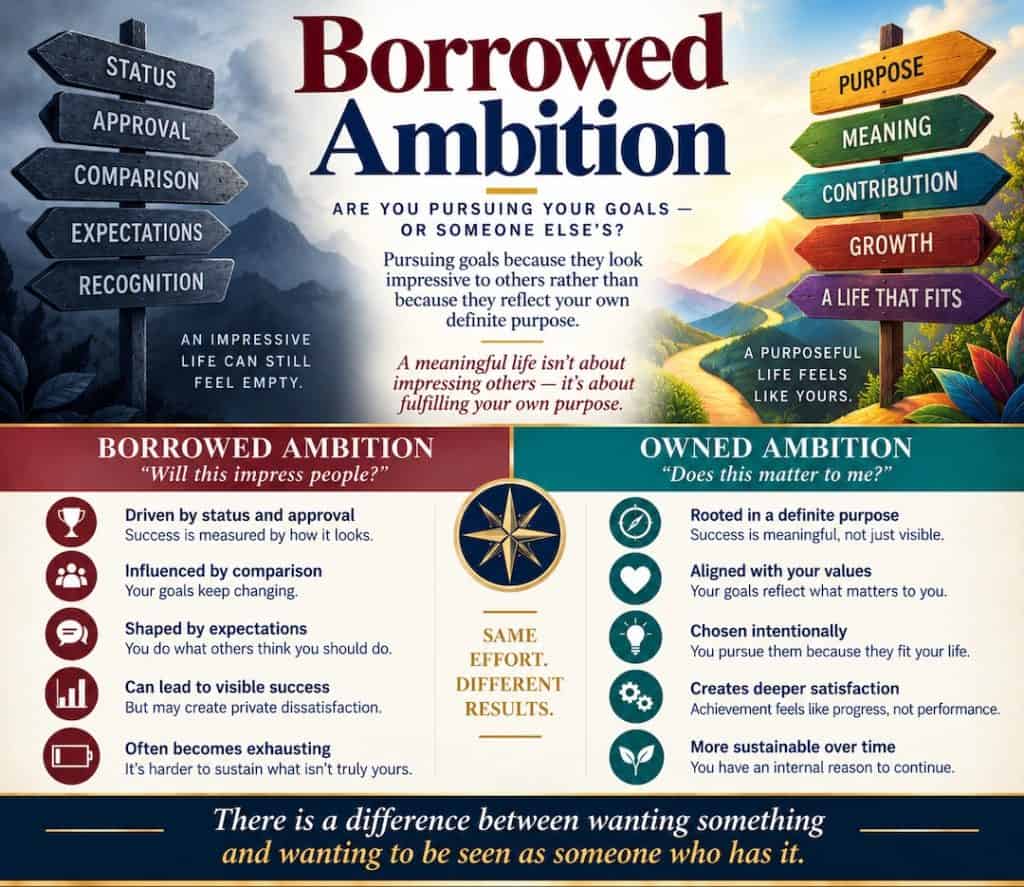
Pursuing goals because they look impressive to others rather than because they reflect your own definite purpose.
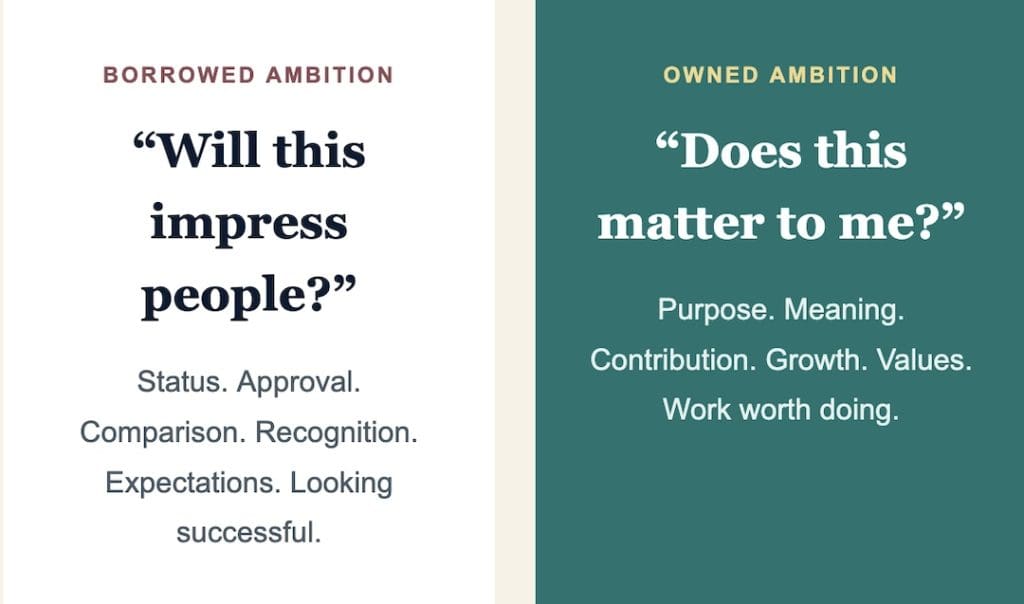
A goal can be impressive, difficult, and socially admired—and still be the wrong goal for you.
How Ambition Gets Borrowed
Sometimes we inherit goals
before we ever examine them.
From an early age, we receive messages about what success is supposed to look like. A certain career is respectable. A particular title proves you have arrived. More money is automatically better. A larger home means progress. Leadership means moving upward. Retirement should look a certain way. Success should be visible enough that other people can recognize it immediately. Some of those goals may genuinely fit us. Others may have entered our lives through family expectations, workplace culture, social comparison, advertising, tradition, or the desire to be admired. The difficulty is that borrowed ambition can feel very much like personal ambition.
You can work extremely hard toward a goal you never consciously chose.
You may study for the degree because it sounds impressive. Pursue the promotion because everyone assumes that is the next step. Build a business larger than you actually want because growth is what successful businesses are expected to do. Accept responsibilities that increase status while quietly removing you from the work you once enjoyed. None of these choices is automatically wrong. The question is whether the goal was examined before it became a commitment.
There is a difference between wanting something and wanting to be seen as someone who has it.
When the Goal Does Not Belong to You
Achievement cannot fully satisfy a purpose
it was never meant to serve.
Borrowed ambition has a strange quality: it can produce visible success while creating private dissatisfaction. You reach the milestone and feel less than you expected. Other people congratulate you, but the accomplishment does not create the sense of meaning you imagined. You immediately search for the next achievement because the last one never answered the deeper question.
| Comparison | Your goals keep changing because someone else’s life keeps giving you a new standard to chase. |
| Performance | You begin designing your life for how it appears rather than how well it actually works. |
| Exhaustion | Effort becomes harder to sustain when the goal provides little internal reason to continue. |
| Arrival | You finally get what you were pursuing and discover that the achievement answered someone else’s definition of success. |
This does not mean every goal must feel exciting every day. A meaningful purpose can require sacrifice, discipline, boring work, delayed gratification, and responsibilities we would not choose for entertainment. The difference lies deeper. When the purpose is genuinely yours, difficulty can still feel connected to something worthwhile. When the ambition is borrowed, difficulty may increasingly feel like payment for a life you do not actually want.
Do not confuse admiration for someone else’s path with evidence that it should become yours.
Definiteness requires more than choosing a goal. It requires knowing whose goal you are choosing.
Napoleon Hill placed Definiteness of Purpose at the foundation of achievement. Hill’s teachings repeatedly ask the individual to identify a definite major purpose and then direct thought, effort, imagination, and action toward it. That emphasis assumes something important: purpose must be chosen deliberately.
The goal is not merely to become highly disciplined at pursuing whatever society happens to reward. Discipline is far more useful when it is connected to something that reflects your values, abilities, responsibilities, contribution, and genuine aspirations.
.
Choose one major goal and ask:
- If no one else knew I achieved this, would I still want it?
- When did I first decide this goal mattered to me?
- Is the goal connected to my own values and purpose—or primarily to status, comparison, or approval?
- What will achieving it actually change in my daily life?
- Would I choose this path again if I were starting today?
- If this goal is not truly mine, what might I pursue instead?
.
Today’s Practice
Remove the Audience for Five Minutes.
Imagine for a moment that no one can see your title, salary, possessions, awards, followers, résumé, degree, or achievements.
Now ask yourself what kind of work, contribution, relationships, learning, and life would still feel worthwhile.
You may discover that many of your current goals still matter deeply. If so, pursue them with greater confidence. If one begins to look different without an audience, pay attention to that information.
The purpose of success is not to build a life that looks convincing from the outside.
It is to build one you have a reason to live from the inside.
.
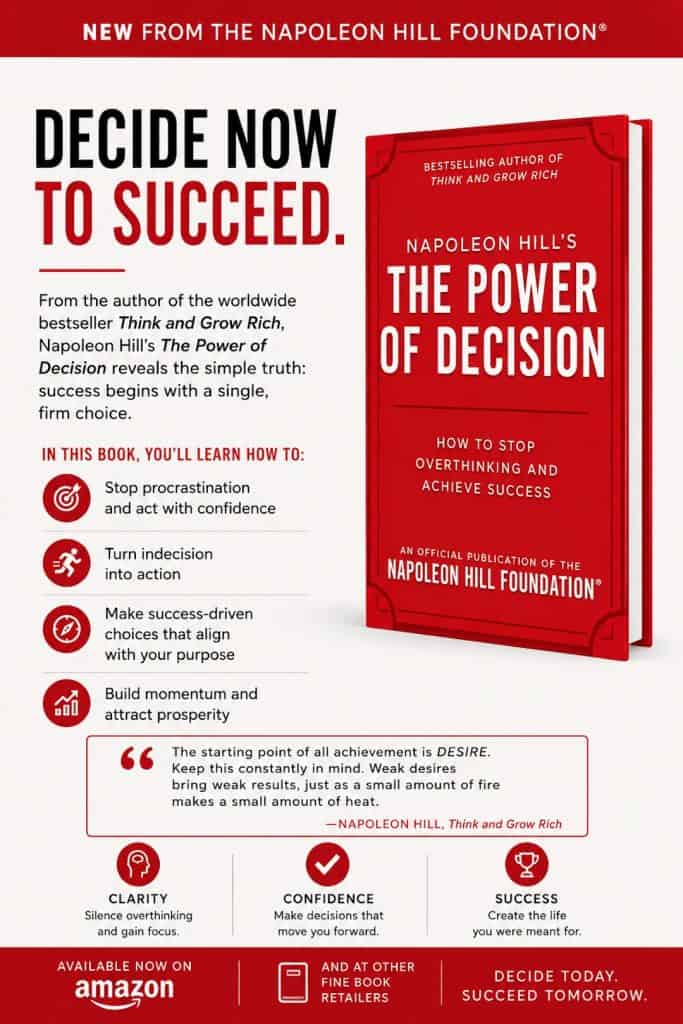
Napoleon Hill’s The Power of Decision: How to Stop Overthinking and Achieve Success
From the author of the worldwide bestseller Think and Grow Rich, Napoleon Hill’s Power of Decision reveals the simple truth: success begins with a single, firm choice. In this newly released compilation, The Napoleon Hill Foundation brings back Hill’s essential guide to overcoming doubt, banishing hesitation, and replacing overthinking with decisive action.
Packed with wisdom and practical steps, Hill shows you how to:
- Stop procrastination and act with confidence
- Turn indecision into action
- Make success-driven choices that align with your purpose
- Build momentum and attract prosperity
When you’re chasing personal goals, business success, or a more fulfilling life, The Power of Decision is your roadmap and motivation to clarity and achievement.
Decide today. Succeed tomorrow.

5 responses to “Borrowed Ambition”
I had never heard the term “borrowed ambition” before, yet knew exactly what it was before reading the entirety of this blog.
I recognized it from past versions of myself that fell into the trap of confusing my own dreams and goals with ones rooted in definitions of success that were not mine.
I exhausted myself “trying” to achieve something that wasn’t aligned. I betrayed myself “trying” to do what I thought I needed to do, or be who I thought I needed to be. Staying in relationships approved of by others knowing they weren’t right for me and conforming to timeline expectations of what milestones I should be hitting by what age. I was constantly seeking approval, people pleasing to be “nice” and liked over honest, authentic and real.
I got so good at performing success that I forgot my own definition of it.
Those versions of me are dead. I now live in alignment and coherence, and walk my own path. I trust myself to make aligned choices and to take aligned actions when the timing is right for me.
Asking myself the 6 questions was valuable. #1. If no one else knew that I achieved this goal, would I still want it?
YES!
Thank you Lindsay 🙏
Same here Lindsay, if no one knew I achieved this goal I would still want it! 🙌
The question then becomes what more do I want? If we’re not growing we’re dying.
Thank you Esther 🙏
Thank you Jojan.🙏