
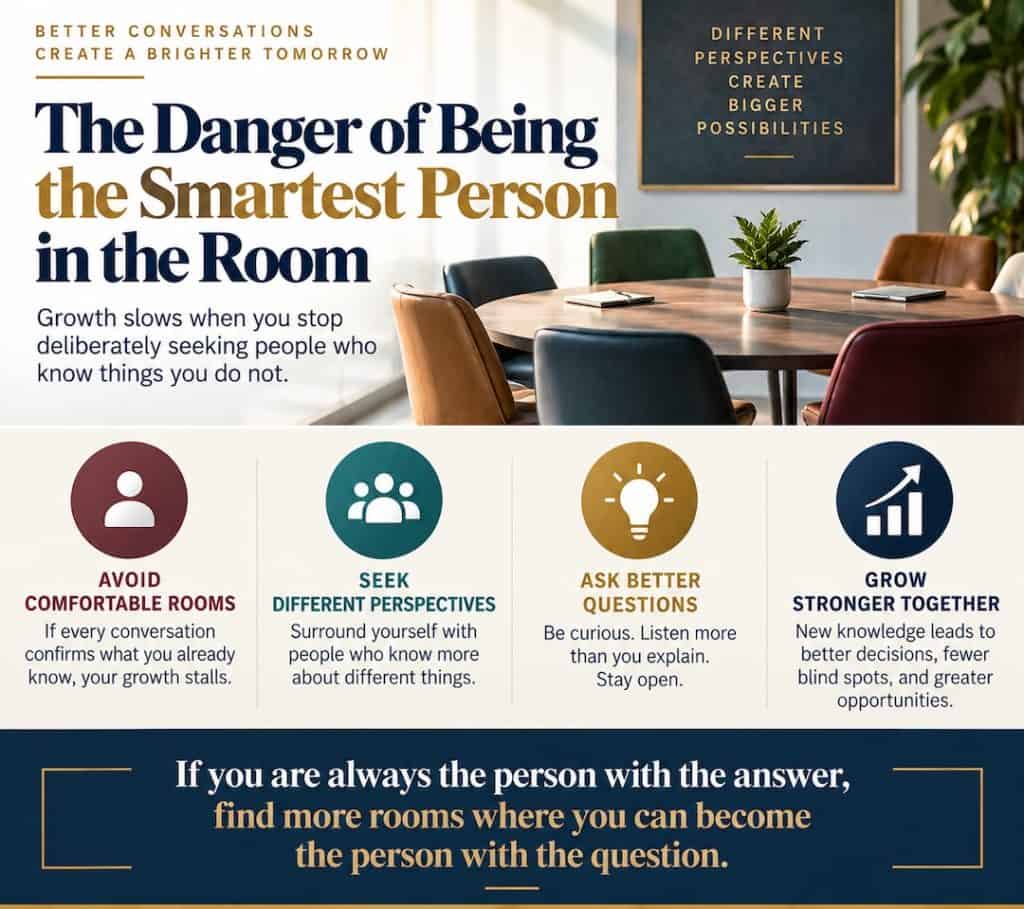
The Danger of Being the
Smartest Person in the Room
Growth slows when you stop deliberately
seeking people who know things you do not.
If every conversation confirms what you already know, your environment may be protecting your confidence more than expanding your thinking.
When Expertise Becomes Comfortable
Being knowledgeable is valuable. Needing to be the most knowledgeable person present can become expensive.
There is nothing wrong with becoming highly skilled. Experience matters. Judgment earned through years of work can save time, prevent mistakes, and help other people move forward faster. But expertise creates a subtle temptation.
Once people routinely come to you for answers, it can become comfortable to remain in environments where you are the one teaching, advising, correcting, and explaining. You become accustomed to knowing more than the people around you. That can feel like success. But there is a difference between being respected for what you know and continuing to place yourself where you can learn what you do not know.
Expertise should increase your capacity to learn—not eliminate your need to.
The danger appears when competence slowly becomes insulation. You stop asking basic questions because you feel you should already know the answer. You spend less time around beginners because their questions feel elementary. You avoid specialists in unfamiliar fields because being inexperienced is uncomfortable. You begin choosing conversations where your expertise is confirmed rather than challenged. Eventually, the room becomes very comfortable.
Comfort, however, is not always evidence that you are still growing.
Expand the Room
Your knowledge becomes more useful when it meets knowledge you do not possess.
No matter how accomplished a person becomes, entire worlds of knowledge remain outside that person’s experience. A physician may know medicine and understand little about logistics. An engineer may understand systems and know very little about human behavior. A veteran executive may know an industry deeply while a younger employee understands a new technology the executive has barely encountered. Education does not eliminate these gaps. Experience does not eliminate them. Age does not eliminate them. They are part of being human.
| What You Know | Your experience, education, judgment, skills, patterns, and lessons earned through practice. |
| What Others Know | Different industries, cultures, technologies, experiences, disciplines, methods, and ways of seeing a problem. |
| What Becomes Possible | Better questions, fewer blind spots, stronger decisions, new combinations of ideas, and solutions none of you may have reached alone. |
This does not mean automatically accepting the opinion of someone who knows more about one subject. Expertise should still be examined. Accurate Thinking still matters. Nor does it mean surrounding yourself only with people who are more accomplished than you. Sometimes the person who expands your thinking is not more successful. They simply know something different.
The goal is not to find people who make you feel less intelligent. It is to find people whose knowledge makes your own thinking larger.
The Mastermind principle begins with an admission: one mind does not contain everything you need.
Napoleon Hill devoted an entire principle of his philosophy to the Mastermind Alliance. At its core is a practical recognition: meaningful achievement often requires access to knowledge, experience, judgment, ability, and perspective beyond what one person possesses individually.
Hill’s philosophy identifies establishing a Mastermind Alliance as one of the core success principles. That makes the principle an important counterweight to intellectual self-sufficiency: The purpose of collaboration is not merely to have more people around a table, but to increase the useful knowledge and thinking available to the group. This is also why a good Mastermind should not become an agreement club. If everyone thinks alike, has the same experience, notices the same risks, and protects the same assumptions, additional people may add very little additional thinking.
.
Look at the people you learn
from most often and ask:
- Who regularly teaches me something I did not already know?
- Who understands a field, technology, culture, or experience that I do not?
- Who is willing to challenge my assumptions rather than simply confirm them?
- Where have I stopped asking questions because I am accustomed to being the expert?
- Whose perspective would make the next important decision stronger?
.
Today’s Practice
Ask Someone to Teach You Something.
Choose someone whose experience differs meaningfully from your own. Instead of explaining what you know, ask what they see that you may be missing. Ask how they would approach a problem. Ask what people in their field understand that outsiders usually overlook. Ask what has changed recently that you should know about. Then resist the urge to prove how much you already know.
Today’s Practice
Ask Someone to Teach You Something.
Choose someone whose experience differs meaningfully from your own. Instead of explaining what you know, ask what they see that you may be missing. Ask how they would approach a problem. Ask what people in their field understand that outsiders usually overlook. Ask what has changed recently that you should know about. Then resist the urge to prove how much you already know.
If you are always the person with the answer, find more rooms where you can become the person with the question.
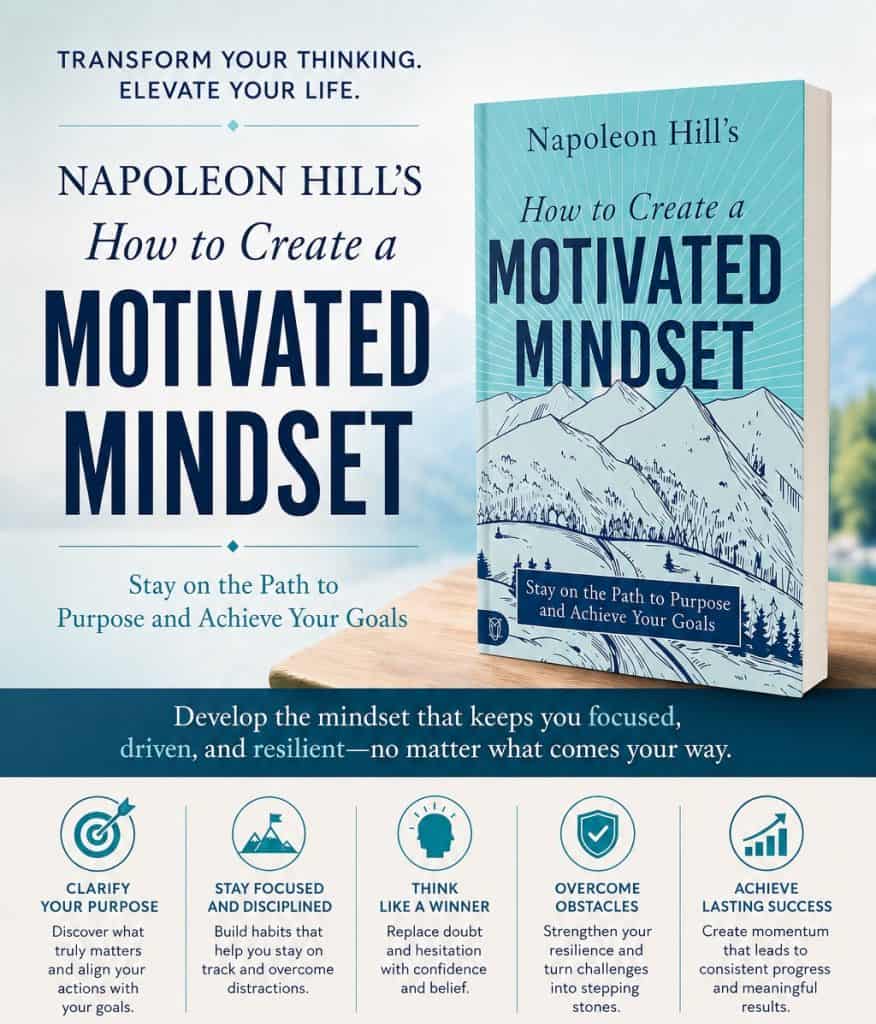
Napoleon Hill’s How to Create a Motivated Mindset: Stay on the Path to Purpose and Achieve Your Goals
In this book, you will learn the secrets to creating a motivated mindset from Napoleon Hill, author of the international bestselling books Think and Grow Rich and Outwitting the Devil.
Like any state of mind, motivation must be cultivated through the repeated expression of thought habits. Discover how you can take control of your mind power and direct it to attain the things you desire in life—all through the application of simple principles and daily practices that condition your mind for success.
Harness the energy of thought to transform motives into burning desires that ignite your enthusiasm, stimulate your imagination, and inspire you to take action daily on your goals. Uncover the keys to:
- Letting go of negative energy and limiting beliefs
- Creating an environment that primes you for success
- Overcoming procrastination and other mental blocks

2 responses to “The Danger of Being the Smartest Person in the Room”
This concept of being surrounded by people who know more about different things than you was also the impetus for Rotary International, successful men in different industries coming together.
There is value in being with people who know more and if you’ve ever been a teacher, you understand there is also value in being with people who know less, because it’s through their questioning, their quest for understanding, that you are prompted to ponder deeply and often come to new cognitions.
This week, I considered this in conversation with my junior teacher. Rather than deciding myself upon a third team challenge for our classes, I asked if he had any ideas. I explained why his first two ideas weren’t in alignment with the criteria (as they were teacher led rather than student focused), and then gave him time to reflect. 15 minutes later, he came back with an idea that fit in perfectly with the other two tasks to that would not have come to my mind.
Also, as experienced as I am, I do acknowledge when I don’t have the answers and consult with other senior teachers.
Grateful for our physical mastermind group and our regular weekly meetings. Reading this reminded me that we have our non physical masterminds that we can consult with and learn from as well. Thank you.
Today my friends 11 year old daughter gave me a gel manicure and I asked her to teach and tell me about her techniques. She was happy to share with me each step of her process and we enjoyed a lovely connection. I remembered that we can learn from everyone.