
The Difference Between Being
Needed and Being Valuable
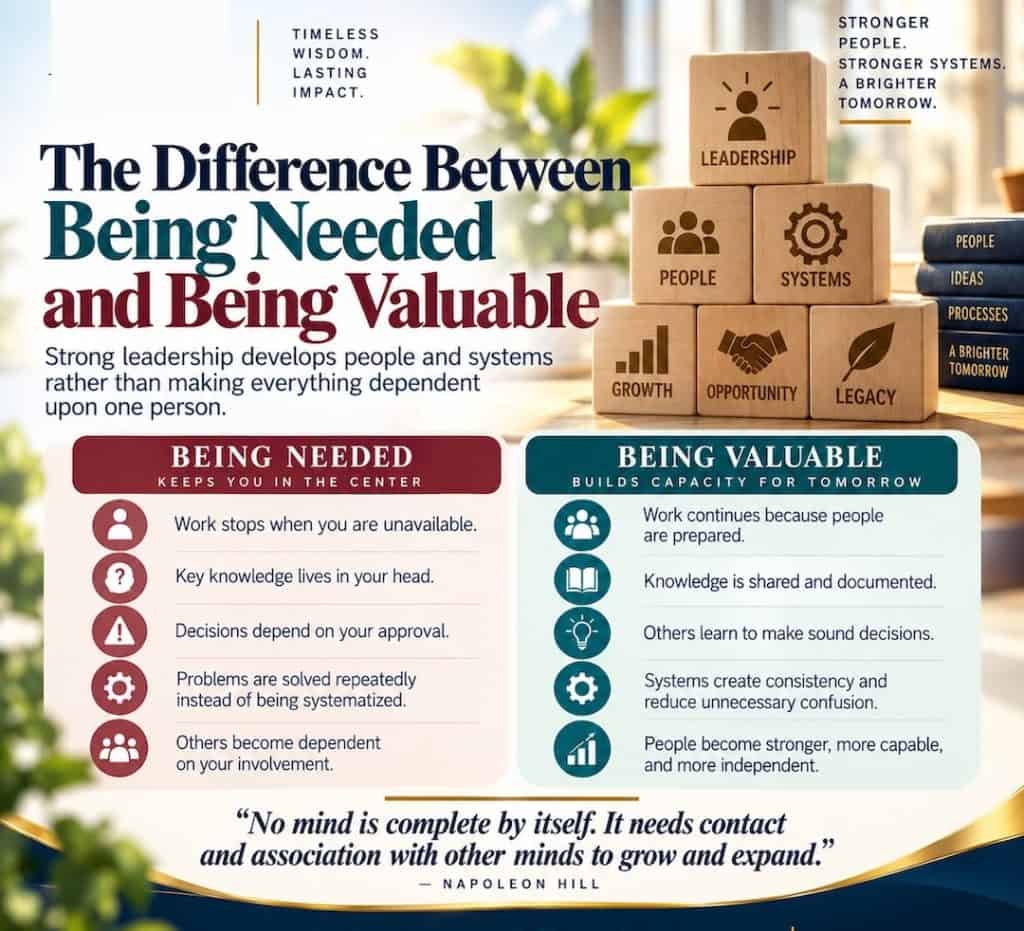
Being indispensable can feel like proof of value. Sometimes it is actually evidence that too much depends on you.
There is a certain satisfaction in being the person everyone needs. You know the process. You have the answer. You can fix the problem. People come to you when something goes wrong because you have proven that you can handle it. That can absolutely reflect competence. But there is a point where being needed for everything stops being a sign of strong leadership and starts becoming a structural weakness.
If the work cannot continue without you, your value may be trapped inside your availability.
The Leadership Test
Does your leadership create more capability—or more dependence?
Weak systems often create heroes. One person remembers every important detail. One person knows where everything is. One person handles the difficult customer. One person approves every decision. One person understands the process well enough to repair it when it breaks. From the outside, that person may look exceptionally valuable. The hidden question is what happens when that person is unavailable.
Being needed solves today’s problem.
Being valuable builds capacity for tomorrow.
A valuable leader does not hoard knowledge simply because expertise creates status. They teach people how to think through problems. They document what matters. They create systems that reduce unnecessary confusion. They build judgment in others rather than requiring every decision to travel upward. This does not mean disappearing from responsibility.
Strong leadership still requires accountability. Some decisions belong with the leader. Some responsibilities cannot simply be handed away. Expertise remains valuable, and certain situations genuinely require the most experienced person in the room. The distinction is whether the leader is constantly increasing the capability around them—or quietly preserving dependence because dependence feels important.
| Knowledge | Do people have access to what they need to know, or does critical information live mostly in one person’s head? |
| Judgment | Are people learning how to make sound decisions, or are they learning to wait until the leader tells them what to do? |
| Systems | Can important work be repeated reliably, or does success depend on someone personally rescuing the process each time? |
| People | Are the people around you becoming more capable because of your leadership—or more dependent upon it? |
One of the strongest signs of leadership is that other people become stronger in your presence.
Achievement grows through cooperation,
not permanent dependence on one person.
Napoleon Hill’s Mastermind principle is built on the idea that useful power increases when people combine knowledge, experience, and effort in harmony toward a definite objective. Hill’s writings describe a Mastermind Alliance as two or more minds working actively together toward a common definite purpose and emphasizes the ability to draw upon the experience, training, and knowledge of others. His Teamwork principle carries the same spirit into everyday cooperation: cooperation is something strengthened by giving it, and meaningful achievement depends on people working together rather than functioning as isolated individuals. Applied to leadership, that suggests an important shift.
The goal is not to become unnecessary.
The goal is to make your contribution larger than your personal presence.
The Leadership Dependence Test
Ask yourself:
• What stops moving when I am unavailable?
• What knowledge do I need to document or teach?
• Which decisions could someone else learn to make well?
• Where am I solving the same problem repeatedly instead of improving the system?
• Who around me is more capable today because I invested in their development?
.
Today’s Practice
Make One Thing Less Dependent on You.
Choose one recurring responsibility, question, or process that unnecessarily depends on your personal involvement. Teach someone how to handle it. Document the process. Clarify the decision rule. Give someone appropriate authority. Improve the system. Then use the capacity you created for work that requires your highest contribution.
Being needed keeps you in the center.
Being valuable helps the whole system become stronger.

Napoleon Hill’s How to Outwit the Six Ghosts of Fear: End Self-Sabotage and Take Control of Your Destiny
Fear is the invisible enemy that robs people of their dreams, decisions, and destiny. In How to Outwit the Six Ghosts of Fear, legendary success thinker Napoleon Hill reveals the six universal fears that haunt our lives—fear of poverty, criticism, ill health, loss of love, old age, and death—and shows you how to defeat them once and for all.
Drawn from Hill’s groundbreaking work Think and Grow Rich, this standalone guide offers timeless wisdom, practical steps, and deep psychological insight into the fear-driven thoughts and habits that sabotage success.
Inside, you’ll discover:
- How indecision and doubt lead to fear—and how to interrupt the cycle
- A detailed analysis of the six most common fears and how they control your actions
- Powerful self-analysis questions to uncover and confront your own limiting beliefs
- How to build immunity to negative influences and reclaim control of your thoughts
- The one thing you do control—your mind—and how it determines your destiny
“The only thing you can control is your mind.” —Napoleon Hill
If you’re ready to conquer fear and unlock the power of your mind, How to Outwit the Six Ghosts of Fear is your ultimate guide to personal power, resilience, and success.
