
Thought for the Day
Moving Beyond the Victim Mindset
Reclaiming Responsibility Without Denying Reality
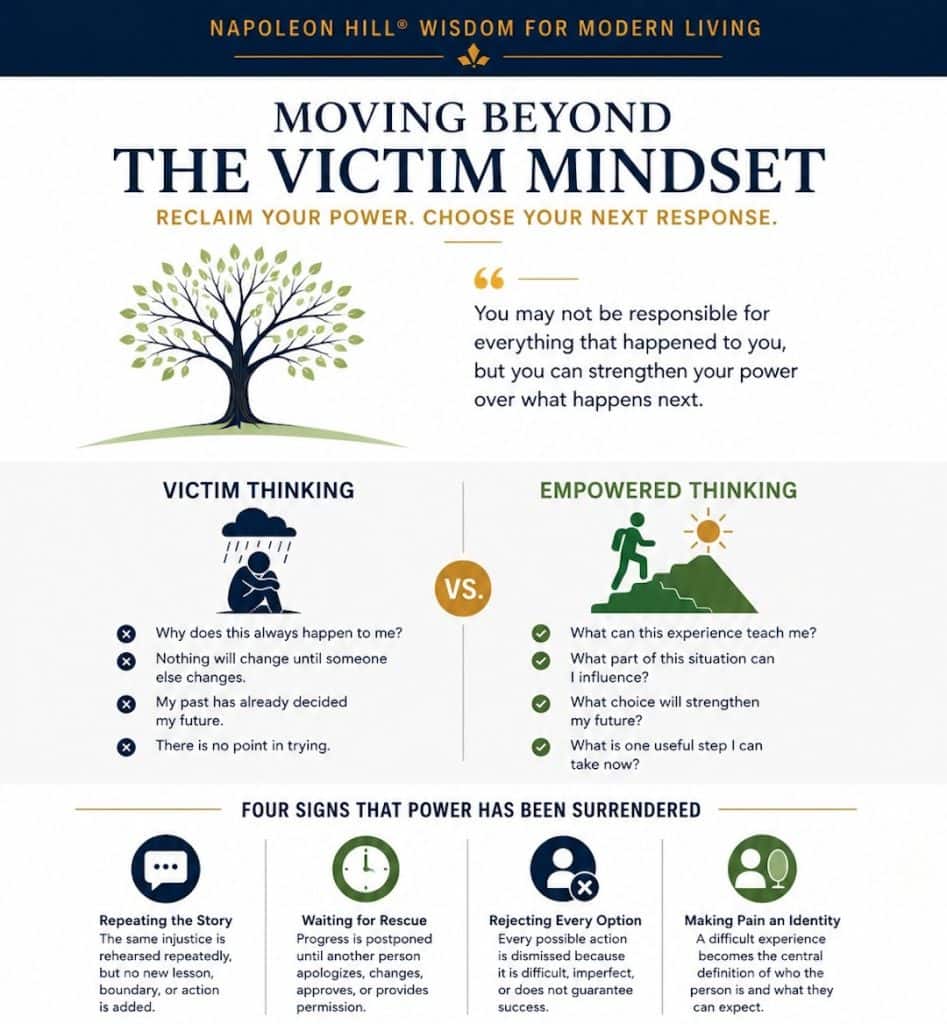
You may not be responsible for everything that happened to you, but you can strengthen your power over what happens next.
Life can place people in genuinely unfair, painful, and difficult circumstances. Some hardships are caused by loss, betrayal, discrimination, illness, economic pressure, or decisions made by others. Recognizing that reality is not weakness, negativity, or a failure of attitude.
The victim mindset begins somewhere else. It develops when a painful experience becomes a permanent explanation for why growth, responsibility, or constructive action are no longer possible.
It is the difference between saying, “This harmed me,” and concluding, “Because this harmed me, I have no remaining influence over my future.”
Personal responsibility is not the
same as personal blame.
Blame asks who caused the problem. Responsibility asks what constructive power remains in your hands now.
Napoleon Hill’s Emphasis on Mental Ownership
Napoleon Hill® repeatedly emphasized definiteness of purpose, self-discipline, personal initiative, accurate thinking, and the ability to direct one’s mental attitude.
His philosophy does not suggest that people control every event. It suggests that surrendering control of thought, interpretation, and response gives adversity more power than the original event already possessed.
A person may be temporarily defeated, disappointed, or limited by circumstances. But Hill’s principles ask that temporary conditions not be accepted as permanent identity.
Victim Thinking vs. Empowered Thinking
- “Why does this always happen to me?”
- “Nothing will change until someone else changes.”
- “My past has already decided my future.
- “There is no point in trying.”
“What can this experience teach me?”
Empowered Thinking
“What can this experience teach me?”
“What part of this situation can I influence?”
“What choice would strengthen my future?”
“What is one useful step I can take now?”
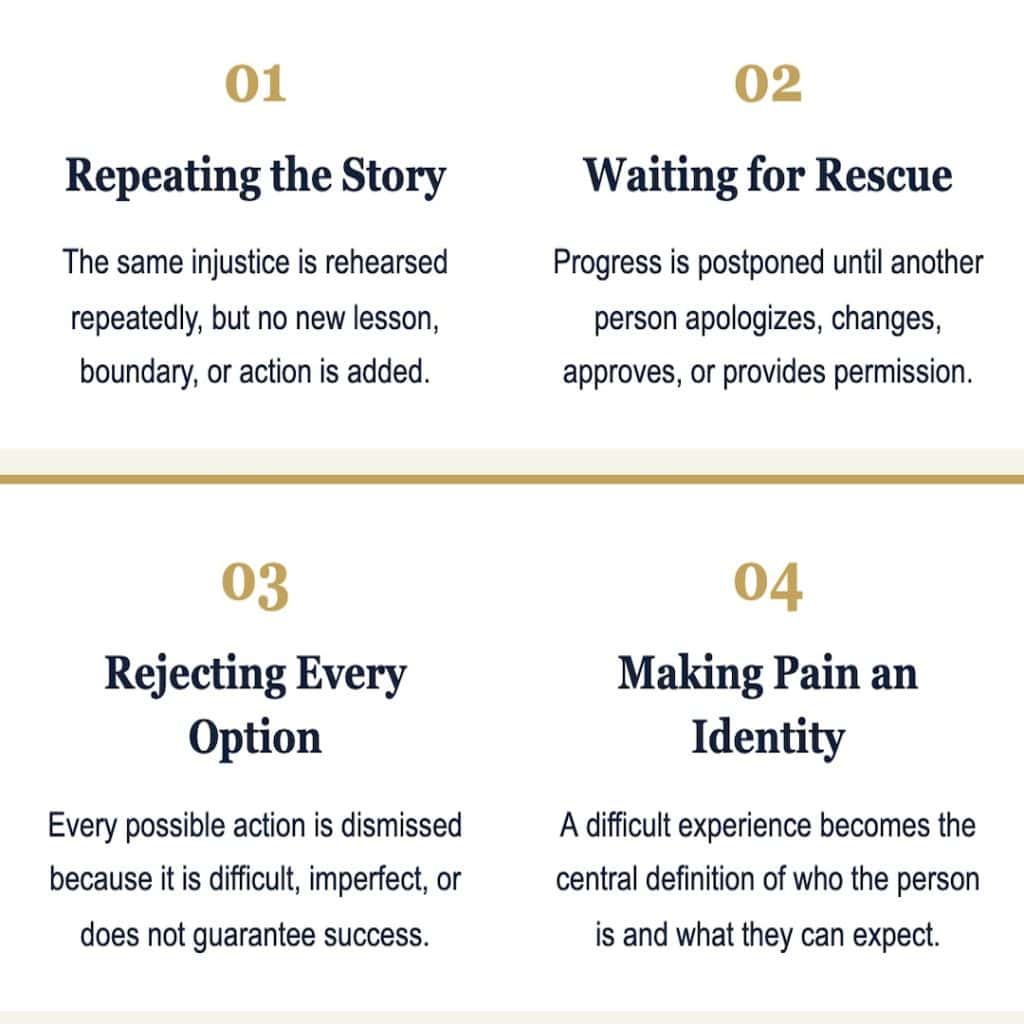
Four Signs That Power Has Been Surrendered
Healing and Agency Can Exist Together
Moving beyond a victim mindset does not require pretending that harm did not occur. It does not mean forgiving before one is ready, remaining in an unsafe environment, or refusing appropriate support.
Seeking counseling, legal guidance, medical care, financial assistance, or the help of trusted allies can be an act of personal initiative. Receiving help is not surrendering responsibility. It is using available resources wisely.
The goal is not to deny pain. It is to prevent pain from becoming the sole author of the future.
The moment you identify one constructive choice, you begin reclaiming power from the circumstances that once defined you
Today, notice where you may be waiting for another person or circumstance to return your power. Their actions may have contributed to the problem, but your future cannot remain permanently dependent upon their willingness to repair it.
Name what happened honestly. Seek help where it is needed. Establish stronger boundaries. Learn the lesson without allowing the event to become your identity.
Then choose one constructive response. It may not change the entire situation today, but it changes your position within it—from passive endurance to deliberate direction.
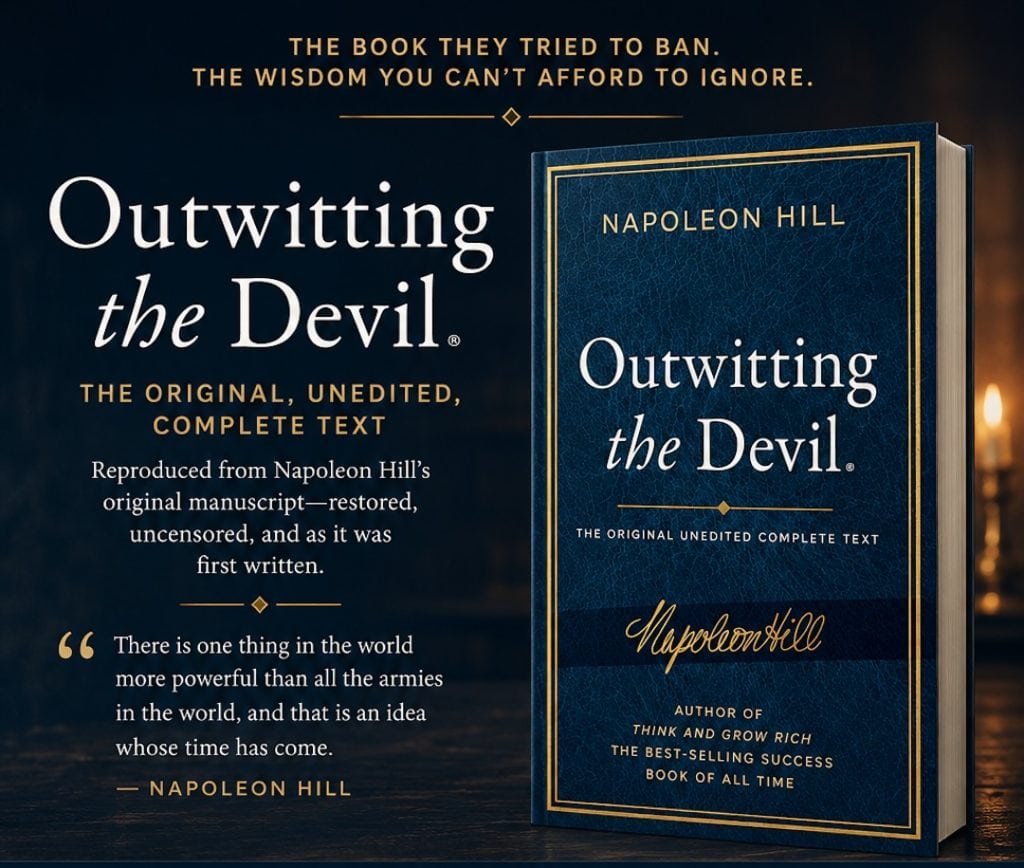
Outwitting the Devil: The Complete Text, Reproduced from Napoleon Hill’s Original Manuscript
Following the success of his 1937 landmark bestseller, Think and Grow Rich, Napoleon Hill wrote Outwitting the Devil, an exposé on the methods the Devil uses to ensnare and control the minds of human beings. Exploring the innermost depths of the psychology of motivation to understand why so many individuals, including himself, cannot find the initiative and courage they need to consistently implement the philosophy of individual achievement, Hill went so far as to interview the Devil himself. The resulting confession from the Devil made this book so controversial as to remain unpublished for over 70 years. Now it is your turn to break the Devil’s code and free yourself from the hidden methods of control that lead to ruin.
In this reproduction of the complete text of Hill’s original manuscript is laid out the exact nature of the power by which the Devil disarms human beings with fear, procrastination, anger, and jealousy so that they do not reach their full potential. This is the same power that paralyzed millions of individuals with fear and despondency during the Great Depression and continues to hold people back from their dreams. Complacency and mediocrity are not the root issue; they are symptoms of deeper ills that we are conditioned by society to accept. But you must open your mind to acquire knowledge and consider facts that might not harmonize with your personal beliefs in order to access a greater truth that will, as Hill said in his original preface, “bring harmony out of chaos in this age of frustration and fear.”
If you have been the victim of lost courage, weakened enthusiasm, and lack of self-discipline—if you are demoralized and plagued by fear, anxiety, overwhelm, or apathy—the seven principles to freedom detailed in this book herald your redemption. You will finally become independent of the causes of failure and misery, break the bonds of destructive habits, and unlock the secret of a natural law as significant as the law of gravity so that you can outwit the devil once and for all.

2 responses to “Moving Beyond the Victim Mindset”
The section describing how healing and agency can co-exist is so powerful. It is a challenging dance.
It brings up for me an observation I’d previously made in witnessing friends or family struggle.
When we’re wronged, especially if attacked or abused, in order to get justice, we are almost forced to be broken. If we do not show how deeply we were impacted by the event or series of events, the guilty party is less likely to be found guilty and face consequences. 6 months or a year after being assaulted, if we were to show up in court with a smile, would we be taken seriously? No? The prosecutor may use our seeming indifference to the event to speculate that it never truly affected us to begin with and maybe even lied about it. If only an act of violence or injustice could be judged for what it is, not for how long a person stays victim to it.
Thank you Keyra 🙏