
The Discipline of Self-Judgment
Seeing Yourself Clearly Before Evaluating Others
Fair judgment begins with the willingness to examine our own assumptions, habits, motives, and performance as honestly as we examine those of others.
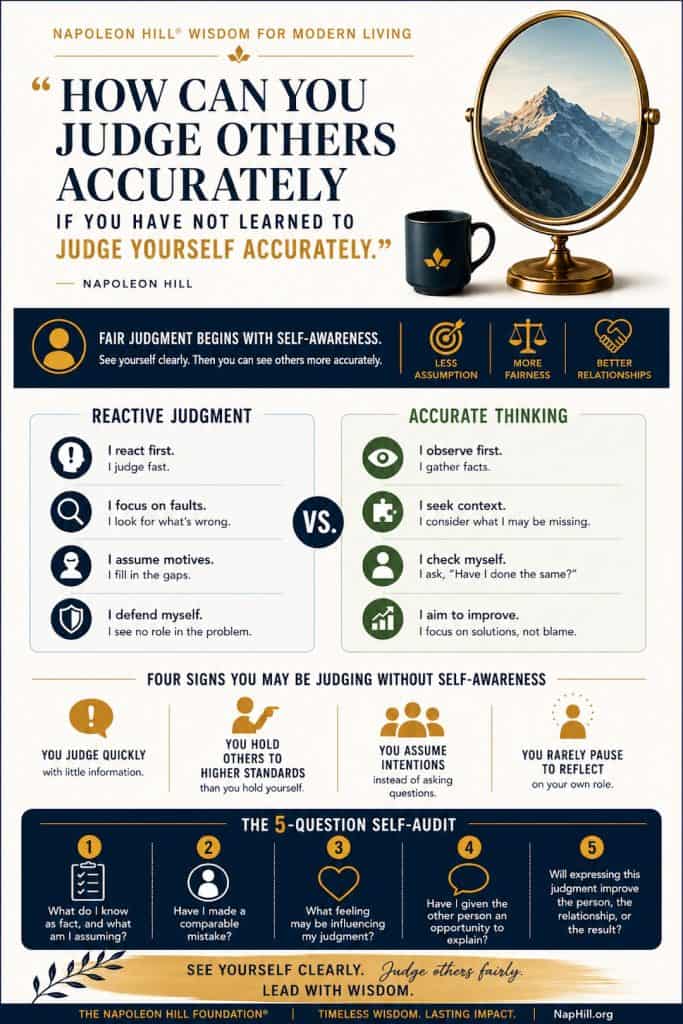
“How can you judge others accurately if you have not learned to judge yourself accurately?”
Napoleon Hill
It has never been easier to form an opinion about another person. A brief video, a single comment, a workplace mistake, or one disagreement can quickly become the basis for a sweeping judgment about someone’s intelligence, character, or intentions.
Yet we rarely evaluate ourselves with the same speed. We explain our own mistakes through context, pressure, fatigue, or incomplete information while interpreting another person’s mistake as evidence of who they are.
Napoleon Hill’s question challenges this imbalance. Before deciding what another person’s behavior means, we must become more accurate observers of our own behavior.
Self-awareness does not weaken judgment. It makes judgment more accurate, fair, and useful.
The Modern Habit of Instant Judgment
Digital communication removes much of the context that helps people understand one another. Tone can be misread. A rushed message may appear dismissive. An incomplete thought may be treated as a final position.
Social platforms also reward speed, certainty, and emotional reaction. We may feel pressure to decide immediately who is right, who is wrong, and what another person’s intentions must have been.
Accurate thinking requires a slower process. It asks us to separate observable facts from assumptions, consider missing information, and examine whether personal pride, fear, rivalry, or past experience is influencing the conclusion.
What Does It Mean to Judge Yourself Accurately
Accurate self-judgment is neither harsh self-criticism nor exaggerated confidence. It is the ability to observe your performance without protecting your ego or diminishing your value.
It means acknowledging strengths without vanity, weaknesses without shame, and mistakes without inventing excuses. It also means recognizing the difference between a temporary failure and a permanent limitation.
A person who can say, “I was unprepared,” “I misunderstood,” or “My reaction made the situation worse,” becomes better equipped to improve, and less likely to condemn another person for the same human imperfections
Reaction or Accurate Thinking?
The questions we ask determine the fairness of the conclusion.

A Modern Example
Katie Ledecky:
Excellence Begins with Honest Self-Evaluation
Katie Ledecky has achieved extraordinary success in competitive swimming, yet her approach remains centered on consistency, thoughtful goal-setting, and the willingness to keep testing the boundaries of her own ability.
Rather than allowing past victories to become proof that improvement is no longer necessary, she continues to examine her preparation, performance, and goals. She has also encouraged younger swimmers and recognized the potential of teammates entering the sport’s highest levels.
Her example reflects an important leadership principle: the ability to evaluate others fairly grows stronger when we first hold ourselves to honest, constructive standards. Self-awareness makes room for both personal improvement and greater respect for the effort of others.
The lesson: Those who examine their own performance with honesty are better prepared to guide, encourage, and evaluate others without arrogance or unfair assumptions.
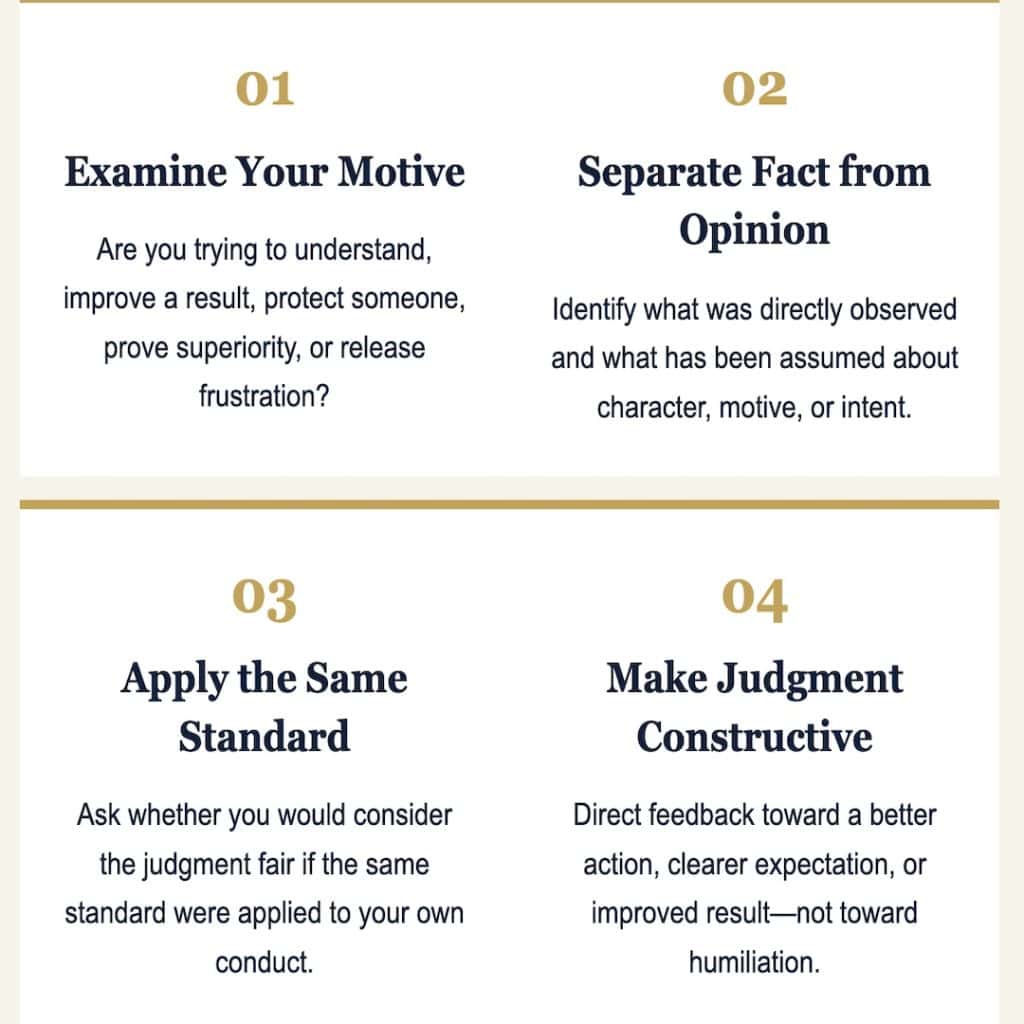
Four Practices of Fair Judgment
Better evaluation begins with greater self-awareness.
Self-Judgment Strengthens Leadership
Leaders must evaluate performance. Parents must correct behavior. Teachers must assess progress. Avoiding all judgment is neither practical nor responsible.
The goal is not to eliminate evaluation, but to remove unnecessary pride, prejudice, resentment, and inconsistency from it. The more honestly leaders examine themselves, the more thoughtfully they can guide others.
A self-aware leader can correct without condemning, maintain standards without becoming self-righteous, and acknowledge another person’s mistake without forgetting their own capacity to make one.
The clearer you become about your own strengths, weaknesses, and motives, the less likely you are to judge another person through pride or assumption.
Today, notice how quickly your mind forms conclusions about the people around you. Before treating an impression as truth, turn the same careful attention inward.
Examine your facts, assumptions, motives, and personal contribution. Extend to others the context and patience you naturally desire when your own actions are misunderstood.
Judge when responsibility requires it—but judge accurately, consistently, and constructively. The discipline of seeing yourself clearly is one of the strongest protections against seeing others unfairly.
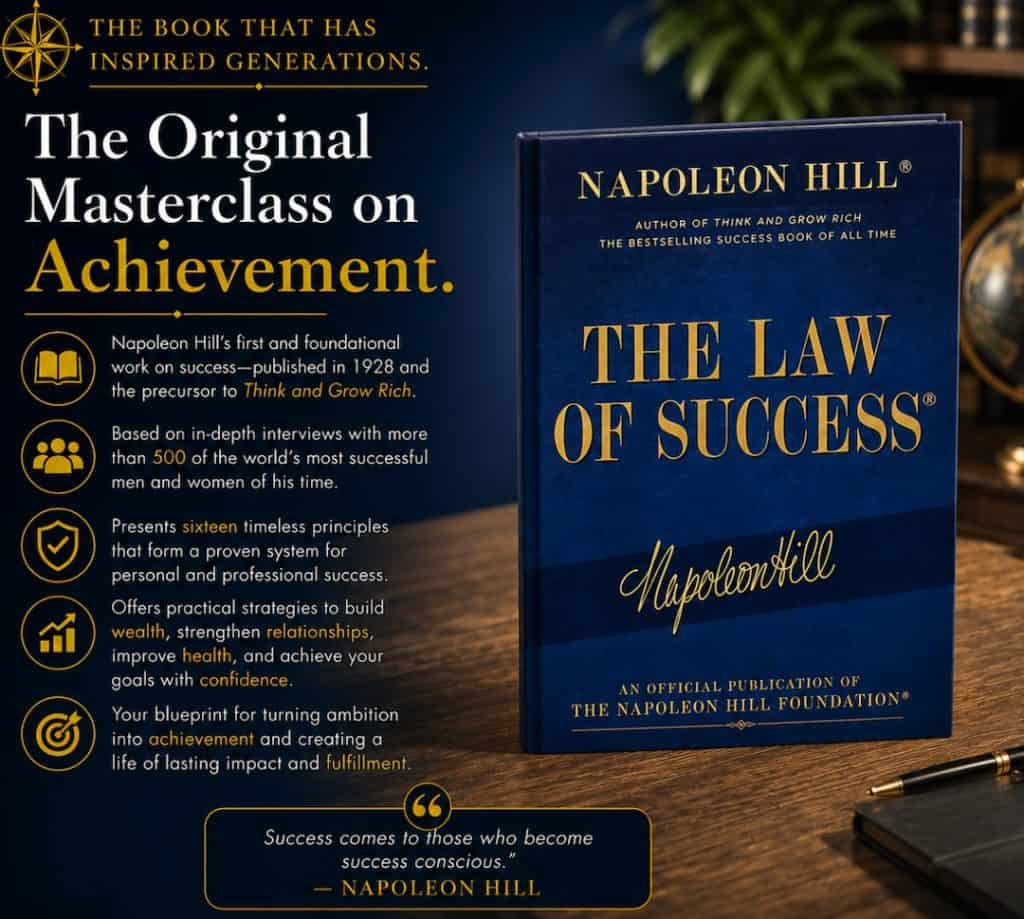
The Law of Success: Napoleon Hill’s
Writings on Personal Achievement,
Wealth and Lasting Success
Before the landmark book Think and Grow Rich came The Law of Success, an eight-volume series in which Hill presents the complete Science of Success philosophy. Originally published in 1928, this success system contains sixteen lessons on personal achievement, gleaned from interviews with and research on over 500 top performers from various industries and walks of life. Now condensed for your convenience into one compact volume curated by the Trustees of the Napoleon Hill Foundation, The Law of Success details the exact steps by which any individual can harness the power of thought to turn their dreams into reality. This is much more than a guide or roadmap; it is a total lifestyle makeover, with concrete resources for everyday application. If you are serious about becoming the best version of yourself in your field, your relationships, your health, and your finances, then you are ready for the original master class on success.

One response to “The Discipline of Self-Judgment”
Every day in every way, I am getting better and better at accurate thinking and fair judgement of myself first before others.
Thank you for this line: Avoiding all judgment is neither practical nor responsible. It’s imperative that people not be turned away by the idea of reaching for something unattainable. Transforming judgement is a much more viable goal than eliminating it completely.