.
Learning from Adversity and Defeat
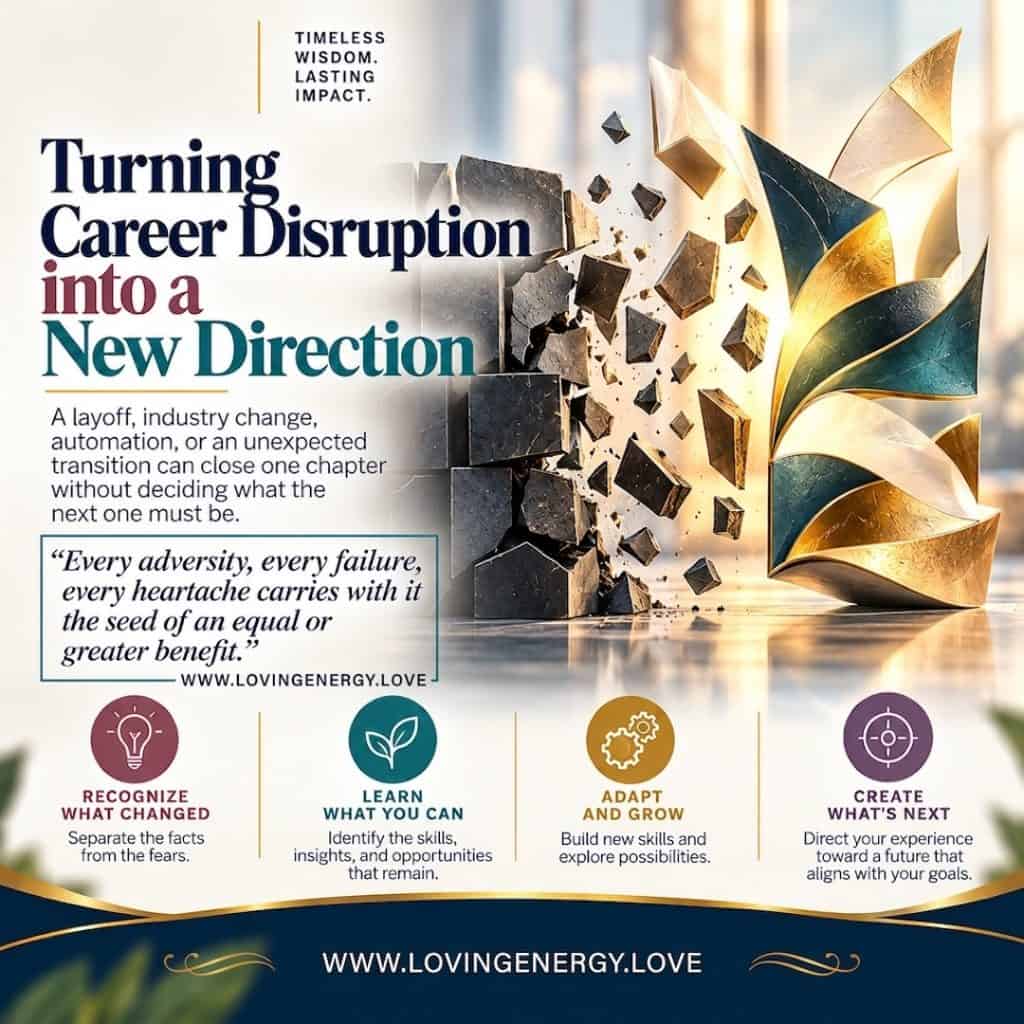
Turning Career Disruption
into a New Direction
A layoff, industry shift, automation, or unexpected transition can close one chapter without deciding what the next one must be.
Career disruption can take away a role. It does not automatically take away your ability to create value.
Work has always changed, but many people today are experiencing that change more visibly and more quickly. A company restructures. A department disappears. New technology changes how a familiar task is performed. An industry contracts. A long-term role suddenly requires skills that were not part of the job a few years ago. Sometimes the disruption is chosen. Often it is not.
That distinction matters because an unexpected career change can feel deeply personal even when the cause is structural. People often tie identity to a title, organization, profession, or level of responsibility. When the role changes, it can create a second loss beyond income: the loss of certainty about who you are professionally. That is why the first task after disruption is not always to rush toward the next opening.
Sometimes the first useful question is: What did this change reveal that I could not see while everything was stable?
.
From Setback to Information
Adversity becomes more useful when we stop asking only what was lost and begin asking what can be learned.
.
A layoff may reveal that your strongest skills are more transferable than your job title suggested. Automation may show that the repetitive part of your work is disappearing while judgment, communication, creativity, leadership, and problem solving are becoming more valuable. An industry slowdown may force you to examine whether you want to remain in that field at all—or whether your experience could be applied somewhere with greater opportunity. Even an unwanted transition can create space for questions that routine rarely encourages us to ask.
.
Reframe the Disruption
What changed?
Separate the facts of the situation from the fears and assumptions surrounding it.
What remains?
List your skills, relationships, experience, reputation, judgment, knowledge, and lessons learned.
What is becoming more valuable?
Look at emerging needs, changing technology, new roles, and areas where human judgment or specialized knowledge still matters.
What needs to change in you?
Identify the skill, habit, credential, relationship, or way of thinking that would make you more adaptable.
This is not about pretending that disruption is pleasant. A job loss can create real financial pressure. A career transition can affect confidence, family plans, benefits, retirement goals, and a sense of security. Those realities deserve to be taken seriously. But difficulty and usefulness can exist at the same time. A setback can hurt and still reveal a better direction.
.
Defeat does not have to be the final interpretation of what happened.
Napoleon Hill repeatedly returned to the idea that adversity and defeat can contain useful information, lessons, and the possibility of future benefit.
Learning from adversity and defeat is part of what Hill classified as a form of resilience and growth. That placement is important because resilience is not simply returning to what existed before. Sometimes growth means using the disruption to build something different. Hill’s broader philosophy encourages us to look for what can be extracted from difficulty rather than allowing the difficulty alone to define what comes next.
.
The New-Direction Audit
If your career changed
unexpectedly, ask:
- What parts of my experience are still valuable elsewhere?
- What skill would make me more adaptable six months from now?
- What kind of work am I no longer willing to return to simply because it is familiar?
- Who knows something about the next direction that I do not?
- What small experiment could help me test a new path before making a major commitment?
.
Today’s Practice
Translate the Setback into Assets.
Take one career disappointment or transition and write down what it taught you, what skills survived it, what relationships remain, and what new possibilities became visible because the old path changed. Then choose one action that moves you toward the next version of your work: learn a skill, reconnect with someone, research an adjacent field, update your portfolio, volunteer for a project, or test a new service.
A disrupted career can close a familiar path.
It can also reveal a direction you would not have considered otherwise.