
Thought for the Day
Winning the Battle You Cannot See
Mastering Internal Conversations Before External Challenges
Long before a difficult conversation, demanding decision, or public challenge begins, the mind has often already predicted the outcome.
The first victory is not over the circumstance. It is over the voice within that says you cannot meet it.
Every day, people prepare for visible challenges while overlooking the invisible conversation already taking place within them. Before the presentation begins, the mind may whisper, “I am going to fail.” Before a difficult conversation, it may rehearse rejection. Before a bold opportunity, it may list every reason to remain where things feel familiar.
These internal conversations may sound like caution, realism, or preparation. Sometimes they are useful. But when repeated without examination, they can become instructions that shape posture, tone, effort, confidence, and behavior.
A person who enters a challenge expecting defeat may speak more hesitantly, prepare less thoroughly, withdraw too quickly, or interpret every difficulty as proof that the negative prediction was correct.
Thoughts do not remain private when they repeatedly influence the actions through which results are created.
Napoleon Hill’s Emphasis on Mental Direction
Napoleon Hill® placed the mind at the center of achievement. Definiteness of purpose, applied faith, autosuggestion, self-discipline, and a positive mental attitude all require deliberate control over the ideas repeatedly accepted and strengthened within consciousness.
This does not mean ignoring reality or pretending that difficulty does not exist. Accurate thinking acknowledges the challenge while refusing to exaggerate it into helplessness.
The goal is not to replace every concern with empty optimism. It is to replace uncontrolled fear with useful questions, deliberate language, and a constructive plan.
The Modern Pressure of Constant Comparison
Internal conversations are increasingly influenced by what we see around us. Social platforms present other people’s polished results, confident performances, successful announcements, and completed goals while rarely showing uncertainty, repetition, rejection, or private struggle.
Comparison can turn another person’s progress into evidence against our own potential. The mind begins saying, “I am too late,” “I am not ready,” or “They have something I do not.”
But another person’s visible success does not provide an accurate measure of your preparation, purpose, timetable, or capacity. Their progress can be studied without being used as a weapon against your confidence.
Fearful Thinking or Directed Thinking?
The language of the mind often determines the quality of the next action.

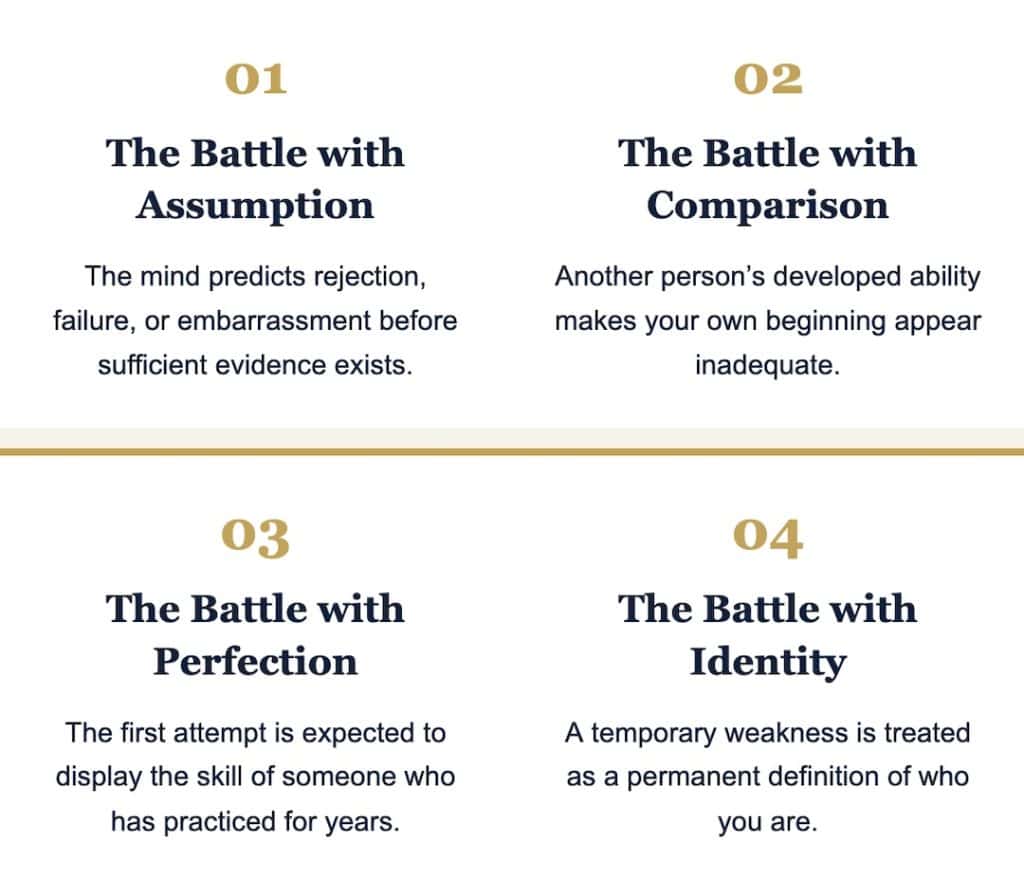
Four Invisible Battles to Win
External performance often improves after internal resistance is addressed.
Speak to Yourself as a Responsible Leader
Effective internal dialogue is neither cruel nor indulgent. A responsible leader does not humiliate people into improvement, nor does a responsible leader ignore necessary correction.
Speak to yourself with the same combination of honesty, expectation, patience, and encouragement you would use with a capable person facing a difficult assignment.
Replace “I always fail” with “This result shows what must improve.” Replace “I cannot handle this” with “What support and preparation will help me handle it well?”
When you change the conversation within, you change the quality of the action that meets the challenge
Today, listen carefully to the way you speak to yourself about the challenge ahead. Is the conversation preparing you to act—or persuading you to retreat?
Do not deny the difficulty. Define it accurately. Do not repeat predictions that have not yet become facts. Ask what preparation, knowledge, cooperation, and courage the situation requires.
The visible challenge may still demand your best effort. But when the mind is no longer fighting against you, more of that effort becomes available for the work that must be done.


Think and Grow Rich
This edition of Napoleon Hill’s Classic Think and Grow Rich is a reproduction of Napoleon Hill’s personal copy of the first edition, the ONLY original version recommended by The Napoleon Hill Foundation, originally printed in March of 1937.
The most famous of all teachers of success spent a fortune and the better part of a lifetime of effort to produce the Law of Success philosophy that forms the basis of his books and that is so powerfully summarized and explained for the general public in this book.
In Think and Grow Rich, Hill draws on stories of Andrew Carnegie, Thomas Edison, Henry Ford, and other millionaires of his generation to illustrate his principles. This book will teach you the secrets that could bring you a fortune. It will show you not only what to do but how to do it. Once you learn and apply the simple, basic techniques revealed here, you will have mastered the secret of true and lasting success.
Money and material things are essential for freedom of body and mind, but there are some who will feel that the greatest of all riches can be evaluated only in terms of lasting friendships, loving family relationships, understanding between business associates, and introspective harmony which brings one true peace of mind! All who read, understand, and apply this philosophy will be better prepared to attract and enjoy these spiritual values.
BE PREPARED! When you expose yourself to the influence of this philosophy, you may experience a CHANGED LIFE which can help you negotiate your way through life with harmony and understanding and prepare you for the accumulation of abundant material riches.

One response to “Winning the Battle You Cannot See”
Some wonderful material to reflect on here